
Review

By The Completionist
WWE 2K26 arrives with a loud “Cult of Personality” riff and a confident promise from 2K: this is the biggest the series has ever been. CM Punk on the cover, four new match types, more than 400 wrestlers, and a creation suite that sprawls across nearly every part of the game. Coming off the solid WWE 2K25, the question is less “is this broken” and more “does this actually move the needle.”
Across PS5, Xbox Series X|S, PC, and Nintendo Switch 2, the answer is mostly yes, with a couple of big caveats, especially if you’re hoping Switch 2 is finally equal footing.
CM Punk Showcase: A Great Story With Asterisks
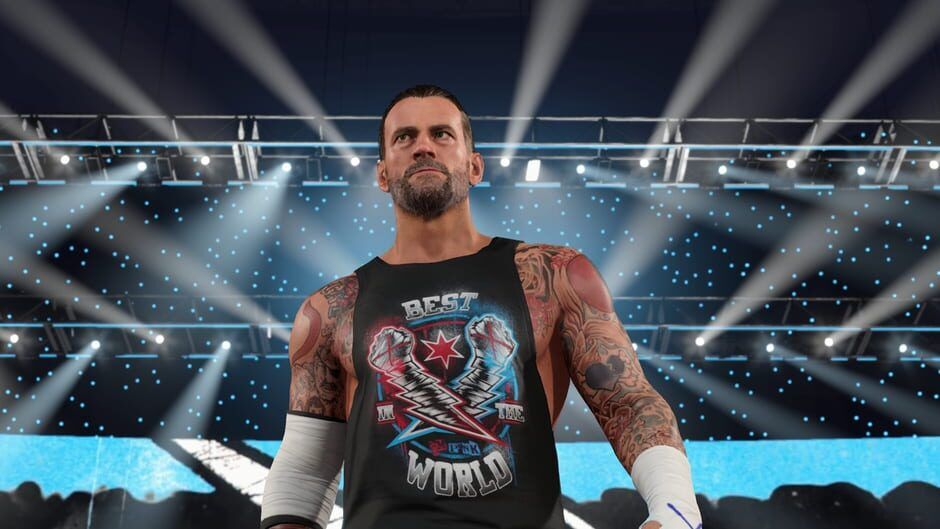
The CM Punk Showcase is the marketing hook and, thankfully, where WWE 2K26 feels most distinct from 2K25. Instead of a straight chronological documentary, it blends real matches, “what if” scenarios, and Punk’s own narration. It is closer in structure to last year’s Bloodline-focused Showcase than a rigid career recap, but the focus is tighter and the tone far more personal.
You jump from his ECW days to the Summer of Punk, through the pipebomb era, and then into fantasy territory like a teased-but-never-happened WrestleMania clash to end The Streak. Punk’s VO does a lot of heavy lifting; he is frank, occasionally petty, and often funny in a way WWE video packages usually sand down. The straight, unfiltered line 2K has been repeating in press materials is not total PR fluff. He calls out politics, backstage friction, and periods where he felt creatively dead in the water.
The storytelling only stumbles when you hit the real-world red tape. Certain rivalries are clearly reconstructed around missing talent or censored terminology. If you know the history, you can see the dodged landmines, and some key feuds feel clipped compared to the full context fans know from TV. Even so, as a playable documentary it lands significantly better than 2K25’s more generic, multi-character presentation.
In terms of mechanics, Showcase objectives are familiar: hit a running knee here, trigger a post-match beatdown there, recreate specific spots with contextual prompts. The scripting is no more restrictive than last year’s, but the match pacing is better. 2K seems to have tweaked health and stun values so you’re less likely to accidentally end a match before every cutscene triggers, something that plagued 2K25. It still forces you down a specific route, but this time the guide rails are smoother and the reward structure of unlockable attires, arenas, and Punk variants feels generous.
In-Ring Feel: Subtle But Meaningful Evolution
Core gameplay continues the simulation-first approach of recent entries, with light/strong strikes, grapples, combos, and a mix of timed counters and breaker systems. Compared with 2K25, the differences are subtle but noticeable once you play a few dozen matches.
Animations chain more cleanly, especially out of Irish whips and corner interactions, which previously could feel sticky. Hit detection is more reliable on springboards and top-rope dives. The new match types, especially Inferno and Three Stages of Hell, show off improved environment interactions, like rope burns, announce table persistence across falls, and better camera framing during high-spots.
The momentum system gets a quiet overhaul. Signature and finisher gain is a touch slower, and reversals no longer feel like an endlessly trading resource. It makes long-form matches, particularly in Showcase and Universe, feel closer to a WWE main event where finishers mean something rather than spammed punctuation marks. Dragging exhausted opponents feels weightier, and collision on multi-man scrambles has fewer inexplicable whiffs than 2K25.
Striking remains a highlight. There is more feedback on heavy chops and kicks thanks to refined sound design and animation overlap. On current-gen consoles and PC at 60fps, that immediacy sells the sense of impact. If you bounced off 2K25’s timing windows you are not going to find a different game here, but veterans will appreciate the refined flow.
AI: Smarter, Still Not Quite Main Event Level
AI is one of the more meaningful step-ups over 2K25, though it is not miraculous. On higher difficulties, opponents in 2K26 cut down on the bizarre, self-sabotaging behavior that often killed immersion last year.
They are more aware of match types and stipulations. In ladder matches they prioritize climbing when they should rather than fixating on grabbing another table. In tag matches, partners break up pins more aggressively and actually play to their role specialties. Finishers are held back for big moments rather than blown mid-comeback every time.
Where it still falters is pacing and endgame logic. You will sometimes see the AI burn resiliency early or roll out of the ring for inexplicable breathers at the peak of a hot sequence. Royal Rumble logic occasionally reverts to old bad habits with wrestlers repeatedly trying the same corner elimination.
Compared to 2K25, though, the net effect is positive. There are fewer matches that feel decided by the AI’s brain cramps instead of your input, and Showcase benefits most from this since scripted beats depend on at least semi-coherent opponent behavior.
Online Stability: Mostly Solid, With Growing Pains
Netcode stability at launch on PS5, Xbox Series X|S, and PC is noticeably stronger than the early days of 2K25. Ranked 1v1 and small-team matches are playable with only occasional rollback hiccups. Inputs generally map to what you see on screen, and the dreaded desync pinfalls where both players swear they kicked out are rarer.
The problems start as you scale up. Larger lobbies and custom-laden arenas introduce lag spikes and intermittent rubber-banding, especially when everyone is using highly detailed created wrestlers. Crossplay, which is expanded this year, magnifies these strains, and matchmaking occasionally dumps you into high-latency matches without warning.
The good news is that stability feels a step above last year’s wobblier launch, where connection drops were common and some modes were borderline unplayable for weeks. The bad news is that we are still waiting for a WWE game that treats multi-man chaos online with the same confidence as offline. If your main goal is ranked singles or small private lobbies with friends, 2K26 is serviceable today. If you live for eight-man trainwrecks, it is still a coin flip.
On Switch 2, online performance is surprisingly comparable to consoles in basic 1v1 matches, though upload bandwidth limits and the system’s Wi-Fi-only reality will be your ceiling. Once you start adding more players or heavy creation assets, the handheld struggles first, taking an extra hit in frame pacing before outright lag becomes obvious.
Creation Suite: Deeper, Broader, Heavier
Creation is where WWE 2K26 makes its loudest claim over 2K25. You still get the expected Create-A-Superstar, arenas, shows, titles, move-sets, and entrances, but the ceiling for complexity is higher and the tools are sharper.
The headliner change is the increased cap of 200 Create-A-Superstar slots, which is exactly the kind of quality-of-life upgrade long-time players have begged for. Layer limits on custom attires are relaxed, leading to more ornate looks. Face and body morphing tools are more granular and less prone to the nightmare distortions that 2K25 could occasionally produce.
Creation for arenas and shows benefits from an expanded object library and more lighting presets. Camera and stage layout tools give you greater control over how entrances are framed, and the overall UI is slightly less obtuse, though it still hides advanced options in nested tabs.
The Community Creations backend appears more robust at launch. Browsing, filtering, and downloading are quicker on PS5, Xbox, and PC, and cross-platform sharing means the best creations are no longer locked to one ecosystem. Upload and download limits have been raised, and early server uptime is more reliable than 2K25’s first few weeks.
On Switch 2, Creation Suite is where hardware differences bite hardest. The good news is that 2K has actually brought feature parity in most categories. You can access Community Creations with cross-platform support, and the game uniquely supports touchscreen and pointer-style “mouse” controls for fine-tuning face and body painting. In handheld mode this is legitimately excellent, letting you tap and drag directly on models instead of wrestling a stick-driven cursor.
The tradeoff is asset loading and performance. Complex created wrestlers and custom arenas take longer to load than on PS5 or Series X, and the system is quicker to cull detail in big multi-man matches that lean heavily on custom content. Creation Suite on Switch 2 is powerful and surprisingly faithful, but you need to be patient.
Compared to 2K25, across all platforms the creation ecosystem feels meaningfully upgraded rather than touched up. If you primarily engage with WWE games as fantasy-booking sandboxes, 2K26 justifies itself.
Switch 2 vs PS5, Xbox Series X|S, and PC
WWE 2K26 is the first in the series designed for Switch 2 rather than a compromised port for aging hardware, and it shows. This is no longer the stripped-down, blurry cousin of the console versions. It is still not perfectly equal, but the gap has narrowed significantly.
On PS5, Xbox Series X, and a capable PC, 2K26 targets a solid 60fps in matches at 4K or reconstructed 4K, with sharp character models, dense crowds, and elaborate lighting. Entrances are rich with pyros, particle effects, and detailed cloth simulation. Load times are short thanks to SSDs, and even custom-heavy cards spin up relatively quickly.
Switch 2 brings most of that feature set across, but with visible compromises. Resolution typically hovers between 900p and 1080p docked and drops below that in handheld, with more aggressive temporal anti-aliasing that can smear fine details. Texture resolution on crowds and some environment assets is lower, and lighting is simplified, especially in large arenas with complex pyro.
Performance-wise, standard 1v1 and tag matches aim for 60fps and usually hit it, though you will see dips during pyro-heavy entrances and big particle bursts. Larger multi-man matches tend to drop more often into the high 40s or low 50s, particularly when populated with ultra-detailed created wrestlers.
The trade-offs are acceptable if handheld flexibility is your priority. Crucially, unlike past Nintendo versions, you are not losing core match types or modes. Inferno, I Quit, and Three Stages of Hell are all present. Showcase content is intact, cutscenes and all. MyGM, Universe, and MyRise are feature-complete. You simply get lower fidelity visuals and the occasional frame wobble.
Against 2K25, where the Switch version was essentially a separate, inferior product, 2K26 on Switch 2 finally feels like it belongs in the same conversation as the main builds, even if it is a clear second-tier for graphics and frame-rate consistency.
Verdict
WWE 2K26 is not a revolution, but it is the most confident and complete wrestling sim 2K has shipped in years. The CM Punk Showcase delivers on its promise of a more personal, prickly story, the in-ring action has been tightened in ways veterans will feel immediately, AI is finally trending in the right direction, and the creation suite crosses a new threshold of depth without totally collapsing under its own weight.
Online still needs work in large matches, and the Switch 2 version, while shockingly capable compared with the series’ handheld history, remains a clear visual and performance step down from PS5, Xbox Series, and PC. If you are on current-gen consoles or a solid rig, this is an easy upgrade from 2K25. If you are coming from older WWE games, it is the entry that best captures the modern product’s scale and spectacle.
For series diehards and CM Punk devotees, WWE 2K26 absolutely earns its “Best in the World” swagger, even if it is not quite undisputed.
Final Verdict
A solid gaming experience that delivers on its promises and provides hours of entertainment.