
Review

By Big Brain
A hand-painted world that deserves better
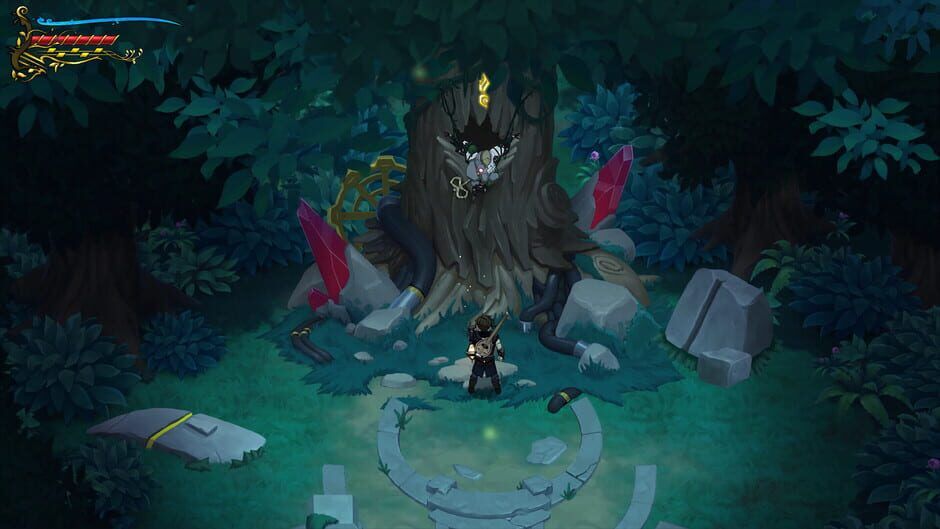
Traveler's Refrain makes a strong first impression on Nintendo Switch. The hand-painted environments look like storybook pages come to life, with thick brush strokes, soft lighting, and a color palette that leans into rich greens and warm violets. Character portraits are expressive, spell effects bloom with watercolor bursts, and the UI echoes sheet music and instrument motifs without cluttering the screen.
Docked, the game holds together visually, though the artwork is clearly being pushed below native resolution. Fine line work looks slightly fuzzy on a big TV, but the broad painterly style hides some of the softness. Handheld mode is where the aesthetic really sings. The smaller screen makes edges cleaner and colors pop, and the intimate framing fits the tone of a traveler threading through a forbidden forest.
Unfortunately, the Switch hardware struggles to keep up whenever the game leans into its more ambitious effects. Heavy combat scenes with multiple enemies, particle-laden spell attacks, and animated backdrops frequently trigger noticeable frame drops. This is not an ultra-fast character action game, but when the frame rate stutters while you are trying to time counters or rhythm-inflected abilities, the sluggishness undercuts the musical precision the combat system is built around.
Magical-instrument combat that cannot keep tempo
The elevator pitch is enticing: you wield a magical instrument to cut through abominations spawned by mecha-goddesses of fate, weaving light combos with musical techniques. On paper it sounds like a cousin to rhythm-action hybrids, and at its best it comes close. Basic attacks riff into short strings, and special moves are mapped to instrument chords tied to different elements. A glowing timing ring or subtle audio cue invites you to press at specific beats for bonus damage or status effects.
In practice, the system struggles with feedback and consistency on Switch. The input window for these rhythm beats is oddly tight yet imprecise. Sometimes a cleanly timed press lands the stronger “resonant” version of a move; other times, under identical conditions, it does not register, even in calmer scenes. The inconsistency feels less like a skill issue and more like the Switch version fighting its own performance.
Enemy design does not help. Early foes telegraph their swings clearly, but later enemies layer overlapping attack patterns and area effects in ways that make it hard to read the battlefield, especially at 30 frames per second with intermittent dips. The combat camera pulls in too closely by default and has a habit of snagging on scenery in dense forest areas, obscuring threats at the edge of the screen. You can adjust sensitivity, but there is no meaningful field-of-view or distance slider that might alleviate some of these issues.
The magical-instrument concept is further undermined by how similar many abilities feel. Different “strings” of your instrument correspond to distinct elemental scales, but in real play too many of them boil down to medium-range slashes with slight variations in color and damage numbers. Only a few high-tier skills introduce genuinely new tempos, like rapid staccato hits that demand quick successive presses or a charged chord that emits a lingering, pulsing field. Those shine because they finally capitalize on the musical fantasy the rest of the kit only gestures toward.
Soundtrack integration: strong themes, clumsy execution
If you mute the TV and listen to the soundtrack on its own, Traveler's Refrain is a success. The score leans on strings, woodwinds, and delicate piano to paint its melancholy world, then folds in synthetic textures when the mecha-goddess elements intrude. Area themes evolve as you progress through the forest, adding instruments or harmonies that mirror the protagonist's emotional state. Boss fights have distinct leitmotifs that cleverly twist core melodies you have heard in quieter scenes.
The problem is how the game ties that music to action and progression on Switch. Combat arenas often trigger abrupt track changes that cut off exploration themes mid-phrase. When you exit fights, the transition back to ambient music is just as harsh. For a project marketed as a music-infused experience, the actual in-game mixing and transitions feel rough and occasionally amateurish.
Rhythm cues tied to your instrument are also mixed too low by default. The faint metronomic ticks that indicate perfect timing are buried under spell effects and enemy grunts, particularly when playing through the Switch's handheld speakers. You can tweak overall music and effects volumes, but there is no dedicated slider for timing cues or your instrument, so getting the audio mix just right is a constant compromise. Missed inputs in a rhythmically focused combat system quickly become frustrating.
There are flashes of brilliance when everything aligns. A mid-game encounter where a boss gradually strips layers from the soundtrack as you damage their core resonates both mechanically and thematically. Your instrument's tone grows clearer in the mix, and successfully timed chords literally rebuild the backing track. Moments like this demonstrate what Traveler's Refrain could have been across its entire runtime, making the more generic encounters feel that much flatter.
Story pacing that drifts off key
Narratively, Traveler's Refrain follows Traveler and his magical instrument as he pushes through a forbidden forest to reunite with a lost love, framed against a conflict with mechanized goddesses of fate. The premise marries mythic romance with techno-mystical trappings, and the opening hour establishes tone well. Hand-drawn cut-ins and short, voiced vignettes hint at a larger tragedy and frame the forest as a liminal space between memory and future.
Once you are past that strong opening, the pacing loses discipline. The game falls into a repetitive loop of long stretches of combat and simple environmental puzzles followed by dense story drops that chatter for fifteen or twenty minutes at a time. These narrative dumps are loaded with proper nouns and lore about past wars, divine clockwork, and the metaphysics of music, but they rarely tie directly into what you just did or are about to do. Instead of feeling like a conversation with your actions, the story often runs on a parallel track.
Companions and side characters briefly punctuate the journey but leave shallow impressions. Their subplots are introduced, teased with one or two key scenes, then resolved abruptly without much player involvement. Thematically, the game gestures at free will versus destiny and the idea of rewriting fate through art, yet most of your choices are cosmetic dialogue variants that do not alter outcomes. It starts to feel like you are riding a pretty tour tram through a world that wants to be a novel.
The ending attempts a bold, musically driven crescendo in which your last major battle syncs closely with a swelling, vocal-backed track. It lands emotionally if you are invested in the central relationship, but the path there is uneven. Late-game dungeons drag on a chapter too long, padded with waves of copy-paste enemies and backtracking that feels like stalling for time before the finale.
Controls and feel on Switch
Traveler's Refrain offers responsive enough movement on paper, with a standard light attack, heavy attack, dodge, instrument skills, and a context-sensitive interaction button. On Switch, though, several small issues stack up. Button mapping places multiple core functions on the shoulder buttons, and while you can swap some assignments, the layout never feels particularly ergonomic. Chord combinations that require squeezing two shoulders and a face button in tight rhythm windows are awkward on Joy-Con, and only marginally better on a Pro Controller.
Input latency is not disastrous, but it is noticeable compared to the PC version. Dodge rolls sometimes feel like they trigger half a beat late, which feeds back into the frustration of trying to time rhythm-based follow-ups. Platforming segments occasionally expose this delay even more starkly, as you watch your character step off a ledge despite having pressed jump at what should have been a safe window.
The game supports both traditional and motion aiming for certain ranged instrument skills. Motion support is underbaked. Sensitivity options are bare-bones, and re-centering is sluggish, so most players will likely stick with stick-based aiming. In handheld mode, the tiny analog sticks make fine adjustments to narrow harmonic rays unnecessarily finicky.
On the plus side, HD Rumble is used sparingly but tastefully, offering gentle pulses that match your instrument's strums or the landing of heavy percussive attacks. Menus navigate cleanly, with only rare hitches when loading large inventories of score fragments and lore entries.
Performance problems that undercut immersion
Technically, this Switch version sits firmly in the "good enough if you are patient" category. Load times into large areas can stretch toward half a minute, and fast travel between forest nodes often tacks on another fifteen seconds. The game hides some of this behind stylized loading screens that display sheet music and character sketches, but frequent backtracking through key hubs makes the downtime feel more oppressive the further you progress.
Frame pacing is the more serious offender. Even outside heavy combat, traversal through particle-heavy zones can exhibit mild judder, which is especially distracting in a game so focused on visual atmosphere. In docked mode, occasional hitches pop up during autosaves and streaming of new environmental layers. These are not game-breaking, but for a title that thrives on flow and mood, disruptive stutters are noticeable every time.
Visual concessions are also apparent in texture quality. Some background art retains its lush detail, but closer inspection reveals muddy surfaces, particularly on mechanical structures and interior spaces associated with the mecha-goddesses. Animations for NPCs sometimes run at visibly lower frame rates than the main character, lending scenes a disjointed appearance.
The game does deserve credit for stability. Crashes are rare, and I did not encounter progress-blocking bugs. The issues here are primarily about smoothness and fidelity rather than outright broken systems.
Verdict: a stirring melody trapped in a scratchy recording
Traveler's Refrain on Nintendo Switch is full of admirable ambition. The hand-painted art style is striking, the musical score is heartfelt, and the core premise of a magical instrument battling mechanical fate holds real power. In isolated sequences, the game achieves something special as music, visuals, and mechanics briefly lock into harmony.
Across the full adventure, though, the Switch version never quite finds a stable tempo. Rhythmic combat is kneecapped by performance hiccups and imprecise feedback, the story drifts between stretches of padding and dense exposition, and the port's control compromises make the most demanding sequences feel clumsier than they should.
If you primarily play on Switch and are willing to forgive technical blemishes for the sake of a distinctive, music-forward fantasy, Traveler's Refrain can still be worth experiencing. Just temper expectations. This is not a showpiece port that does justice to the artwork or the musical mechanics. Where the game wants to be a clear, resonant performance, the Switch version too often sounds like it is being played through a worn-out tape deck.
Final Verdict
A solid gaming experience that delivers on its promises and provides hours of entertainment.