
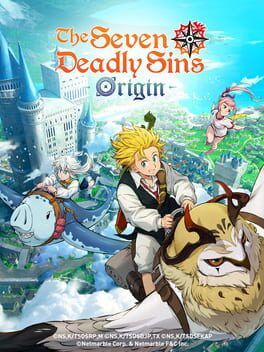
Review
By Big Brain
Overview
The Seven Deadly Sins: Origin arrives with a crystal‑clear pitch: take the familiar comfort food of Genshin‑style open‑world gacha and pour it over Netmarble’s slick Seven Deadly Sins anime license. You play primarily as Tristan, hopping across a stitched‑together multiverse of Britannias, scooping up loot, clearing map icons, and rolling a gacha for shiny new party members.
If you are a fan of the anime, the game is immediately appealing. If you are an open‑world gacha player, it is immediately familiar. The problem is that “familiar” often curdles into “derivative,” and Origin spends a lot of its runtime wobbling on that line.
Combat: Flashy Links, Limited Depth
Combat is where Origin tries the hardest to carve out an identity. Battles are real‑time, team based, and built around a “link‑up” system that lets you chain skills between characters. Swap Tristan into Diane for a ground‑shattering follow‑up, then tag in King for aerial crowd control and you get a nice rhythm of cancels, juggles, and ultimates.
The good news is that the core feel is responsive, especially on PS5 and PC with a controller. Animations have weight, hit‑stop sells impact, and the better characters have a clear role. Co‑op boss fights in particular can look spectacular when three players are weaving their skills together.
The bad news is that the depth peaks early. Enemy patterns are rudimentary, and outside of higher‑tier bosses you rarely need to think beyond “rotate skills off cooldown, dodge red telegraphs, hit your link prompt.” Elemental interactions exist but they are closer to basic rock‑paper‑scissors than a real combat puzzle. Once you settle on a strong team, fights blur into one colorful mash.
Compared directly to Genshin Impact, Origin’s combat is more kinetic in the moment but less tactical over time. There is little incentive to build around niche reactions or quirky weapon types; you are mostly scaling numbers on a small handful of meta units. If you enjoy big anime skills and easy spectacle, it works. If you were hoping this would be the system‑heavy alternative to Hoyoverse design, it is not there at launch.
Exploration: A Decent Playground That Rarely Surprises
Origin’s world is a multiverse patchwork of iconic Britannia locations and new regions. Visually it looks great. Unreal Engine 5 lighting does a lot of work, and soaring over fields on the flying hog is pure anime comfort. Climbing, swimming, gliding and light puzzle interaction follow the usual open‑world template.
On paper there is plenty to do. You unlock fast‑travel points, tackle combat challenges, poke at environmental puzzles, and farm chests for assorted currencies and upgrade mats. Co‑op traversal is a fun wrinkle, letting friends tag in to help with some platforming sections or elite mobs.
In practice the exploration loop rarely steps out of Genshin’s shadow. Puzzle density is lower, and most side activities feel like checklists laid over pretty backdrops rather than discoveries you stumble into. A few multiverse detours play with gravity or time shifts, but they are short flourishes rather than a full design philosophy.
The stamina system also undercuts the sense of adventure, especially on mobile. Glide and dash drain quickly, which makes routine traversal feel stingy instead of liberating. It is not crippling, just persistently annoying in a genre that lives or dies on how good it feels to move through its world.
Story and Multiverse Structure: Great Hook, Uneven Execution
For anime fans, the big pitch is the story. Origin puts Tristan at the center of a multiversal crisis, bouncing between timelines and alternate takes on Britannia. This setup does a couple of things well. It justifies a packed roster of legacy characters, lets the writers remix favorite arcs without being bound to strict canon, and gives you some genuinely cool what‑if scenarios.
The opening hours land nicely. There is a clear inciting incident, solid production values on key cutscenes, and enough emotional hooks to keep fans invested. Seeing familiar faces interact across fractured worlds is genuine fanservice in the best sense.
Then the live‑service pacing kicks in. Main story beats are chopped into bite‑sized chapters padded with errands and routine combat encounters. Interesting multiverse ideas show up in brief vignettes and then vanish so you can go clear more map icons. By the time the initial story arc hits its first major climax, it feels less like a seasonal anime and more like a content treadmill decorated with anime stills.
If you are new to Seven Deadly Sins, the game throws around names and history with little onboarding, and the multiverse framing can feel like inside baseball. Fans will get more out of it, but even they may feel the drag whenever the story has to slow down so another event currency or limited banner can be justified.
Gacha and Monetization: Strong Pressure, Familiar Netmarble Habits
Origin is free to play, and it is not shy about it. Characters and key weapons are locked behind multiple gacha banners, with standard pity systems and the usual shards, tickets, and premium currency maze. Rates are not catastrophically stingy, but they sit in the same “acceptable if you are disciplined, dangerous if you are impulsive” band as other big Korean gachas.
The true friction is not just in the gacha itself but in how aggressively the game pushes you toward it. Early story content showers you with enough pulls to build a functioning team, but the difficulty and stat curves climb right as those freebies dry up. Endgame bosses and certain co‑op challenges feel tuned around having a few specific high‑rarity units and weapons. Technically you can grind, practically the time cost starts to look like a soft paywall.
Layered on top are limited‑time banners tied to story milestones, paid “value” packs that bundle energy, currency, and shards, and early battle passes. Veteran gacha players will recognize every trick in the book. None of it is uniquely predatory compared to the worst of the genre, but there is an unmistakable sense that Origin was balanced first around monetization targets and only second around a healthy progression curve.
If you were hoping for a more relaxed, cosmetics‑heavy model like Genshin, adjust expectations. Origin lands closer to Netmarble’s prior catalog, where leaning in with your wallet is very obviously the intended way to keep up.
Technical Performance: PS5 Best, PC Acceptable, Mobile Struggles
Across its main platforms, Origin is playable but inconsistent. On PS5 it is the closest to what the trailers promise. Visual settings default high, load times are short, and combat sticks fairly close to its target frame rate, with only occasional dips during the busiest co‑op boss encounters.
PC is more mixed. With competent hardware you can push higher resolutions and get a slightly sharper look than console, but the port suffers from uneven optimization. Certain areas hitch for no clear reason, and keyboard and mouse controls feel like an afterthought compared to controller.
Mobile is where the cracks really show. High‑end devices can run the game reasonably well at medium settings, but extended sessions heat up phones, drains batteries quickly, and still suffer from frame drops during heavy fights. On mid‑range hardware, visual sacrifices and stutter become difficult to ignore, which is rough in a game that wants you grinding daily.
Netmarble’s decision to launch simultaneously across PS5, PC, iOS, and Android is ambitious, but the result is a game that feels designed first for a powerful console and then squeezed down to everything else.
How Genshin‑Like Is It Really?
Players were calling Origin “Seven Deadly Sins Genshin” long before launch, and playing it does nothing to dispel that reputation. The art style, exploration loop, gliding and climbing, chest scattering, banner structure, even the broad cadence of story chapters all track closely with Hoyoverse’s template.
This is not a subtle homage. It is a direct attempt to compete in the same space, using a beloved anime license and co‑op emphasis as differentiators. To its credit, Origin does have a few unique hooks. The link‑up combat system gives battles a distinct visual flavor, the multiverse framing allows for crossover fanservice Genshin simply cannot match, and co‑op is better integrated into core progression than in many rivals.
Yet once the novelty of those elements wears off, you are left with a game that feels more like an alternate skin than a bold alternative. Systems you already know are recreated with minor tweaks rather than reimagined. If you are deep into Genshin and craving something structurally similar but with Seven Deadly Sins flavor, this might be exactly what you wanted. If you were hoping for a fundamental rethink of the open‑world gacha formula, Origin plays it far too safe.
Long‑Term Potential: Live Service Comfort Food, Not a New Obsession
So does The Seven Deadly Sins: Origin have the chops to become a years‑long live‑service obsession?
For anime fans, the answer is “maybe, if you can stomach the gacha.” The sheer pleasure of inhabiting Britannia in an open world, hanging out with a big multiverse cast, and riding a flying hog through lavishly lit skies has real staying power. If your primary joy is collecting your favorites and seeing them in new storylines, the game is built to feed that habit for a long time.
For open‑world gacha veterans, it is a tougher sell. Combat is solid but not transformative, exploration is pretty but rarely surprising, and monetization is assertive enough to make every power spike feel like a reminder of the shop. As a side game you dip into between other releases, it works fine. As the next big main game you build your gaming schedule around, it lacks the systemic depth and generosity that define the best in the genre.
Ultimately, Origin is not a disaster, but it is also not the revolution it could have been. It is a slick, good‑looking, occasionally thrilling adaptation weighed down by conservative design and loud monetization. If that sounds like your comfort zone, you will find plenty to enjoy. If not, it is hard to shake the feeling that you are playing an echo of a game you already invested years into somewhere else.
Final Verdict
A solid gaming experience that delivers on its promises and provides hours of entertainment.