
Review

By Parry Queen
A Goonies Sequel In Everything But Name
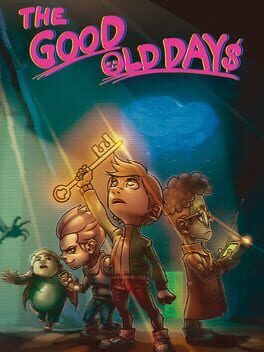
The Good Old Days is almost embarrassingly upfront about what it wants to be. This is a kids-on-bikes, treasure-hunt adventure where you raid booby-trapped tunnels, outwit goons, and scrape together courage with a bunch of loud, lovable misfits. It feels like the NES follow-up The Goonies never got, right down to the way the kids bicker in cutscenes, the way the camera lingers on CRTs and comic stacks, and the way every adult either underestimates you or is secretly shady.
Unlike a straight platformer homage, though, The Good Old Days wraps that premise in a compact Metroidvania structure with a ticking clock. You are Sean, stuck in the rundown seaside city of Arostia, trying to scrape up enough cash and clues to save your dad from a looming debt disaster while chasing rumors of hidden pirate treasure beneath the town. Each run gives you a set number of in-game days to explore, rescue friends, and unlock abilities before the story snaps forward to its conclusion.
This is the game’s best idea. It turns what could have been a thin, retro pastiche into something closer to a puzzle box. You are not just learning enemy patterns and routes. You are learning the entire town’s schedule, when certain shortcuts open, and how far you can push a day before you have to drag your exhausted party back home.
Time Pressure As Game Design, Not Just A Gimmick
Early on, The Good Old Days feels surprisingly strict. You wake up, pick a direction, maybe clear a small dungeon and rescue one buddy before you realize that evening has crept in and your window to get back safely is closing. At first, this can feel arbitrary, especially if you grew up on more open Metroidvanias where you are free to wander until you die or get bored.
But after a couple of cycles the rhythm clicks. Knowing that you cannot see everything in one run reframes the game. You start carving mental routes through Arostia, deciding which sewer entrance to prioritize, which ability upgrade can wait, and which character questlines are worth burning precious hours on. The time limit is not as punishing as a full roguelite reset, yet it keeps a constant low-level pressure that suits the theme of kids racing against grown-up problems they do not quite understand.
The trade-off is that this structure will not work for everyone. If you want a single, exhaustive clear where you sweep every room and hoover up every power-up, the enforced incompleteness of early playthroughs feels less like tension and more like the game deliberately stonewalling you.
Light Metroidvania, Heavy Routing
Despite the marketing, The Good Old Days sits on the lighter end of the Metroidvania spectrum. Arostia is a dense, stacked 2D city with sewers, rooftops, caves, and hidden tunnels, but its progression is more about key abilities and smart routing than hardcore combat mastery.
You gain movement tools and character-specific skills that open new paths, and the map folds back on itself in satisfying ways. A cracked wall you ignored as Sean becomes a vital shortcut once you recruit a heavier friend. A suspicious ventilation shaft you could not quite reach turns into an express lane when you bring along the kid with the grappling gadget. There are fewer pure stat checks than in something like Hollow Knight, and more “aha” moments tied to party composition and time of day.
If you come looking for a big, combat-driven Metroidvania in the mold of modern indie hits, you will find a smaller, more constrained spin on the formula. The scale is closer to Gato Roboto or a Storyteller-sized puzzle box than an epic, map-spanning pilgrimage. On Switch and PC in 2025, that niche is crowded, but The Good Old Days still manages a distinct identity by centering multiple routes and character-driven utility over raw mechanical execution.
Goonies-Style Party Dynamics
The Goonies influence really sings once you start recruiting your friends. Each kid has a clear archetype and a unique ability that changes both exploration and, to a lesser extent, combat. The loudmouth bruiser can shoulder-check breakable walls. The scrawny tinkerer can interact with certain gadgets and open locked shortcuts. The daredevil skateboarder gets better momentum and can clear wider gaps.
In theory, this makes every run an experiment in party synergies. In practice, the balance is not quite there. Some kids are simply more broadly useful than others, and the game rarely disguises it.
Abilities tied to mobility and traversal vastly outweigh quirks that only shine in narrow context. If a friend’s skill primarily interacts with a couple of puzzle rooms or offers a minor combat tweak, you quickly learn to leave them at home in favor of the kid who unlocks an entire extra layer of the map. Once you realize certain characters enable more treasure, more shortcuts, and more safety, your squad composition calcifies.
The writing and animation do a lot to keep the whole group likeable regardless. Their banter sells the sense of a semi-chaotic clubhouse adventure. But as a system, the party feels skewed. The game tells you to experiment with different kids each run, then quietly punishes you when you do.
Clunky Platforming In A Game That Really Needs It
The weakest part of The Good Old Days, especially compared to its stylish peers on Switch and PC, is the platforming. This is not a precision platformer by design, but the input feel still matters, and here it is muddy.
Movement has a slightly floaty arc and an awkward acceleration curve that makes short hops and fine control trickier than they should be. Ladders are stiff. Ledge grabs can be finicky about positioning. There is a narrow dead zone between walking and running where your button presses feel like they get eaten, so you occasionally miss jumps that looked trivial.
Most of the time, the level design is soft enough that this is an annoyance rather than a disaster. The problem is that the game occasionally spikes into trickier platforming challenges, especially in later dungeons and some optional treasure paths. When precision suddenly matters, the rough edges of the controls become impossible to ignore.
You can feel what designer-intent platforming sequences are going for, but you end up fighting the input instead of solving the obstacle. On both Switch and PC, there is a sense that response and collision detection needed another tuning pass. Playing on a controller helps a little compared to keyboard, yet never fully fixes the sense that you are wrestling with the game when it calls for finesse.
In a crowded Metroidvania field where games like Ori, Aeterna Noctis, and countless pixel-precise platformers have nailed buttery movement, this clunkiness immediately pushes The Good Old Days down a tier.
Multiple Solutions And New Game+ Pay Off The Time Loop
Where the game claws back ground is in how it embraces multiple solutions and a robust new game+ structure. That time-limited campaign you struggled through once does not just reset into a harder mode. It folds in on itself.
Information you pick up on a first run, from safe combinations to secret routes and NPC schedules, becomes instantly actionable on your second. Doors you stumbled into by accident before can beeline you to key objectives. The game varies events slightly between loops, but not so much that the knowledge becomes obsolete. It feels like you are getting better at the town itself, not just at its enemies.
The designers also sprinkle in alternate paths to important goals. Maybe on run one you reached a hideout through a long underground route. On run two, you might discover a risky rooftop jump that requires a specific character’s ability, shaving off an entire in-game day. Certain story beats have more than one resolution, and while this is not a full branching narrative, the permutations of who you save, how fast, and with which methods end up feeding directly into which ending you see.
New game+ changes resource availability and enemy layouts just enough to stop routing from becoming rote. It is less about bullet-sponge foes and more about pressure in different places. A shortcut might now be guarded by a nastier hazard, asking you to choose between burning time detouring or investing in upgraded gear earlier.
The system is not as wildly reactive as something like a full roguelike, but for a modestly sized indie adventure it feels generous and smart. If the thought of optimizing runs and teasing out every possible route excites you, The Good Old Days has genuine staying power.
How It Stacks Up In 2025’s Indie Adventure Crowd
On Switch and PC in 2025, the indie Metroidvania and adventure space is brutal. You can buy something like Animal Well, Prince of Persia: The Lost Crown, or half a dozen hyper-polished, razor-tight platformers within the same price band. In that context, The Good Old Days struggles to compete mechanically.
Its edge is personality. The Goonies energy is not just marketing fluff. The kids feel like they belong to that era without leaning too hard on lazy reference humor. The world design, from cluttered bedrooms to graffiti-tagged alleys and creaky wharfs, is cohesive and expressive. The soundtrack hits that sweet spot of sentimental chiptune and scrappy rock, frequently doing more work than the on-screen action.
If you want a pure-feel Metroidvania, there are better options. If you want a rich, branching narrative adventure, there are also stronger contenders in the visual novel and narrative-puzzler space. Where The Good Old Days carves a niche is as a compact, replayable adventure that treats its map like a puzzle and uses a time loop to make its small world feel bigger.
That is enough to justify a look, particularly if you are nostalgic for 80s and 90s kids’ adventures and grew up with The Goonies or its many imitators looping on VHS. Just be prepared to forgive some mechanical slop along the way.
Verdict
The Good Old Days is not the slickest Metroidvania on Switch or PC, and its clunky platforming and lopsided character balance pull it back from greatness. But its Goonies-inspired premise, clever time-limited structure, and genuinely thoughtful new game+ design give it a charm and replayable spine that many prettier games lack.
If you can tolerate some imprecision in the jumps and are the type of player who enjoys planning routes and squeezing efficiency out of repeated runs, it is an endearingly rough gem. If you demand tight controls and perfectly tuned platforming, you will likely bounce off it quickly, no matter how much you love kids-on-bikes adventure stories.
Final Verdict
A solid gaming experience that delivers on its promises and provides hours of entertainment.