
Review

By The Completionist
A 16-bit Fever Dream Of Judgment Day
Terminator 2D: No Fate feels like someone fed a VHS copy of Terminator 2, a stack of 90s arcade boards, and a modern roguelite into Skynet and asked it to spit out a side-scroller. Bitmap Bureau leans hard into chunky pixel art, crunchy guns, and loud arcade flair, then wraps it all around the most quoted sci-fi movie of the 90s.
This is not a beat-for-beat retelling of the film. Instead, it jumps between reimagined scenes and original missions set both in 1995 Los Angeles and the future war. You swap between Sarah Connor, the T-800, and John Connor in story episodes and arcade-style modes, unlocking new routes and endings. It is shamelessly fan-service heavy, but surprisingly often it earns it.
Combat: Heavy Metal And Hot Lead
The most important thing in an action platformer is how it feels to move and shoot, and No Fate mostly nails it. Every character shares the same basic template of a snappy run, a responsive jump with a short coyote-time buffer, and a quick snap to aiming diagonally or straight up. Enemies die in satisfying showers of scrap and gore, and the screen regularly erupts into a haze of muzzle flashes and particle sparks.
What sells the combat is the weight of the arsenal. The T-800’s shotgun hits like a truck, staggering HK drones and knocking endoskeletons off ledges. Sarah leans into burst-fire rifles, mines, and incendiary grenades, feeling scrappier and more improvisational. John mixes lighter automatic weapons with hacking gadgets that can briefly turn turrets or Hunter-Killers friendly. Spray-and-pray will clear early stages, but as the game ramps up, positioning and target priority become crucial to not getting erased by crossfire.
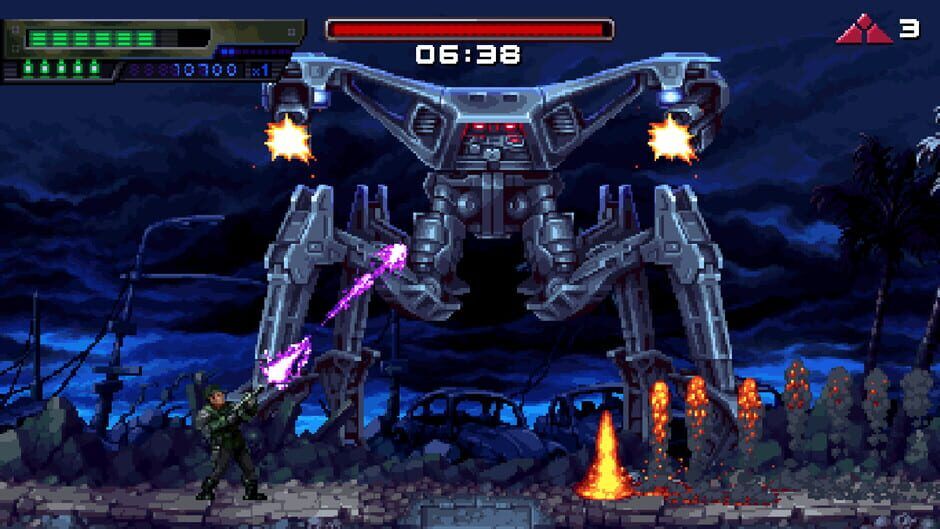
Where No Fate stumbles is in readability during its most chaotic moments. The pixel art is busy in a good way, but when purple Skynet lasers, orange explosions, and blue Resistance bolts overlap, it can be hard to read incoming fire, especially in handheld on Switch. Later stages throw bullet-hell style patterns at you, which is a fun twist until a stray projectile you never saw clips your last hit point.
Still, when it clicks, this is some of the most gratifying licensed run-and-gun combat since the Contra heyday. Dodging a barrage, sliding under a T-1000 swipe, and countering with a perfectly timed shotgun blast feels terrific.
Level Design: From LA Freeways To Future Ruins
No Fate splits its campaign between two broad types of stages: film-inspired set pieces and original future-war operations. The best levels remix iconic sequences into multi-layered gauntlets. The canal chase is now a sprawling industrial map that starts with a foot chase, shifts into a bike escape with simple lane-switching, then ends in a claustrophobic interior fight against a relentless T-1000 variant. The Cyberdyne break-in becomes a stealth-light infiltration where alarms escalate enemy spawns and route you into harder side rooms stocked with better upgrades.
Bitmap Bureau’s pedigree in arcade-style design shows in how these levels loop and escalate. Many stages feature optional side paths that trade safety for better gear or lore pickups. Future-war maps open up even more, with vertical routes across ruined high-rises and underground machine nests. You are rarely lost, but often tempted to detour and risk another encounter for one more weapons crate.
There are some weaker links. A mid-game refinery stage drags, repeating the same enemy mix and layout gimmicks for a bit too long. A couple of vehicle segments, particularly a turret sequence aboard a Resistance convoy, feel more like quick-time distractions than fully realized levels. But the game usually recovers quickly, throwing you back into tighter, more thoughtfully constructed arenas.
Boss fights are a highlight. The defensive wall boss that fans have seen in early screenshots is a brutal test of pattern recognition, forcing you to weave across platforms while cycling through weak points under heavy fire. Multiple T-1000 showdowns play almost like fighting game bouts in confined arenas, where reading telegraphed lunges and mid-air stabs is the key to survival.
Co-op: Chaotic Good, With Caveats
On paper, two-player co-op is the perfect fit for a game about a Terminator and a human resistance fighter. In practice, co-op is a blast in the right context but exposes some structural cracks.
Locally, sharing a screen with a friend immediately makes the game more entertaining. The characters complement each other well, especially in the future-war chapters. Having Sarah lay mines and watch the flanks while the T-800 soaks up damage on the front line creates an organic rhythm. On higher difficulties, coordinated use of special abilities, like John’s temporary drone hacks combined with the T-800’s heavy weapons, can completely flip impossible encounters.
The problems start with scaling and visibility. Enemy health and numbers spike in co-op, which makes sense, but combined with the already noisy particle effects, the screen can devolve into visual soup. There are moments where you lose track of your character entirely. Certain platforming segments also feel cramped with two players, leading to accidental pushes into hazards or off-screen deaths.
Online play, available on PC and current consoles, works but feels barebones. There is basic matchmaking and quick join for friends, but no drop-in mid-mission and no meaningful co-op specific progression. You are essentially sharing the same unlocks and routes you would in solo. Connections held stable in most tests, though occasional latency spikes can turn precise dodging into guesswork.
Despite these frustrations, co-op magnifies the arcade energy that No Fate is going for. It is just not the transformative mode it could have been with more tailored level tweaks and UI work.
Fan-Service Vs Fresh Ideas
Licensed games often suffocate under the weight of their references. No Fate walks closer to the line than it should, but ultimately finds a workable balance between nostalgic callbacks and new arcade systems.
You will hit every major beat you expect: the bar, the mall, the canal, the mental hospital, the Cyberdyne raid, and a molten-metal finale. Voice lines, text snippets, and background details quote the film liberally, sometimes too liberally. The game leans on certain lines so hard they start to sound like social media memes rather than a hard-edged 90s sci-fi story.
What saves it is that these touchstones are rarely just passive re-creations. The layouts twist the familiar into something built for fast action. The mental hospital is now a multi-floor escape with optional hostage rescues. The final steel mill showdown branches into different routes depending on which objectives you completed earlier, lightly echoing the film’s theme about changing fate while also supporting replayability.
The original future-war content is where the game truly steps out of the film’s shadow. Missions that have you escorting ragtag human convoys through blasted freeways, sabotaging Skynet’s regional hubs, or fighting prototype machines that feel like halfway steps between T-800s and T-1000s give the campaign its own identity. These sections could sit comfortably beside Bitmap Bureau’s non-licensed work, which is the highest compliment.
Pixel Art, Sound, And Performance
No Fate’s pixel art will likely be divisive. Characters are short and chunky, more in line with 16-bit arcades than modern sleek indies. Up close, that means faces are more suggestive than accurate, but in motion the exaggerated silhouettes work. You can always tell a T-800 from a human from a T-1000 at a glance, and environmental details from blasted billboards to Skynet’s cold steel infrastructures give each locale a clear identity.
Animations have a satisfying mechanical snap. The T-800 racks a shotgun with a looping flourish, Sarah’s reloads look hurried and tense, and the T-1000’s liquid-metal transformations are surprisingly expressive for such a low pixel count. Effects like sparks, muzzle flashes, and debris are constant but mostly tasteful.
The soundtrack delivers a punchy mix of synths and percussion that riffs on Brad Fiedel’s iconic themes without outright copying them. Stage tracks swell during boss phases and quiet down in stealthier sections. Weapon sound design is crisp, with standout clanks and metallic groans from downed endoskeletons. Some repeated voice clips wear out their welcome, especially when you die often on a tough stage.
Performance is solid on higher-end systems. On PlayStation 5 and Xbox Series X, the game locks to 60 frames per second without visible issues. On Switch, docked is mostly fine, while handheld can dip during the busiest firefights. The drops are not catastrophic, but in a game that demands quick reactions, they are noticeable.
Verdict
Terminator 2D: No Fate is a rare thing: a movie tie-in that feels like an honest-to-goodness arcade game first and a brand extension second. Its combat has real heft, its level design mostly respects your time and skill, and its barrage of fan-service, while occasionally cloying, usually serves to energize rather than weigh down the experience.
Co-op, while imperfect, is still an enjoyable way to experience the chaos, and the future-war missions do the heavy lifting in carving out a fresh identity within one of the most overused sci-fi settings in games.
If you come in expecting a meticulous story retelling or a cutting-edge action epic, you might bounce off the chunky sprites and loud arcade sensibilities. But if you grew up on Contra cabinets, 16-bit shooters, or the original Terminator 2 arcade game, this is one of the more sincere and satisfying takes on the license in years.
In the war against mediocre licensed games, Terminator 2D: No Fate feels like the Resistance finally scored a win.
Final Verdict
A solid gaming experience that delivers on its promises and provides hours of entertainment.