
Review

By MVP
Super Meat Boy 3D Review
Super Meat Boy 3D has the worst possible job for a sequel. It is not just following a beloved precision platformer. It is following one of the cleanest, meanest, most instantly readable platformers ever made. The original Super Meat Boy worked because every part of it pushed in the same direction. Movement was razor sharp, hazards were legible in a glance, deaths came fast, restarts came faster, and the whole thing had a grubby little punk energy that made failure feel funny instead of exhausting.
So the obvious question is whether that survives the move to 3D. The answer is yes, but with an asterisk big enough to splatter across the whole screen.
At its best, Super Meat Boy 3D absolutely understands the series' core appeal. Meat still feels wonderfully disposable and strangely athletic, flicking off walls, hurtling over saws, and squeezing through death traps with a split-second margin for error. The game still wants you to improvise at high speed, then immediately try again after disaster. It still gets a lot of mileage out of the old formula of short obstacle courses built around momentum, rhythm, and humiliation. When a stage clicks, it has that old Meat Boy magic where a route that seemed impossible 30 seconds ago suddenly feels elegant, obvious, and almost musical.
That movement feel matters more than anything, and thankfully it lands more often than not. Meat accelerates quickly, sticks to surfaces with satisfying snap, and carries enough weight that jumps feel committal without becoming sluggish. There is a pleasing violence to the controls. You do not drift through space so much as throw yourself through it. The game captures the series' trademark sense that success comes from controlled panic. It is not as surgically perfect as the 2D original, because 3D platforming inevitably introduces more ambiguity in angle and landing judgment, but the basic act of moving is good enough to support a difficult game built almost entirely on trust.
That trust is where the cracks start to show.
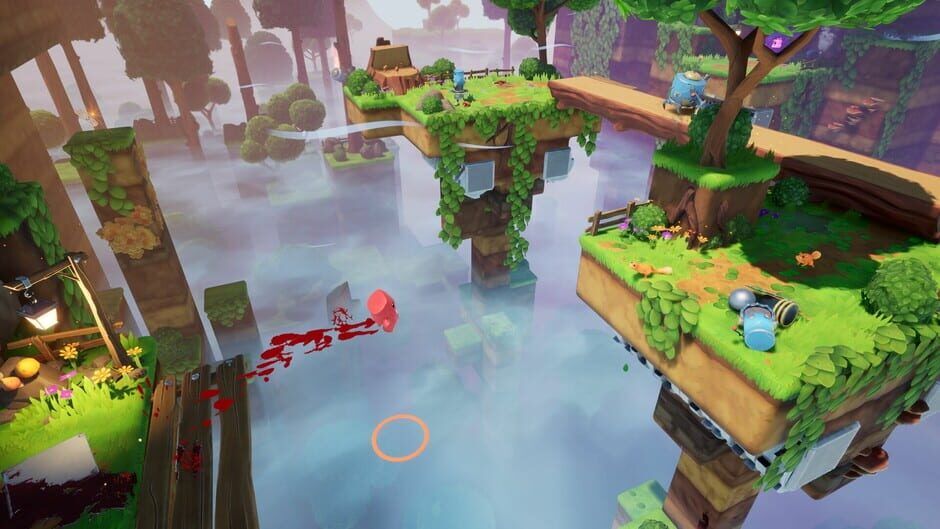
Level readability is the biggest casualty of the transition. In 2D, the original game could present a room full of blades, collapsing ledges, missiles, and wall-jump routes, and your brain would parse the solution almost instantly. In 3D, that clarity takes a hit. Distances are harder to judge, safe landing zones can blur into background detail, and the exact placement of hazards is sometimes less obvious than it should be in a game this punishing. There are stretches where you die because you mistimed a move, which is exactly what Super Meat Boy should be about. There are also stretches where you die because the geometry was harder to read than the challenge deserved.
This is closely tied to camera friction, which is the game's recurring sin. A precision platformer can be brutally hard, but it cannot afford to be vague. Super Meat Boy 3D is usually smart enough to frame the action from useful angles, yet "usually" is not good enough when the design is asking for near-perfect execution. Some jumps become less about skill and more about negotiating perspective. Camera positioning can flatten depth, obscure the edge of a platform, or make wall routes feel awkwardly inferred rather than clearly seen. The game is rarely broken, but it is often annoying in exactly the wrong way. You can feel the original design ideals wrestling with the limitations of 3D presentation, and they do not always win.
The good news is that the death-restart flow still does heroic work to keep frustration from curdling. This series has always understood that difficulty is only tolerable when downtime is nearly nonexistent, and Super Meat Boy 3D retains that crucial tempo. You die, you pop back in, you go again. There is very little ceremony and almost no chance for self-pity. That immediacy keeps experimentation alive. Even when the camera has just gotten you killed in a mildly stupid way, the restart is quick enough that you are already halfway into the next attempt before the irritation fully settles in. It is not a complete shield against the game’s rougher moments, but it is the reason those rough moments do not sink the whole thing.
What does take a heavier hit is the aesthetic identity. This is where the concerns about the series losing its personality feel justified. Super Meat Boy 3D still has gore, ugliness, exaggerated menace, and the same juvenile sense of gross-out slapstick, but the original game's iconic look was more than blood and noise. It had a wiry, abrasive charm. It looked handmade in the best way, with a hostile little grin on its face. Here, some of that singular vibe gets sanded down by the move to a more conventional 3D style. The game is not visually anonymous, but it is closer to anonymous than Super Meat Boy ever should be.
That loss of personality matters because it changes how the punishment feels. The original wrapped its cruelty in such a specific tone that repeated failure became part of the joke. In Super Meat Boy 3D, the attitude is still present, but it feels louder and less distinct. Some environments and character work still sell the brand, yet the overall presentation lacks the instant visual identity that made one screenshot of the 2010 game enough to know exactly what it was. The new game has the mechanics of Meat Boy more often than it has the soul of Meat Boy.
Still, it would be unfair to call this a failed experiment. Too much of it works for that. The best levels create a genuine 3D version of Meat Boy pressure, where wall-jumps, hazard dodges, and desperate course corrections blur into one ugly little ballet. The game understands speed. It understands repetition. It understands that a brutally hard platformer lives or dies by whether retrying feels exciting instead of tedious. On those terms, it survives the transition better than skeptics might expect.
It just does not conquer the dimension the way the original conquered the plane. The move to 3D preserves the series' precision in spirit, but not with the same purity. The personality survives, but in diluted form. The result is a good precision platformer carrying the name of a great one, constantly reminding you why that distinction matters.
Super Meat Boy 3D proves the formula can survive in 3D. What it does not prove is that 3D was the best place to take it.
Score: 7/10
Final Verdict
A solid gaming experience that delivers on its promises and provides hours of entertainment.