
Review

By Headshot
A promising street session that runs out of spots fast
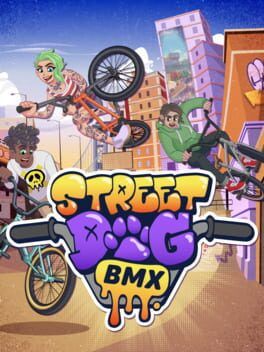
Streetdog BMX rolls onto PC as a compact, stylized take on street riding. On the surface it looks like the kind of comfort-food extreme sports game that could quietly become a cult favorite: bright art direction, chunky rails, six sizable maps, and a focus on flow over strict simulation.
A few hours in, though, it becomes obvious that Streetdog BMX feels more like an Early Access prototype than a fully realized BMX experience. The foundations for something special are here, but the career structure, control depth, and creation tools lag far behind both the classics and the best modern indies.
Career mode: a weak trickle instead of a proper career
The game’s “career” is essentially a series of handcrafted challenges scattered across its six maps. You drop into a level, ride to glowing markers, and clear objectives like hitting a specific rail, scoring a set number of points in one combo, or stringing a manual through a section.
On paper that sounds fine, but the structure is paper-thin. There is no real narrative framing, no sense of rising through a scene, and barely any long-term progression. Completing challenges unlocks cosmetics and occasionally opens up a new area, yet it never feels like you are working toward a meaningful goal. It is more like a checklist of side missions than a career mode.
The pacing is also uneven. Early challenges are insultingly basic, while mid-game tasks swing straight into frustration by demanding strict trick combinations that the control system is not tight enough to support. There is no interesting meta-system around sponsorships, rival riders, or event circuits, just a steady drip of “do three grinds here” and “score X points there” that blurs together after a couple of sessions.
Compared to the cheerfully trashy structure of BMX XXX, which at least had big event spikes and clear milestones, Streetdog BMX feels flat. Stack it against modern indie standouts like the Session and Skate-style titles or Riders Republic’s bite-sized but varied playlists, and this career mode looks like a bare minimum implementation.
Trick mapping on keyboard: serviceable but clumsy
On keyboard, Streetdog BMX is technically playable, yet almost never comfortable. Tricks are mapped across a combination of directional keys plus modifier buttons. Rotations sit on the horizontal axis, with separate keys for flips and spins, while grabs and variations share modifiers.
In theory you can access a decent range of tricks, but in practice combinations feel cramped and imprecise. Trying to manually control spin, add a grab, and prepare a manual or grind landing on a keyboard quickly becomes a finger-twisting mess. It does not help that key rebound options are limited and the game offers no flexible preset schemes tuned specifically for keyboard riders.
More importantly, keyboard input lacks the nuance that Streetdog’s physics clearly want you to use. Subtle pump timing, small hop corrections, and line adjustments on lips and rails are all harder to execute cleanly without analog input. The game has a generous rewind feature to soften the blow, but you end up leaning on it more because of the controls than the difficulty of the levels.
If you are stuck on keyboard you can scratch the arcade itch for a while, but the scheme never graduates from “it works” to “this feels right.”
Trick mapping on controller: better feel, shallow ceiling
With a gamepad, Streetdog BMX improves noticeably. The left stick controls movement and pumping into transitions, while the right stick handles trick initiation and modifications. Face buttons add grabs and variations, and bumpers manage spins and flips.
The first hour on controller is fun. The game is tuned so that landing your first decent lines and combos is quick, and the physics have just enough heft that big airs and deep carves feel satisfying. Manuals, grinds, and lip tricks chain together smoothly enough as long as you keep things simple.
However, the more you push the system, the more its simplicity starts to grate. The trick set is limited, with many variations blurring together visually and mechanically. Inputs that should feel distinct, like tweaking a table versus throwing a different grab, often result in similar looking animations or only marginal scoring differences. There is no sense of dialing in a truly personal style the way you can in the best skate or bike games.
Worse, consistency is an issue. The timing window for edging into manuals or snapping into certain grinds feels a bit slippery, and there are odd moments where identical inputs on similar terrain yield different results. It never collapses into unplayable chaos, but it never reaches that point where you completely trust it. When you blow a line in Streetdog BMX, you are often left wondering whether you messed up, or the game did.
Controller is easily the preferred way to play, yet even with a pad the trick system feels like a decent prototype instead of a fully fleshed-out language of movement.
Physics and flow: fun, arcade-focused, and a little too forgiving
Streetdog BMX is not going for hyper-realism, and that is fine. Its physics favor approachable, flow-heavy riding. Pumping transitions gives you clear speed boosts, hopping into grinds locks you in fairly generously, and manuals auto-correct a bit as long as you do not push the angles too far.
This makes the early game genuinely fun. You can quickly fall into a rhythm of cruising a street loop, popping a couple of grinds, dropping into a bowl, and stringing everything together into a smooth line. Crashes are spectacular enough to be entertaining, and the slam animations sell the impact.
The downside is that this forgiving model leaves little room for mastery. Once you understand the timing windows, you realize there is not a lot of nuance beneath the surface. Hitting a long line feels more like staying inside invisible guardrails than genuinely balancing risk and precision. Where modern indies like Session or Riders Republic challenge you to progressively refine your technique, Streetdog BMX plateaus early and stays there.
Park editor: thinner than it looks
For many players, the park editor will be the deciding feature. Unfortunately, this is where Streetdog BMX wipes out the hardest.
The game offers a basic suite of ramps, rails, funboxes, and street furniture. You can rotate objects, adjust height within a limited range, and stitch together basic lines. That is the extent of the toolset. There are no advanced snapping tools, no real terrain sculpting, and only the most elementary control over banking, transitions, and support structures.
Building something that rides well is much harder than it needs to be because the editor fights you at every step. Objects have awkward collision bounds that do not always match their visuals, leading to unexpected hang-ups mid-line. The camera in edit mode is fussy and sluggish, making it a chore to fine-tune spacing on complex setups. Asset variety is also weak, so every user-made park ends up looking like a remix of the same stock plaza.
Sharing and browsing creations is similarly undercooked. There is no robust tagging or rating system, and discovery tools are barebones. Compared to the park editors in modern skate titles or the wild user creations seen in Riders Republic and similar games, Streetdog BMX’s tools feel like a tech demo locked to the tutorial phase.
If you were hoping for a deep, long-term creation sandbox, you will be disappointed. This is the sort of editor you play with for an hour, realize how limited it is, and then never touch again.
How it stacks up against BMX XXX and modern indies
Looking back at BMX XXX is instructive, even if that game leaned on its infamous gimmicks more than its mechanics. Critically, it had a clearer sense of progression. Events, unlocks, and map rollouts gave you something to chase, and the trick system, while far from perfect, at least had distinct tiers of difficulty you could feel yourself climbing.
Streetdog BMX, by comparison, feels timid. It has none of BMX XXX’s structural swagger and does not replace it with simulation depth or modern systems. It sits awkwardly in the middle as an arcade experience with too little attitude and not enough mechanical sophistication.
Against contemporary indie extreme sports titles, the contrast is even sharper. Games like Session, skater-style indies, and Riders Republic offer either deep simulation or vast, replayable playgrounds with robust online hooks and creation tools. Streetdog BMX has none of that. Its career is short and repetitive, its trick system tops out early, and its park editor lacks the power and usability to sustain a real community.
You can feel the passion from the small team in details like level layout and the upbeat, clean presentation, but passion alone cannot cover the structural gaps.
Verdict
Streetdog BMX on PC delivers a pleasant few hours of casual street riding, then spectacularly runs out of things to say. The core loop of pumping, hopping, and chaining tricks across its maps is momentarily satisfying, especially on a controller, but everything wrapped around that loop is sadly underbaked.
The career mode is a glorified checklist without momentum, keyboard controls are clumsy, controller input hits a low-skill ceiling, and the park editor is too primitive to matter. As a budget diversion it might be worth a deep sale if you are desperate for any new BMX game, but as a day-one purchase it is impossible to recommend over revisiting older titles or diving into the richer, bolder offerings of today’s indie extreme sports scene.
Streetdog BMX has the skeleton of a good game. It just needs far more muscle, risk, and ambition before it can hang with the greats.
Final Verdict
A solid gaming experience that delivers on its promises and provides hours of entertainment.