
Review
By Big Brain
A Playable Cartoon Feature
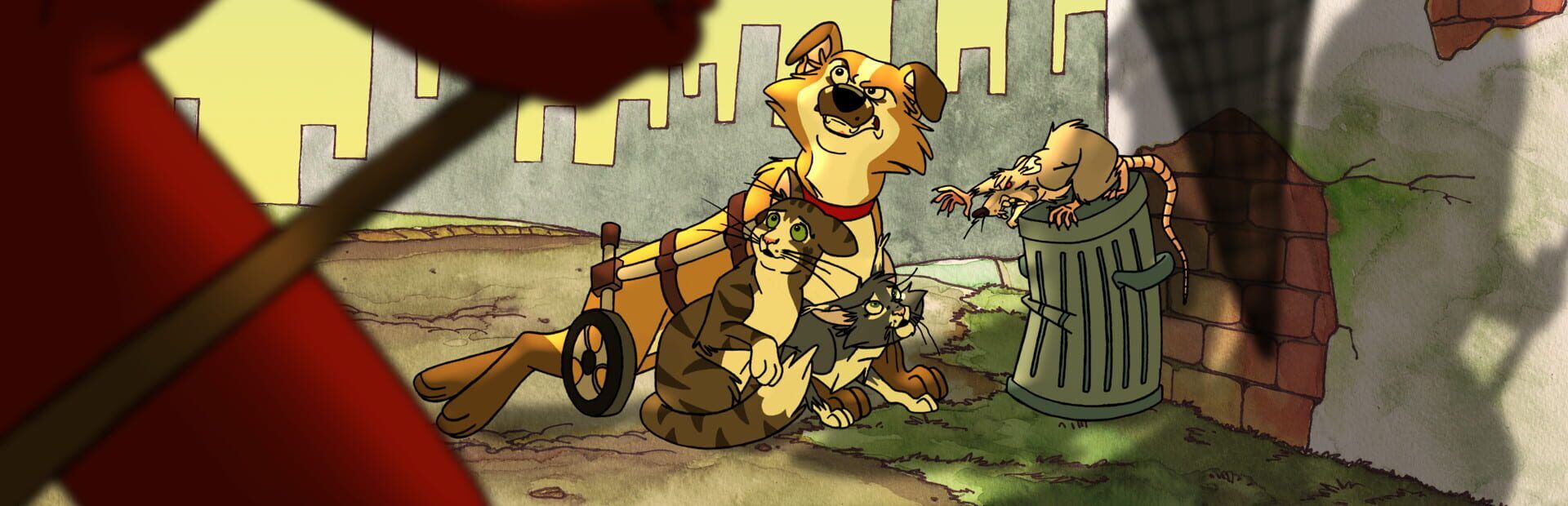
Stars In The Trash is the rare game that actually looks like the trailer. Across its five-ish hours, Valhalla Cats’ 2.5D adventure genuinely feels like playing through a lost 90s animated feature about a runaway housecat in the big city. The hand-drawn animation, the melancholy cityscapes, the slapstick chases, the wordless emotional beats – it is all-in on classic animation energy.
The question is whether that style survives contact with a full playthrough, and whether the simple puzzle-platforming and city-stray story can carry the weight of that ambition. The answer is mostly yes, sometimes spectacularly so, with a few pacing and interaction quirks that keep it just short of masterpiece territory.
Hand-Drawn Animation That Actually Carries The Game
The pitch is “a game that feels like an old Disney movie,” and visually Stars In The Trash delivers. Every frame of Moka the cat is traditionally animated, with floppy paws, twitching ears, and those elastic double-takes you’d expect from a 2D feature. Idle moments are a joy. Moka stretches, paws at dust motes, reacts to distant sounds, or arches his back at a passing rat. None of this is mechanically necessary, but it is crucial to how convincing the world feels.
What impresses over a full playthrough is the consistency. Early scenes in the apartment are cozy and warmly lit, with cluttered backgrounds painted like storybook illustrations. Later, the city opens up into alleys, rooftops, sewers, and riverside docks, and the art keeps finding new ways to showcase scale from a cat’s-eye view. Streetlights tower like monoliths, cars whip by like predators, and the kennelman’s van prowls the streets as a rolling, shadowy threat.
The animators lean into classic visual language: squash and stretch in every leap, big silhouette changes for emotions, and physical comedy that plays out clearly even without dialogue. There are chase sequences where the background loops rhythmically, perspective warps ever so slightly, and you could pause at almost any moment and mistake the frame for a cel from a feature film.
The downside is mostly technical rather than artistic. Some transitions between gameplay and cutscenes are a little abrupt, and occasionally collision and animation don’t perfectly agree, leading to a paw clipping a ledge or a slightly floaty landing. These moments are noticeable because the rest is so polished, but they never seriously damage the illusion.
A Cat In The City Story That Goes Darker Than You’d Expect
On paper, Stars In The Trash is about a spoiled housecat that gets bored, bolts out the front door, and finally learns the grass outside isn’t actually greener. In practice, the narrative is a much more layered tour of what it means to be loved, abandoned, and hunted as an animal in a human city.
There’s almost no spoken dialogue. Story beats are carried by pantomime, framing, and the soundtrack. Moka’s human family is shown more through routine than exposition: feeding time, half-ignored play, the lonely hours when everyone leaves. When Moka runs away, you understand exactly why, even without a single voiced line.
Once outside, the tone shifts between cozy curiosity and genuine menace. Other animals you meet range from skittish alley cats to loyal dogs, each animated with distinct personalities. A recurring dog companion, in particular, quietly steals scenes through body language alone. Their friendship is built through shared scares, small acts of protection, and quiet moments resting in pools of streetlight.
Then there is the kennelman, looming over the story like a cross between a villainous dogcatcher and a horror-movie silhouette. His presence is mostly conveyed through his van, his boots, and his swarm of rats. The further you get, the more the game leans into an almost Don Bluth style of darkness: abductions, cages, and animals who don’t all make it home.
Across a full playthrough the narrative arc holds together remarkably well. The game never loses sight of Moka’s internal journey from selfish curiosity to a more mature sense of connection and responsibility. The final act doubles down on spectacle and heartbreak, and there are sequences near the end that feel emotionally closer to something like The Fox and the Hound or The Land Before Time than a typical platformer.
Where it stumbles is pacing. The mid-game has a couple of stretches that feel like they exist more to pad out the journey than to advance the story. You get a prolonged sewer section and some industrial areas that, while beautifully drawn, repeat the same “sneak, hide, jump, pull a lever” rhythm without a strong new emotional beat. The game is short enough that this doesn’t become tedious, but those chapters don’t land as powerfully as the opener or finale.
Puzzle-Platforming: Simple, Slightly Clumsy, But Just Enough
Mechanically, Stars In The Trash sits in that narrative-platformer space alongside games like Limbo, Inside, or Planet of Lana, only gentler and more family-friendly. You run, jump, climb, push objects, pull switches, hide, and occasionally time a dash or leap to avoid danger. There are no deep skill trees, no collectibles that meaningfully change your capabilities, and no real combat beyond a few context-sensitive scuffles and chase scenes.
Over a full playthrough, the platforming remains accessible, sometimes to a fault. Most jumps are generous, death pits are rare, and checkpoints are forgiving. The puzzles typically revolve around moving a crate, scaring a rat, or using environmental objects to distract the kennelman’s forces. A lot of the challenge is in reading the environment rather than performing complex inputs.
This can be a strength or a weakness depending on what you want. If you come in expecting Ori-level precision or Trine-style brainteasers, you’ll be disappointed. The platforming is more of an interactive delivery system for the art and story. For the most part, it succeeds in that mission: you stay engaged enough with the environment that you feel like you’re inhabiting Moka’s body, without getting stuck on logic puzzles that break the narrative flow.
There are a few rough edges. Because animations prioritize fluidity and character, inputs occasionally feel a half-second soft. Leaping from tightly spaced platforms or grabbing specific ledges can lack snappiness. A handful of stealth-lite sequences depend a bit too much on trial and error, with enemy cones of vision or patrol timings not communicated quite as clearly as they should be.
Importantly, though, frustration never spikes for long. Deaths tend to be fast and visually expressive, reloads are snappy, and the game rarely makes you repeat long sections. Over the course of a playthrough, that keeps the puzzle-platforming in the “pleasantly involved” zone rather than “mechanically thrilling,” but that suits the overall experience.
Does It Really Capture Classic Disney Energy?
Marketing around Stars In The Trash foregrounded “classic Disney charm,” which is a dangerous promise. That phrase covers more than just pretty drawings; it implies musicality, pacing, character arcs, and a certain emotional clarity. Surprisingly, the game gets closer to that ideal than most.
The animation clearly leans on the language of 80s and 90s theatrical features. Moka is expressive enough that younger players will read his emotions instantly, and adults will pick up on the more complex undertones of guilt and grief. Supporting animals are sketched in quickly through iconic traits and silhouettes, exactly like strong secondary characters in an animated film.
The story also hits the fundamentals: a clear central flaw in the protagonist, a tempting but dangerous world, an escalating threat, a midpoint fall, and a redemptive climax that reframes what “home” means. There are visual motifs that pay off late in the story, and a few wordless scenes that land with the kind of emotional punch the marketing hinted at.
What holds it back from feeling fully “feature-length Disney in interactive form” are a few missing elements. First, there is no equivalent to a musical number or strongly defined leitmotif that players will hum afterward. The score is nicely orchestrated and supports the mood, but it rarely becomes the star of the show. A couple of sequences beg for a bold, memorable theme that never quite materializes.
Second, some side characters feel more like set dressing than fully realized personalities. There are moments where you sense the game wants to introduce a rival cat, a mentor figure, or a recurring comic-relief duo and really develop them, but the brisk runtime and limited interaction tools keep them mostly in the background.
Finally, a few of the darker beats pull their punches slightly. The game flirts with truly harrowing territory involving animal cruelty and loss, but usually pulls back to keep things broadly all-ages. That is understandable, and the emotional core still works, but it also makes some scenes feel like they’re hinting at trauma the script then glosses over.
Even with those limitations, Stars In The Trash comes closer to the promise than it has any right to. It nails the feeling of curling up on the couch with a slightly sad animal movie and living through it from the inside.
Full-Playthrough Verdict
Taken across its whole runtime, Stars In The Trash does what most “cinematic” platformers only talk about: it uses its hand-drawn animation, its simple interactions, and its cat-in-the-city story to build a cohesive, emotionally resonant playable cartoon.
The hand-drawn art doesn’t just look good in screenshots; it sustains its quality from opening apartment mischief to final, desperate scrambles away from headlights and cages. The narrative balances cozy cuteness with a surprisingly heavy exploration of abandonment and belonging. The puzzle-platforming is rarely more than moderately challenging, but it is consistently readable, thematically appropriate, and unobtrusive enough to let the animation and story shine.
It is not flawless. Input softness, a sagging middle stretch, a relatively safe approach to its darkest themes, and a soundtrack that never quite reaches “instant classic” status keep it from fully matching the giants it emulates. But when the credits roll, you’re more likely to remember the way Moka curls up beside a friend in a shaft of alley light, or the way the kennelman’s van looms at the end of an empty street, than any individual mechanical gripe.
If you come for tight, demanding platforming, you may feel shortchanged. If you come for a heartfelt, beautifully animated story about a cat discovering what home really means, Stars In The Trash absolutely delivers on its classic Disney promise in interactive form.
For animation lovers, pet owners, and anyone with a soft spot for melancholy animal adventures, this is a city worth getting lost in.
Final Verdict
A solid gaming experience that delivers on its promises and provides hours of entertainment.