
Review

By The Completionist
Spooky Express is a rare thing in puzzle games: a genuinely family-friendly brainteaser that doesn’t sand off its edges for adults. Built as a Halloween spin on the pathfinding formula of Cosmic Express, it hands you the keys to a tiny train line running through Trainsylvania and asks a seemingly simple question: can you get every spooky passenger where they need to go without causing chaos?
Very quickly, that “simple” question turns into a satisfyingly tangled knot.
A Halloween toy box of trains and monsters
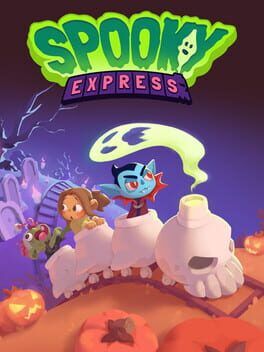
Spooky Express wears its theme proudly, but gently. This is Halloween as a cozy costume party, not a horror game. Each level is presented as a small diorama: a slice of pumpkin patch, a crooked graveyard, a carnival full of creaking rides. Your train chugs through it all, picking up zombies, vampires, witches, and the occasional squishy human who really shouldn’t be sharing a carriage with a werewolf.
The character art leans cute and cartoonish. Kids will spot visual gags like ghosts squishing into the carriage or skeletons waving their arms as the train passes. Adults will appreciate how cleanly the visuals communicate rules: monster types are clearly distinct, their destinations are obvious, and hazards stand out without cluttering the board. Nothing looks genuinely scary, which makes this safe even for younger players, but it still nails that warm orange-and-purple Halloween mood.
The soundtrack reinforces that tone with low-key, looping tracks full of xylophones and soft organ riffs. It’s the kind of music you can listen to for long puzzle sessions without getting tired of it, and it quietly sells the sense that you’re playing with a haunted model train set on a coffee table.
Route-planning that starts simple and quietly gets devious
At its core, Spooky Express is a route-planning puzzler about drawing a single continuous rail line across a compact grid. Your train runs that line once, from the station back to the station, stopping whenever it passes a platform to pick up or drop off passengers.
Two rules define almost everything that follows: there is only room for one passenger in the carriage, and your track cannot cross itself. Combined with passengers who need to be collected in a particular order, or dropped at specific locations, those limits push you into surprisingly brain-bending layouts.
The early chapters focus on pure pathfinding. You learn to snake your route around obstacles, double back to reuse track, and time your pickups so the last stop is always the right one. Levels are small enough that kids can brute-force a solution by trial and error, but the correct paths are elegant enough to make adult puzzle fans feel clever when they finally see the pattern.
As you move deeper into Trainsylvania, the designers steadily add new wrinkles. Some monsters can’t be seated with humans. Others need to be delivered before night falls, which basically means hitting certain stops earlier in your route. Platforms may share tracks, so visiting one passenger at the wrong time can block another. None of these ideas are complicated on their own, but the game excels at combining two or three of them in a single level so that your first obvious path is always wrong in an instructive way.
This is where Spooky Express starts to shine for experienced puzzle players. The best levels feel like little logic proofs you sketch directly onto the board. You’ll mark in your head which station must be last, which must come first, and which corners of the grid are effectively dead ends. Kids will mostly approach the same levels more visually, trying things and watching what happens. Both approaches are valid, and the level design supports that dual audience unusually well.
Escalating difficulty that respects your time
The progression curve is one of Spooky Express’s biggest strengths. Each new mechanic is introduced in a couple of gentle puzzles that can be solved quickly, even by children. Then the game starts intertwining those mechanics, often in ways that feel playful rather than punishing.
Typical chapters open with a layout that looks busy but collapses into a straightforward route once you understand the new idea. Mid-chapter puzzles force you to route and reroute the train mentally before you even lay your first track segment. By the time you hit the later areas like Final Funfair, many levels become full-blown think pieces that can occupy a seasoned puzzle fan for ten or fifteen minutes.
Crucially, the game avoids the common trap of padding. There are over two hundred handcrafted stages, but they’re tuned tightly enough that you rarely feel like you’re solving the same puzzle twice. If you’re introducing a younger player to the genre, you can stop after a chapter or two in a session and still feel like you’ve made real progress. If you’re a veteran of Draknek’s previous logic games, you can chase optional side puzzles and trickier layouts that twist the rules harder.
The only caveat is that there is a real spike toward the final chapters. Kids who’ve breezed through the early areas might suddenly smack into puzzles that demand careful sequencing and pre-planning. For families, that’s a good opportunity to switch into a “solve it together” mode, but solo younger players may stall out without some guidance.
PC versus mobile: both versions feel built for brains, not reflexes
Turn-based, grid-based train planning is a natural fit for both mouse and touch, and Spooky Express handles the transition between PC and mobile better than most.
On PC, you click and drag to lay track, with right-clicks or dedicated keys to erase and adjust. The interface is clean and forgiving. Segments snap to the grid predictably, and undoing a section never feels finicky. Keyboard shortcuts are minimal but sensible: you can reset instantly when a route clearly isn’t working, and you can fast-forward the train’s run once you’re confident your layout is correct.
On phones and tablets, the touch controls are perhaps even better suited to the toy-train fantasy. Drawing a route with your finger feels tactile and immediate. The game allows for generous input correction, so slightly crooked swipes still resolve into clean grid lines. Long presses and simple taps handle deletions, and zooming is rarely necessary thanks to the compact board sizes.
For kids, that touch-first approach is ideal. They can trace ideas directly onto the screen, erase, and try again without ever wrestling with interface complexity. Adults playing on PC get the benefit of precision and slightly faster iteration, but neither platform feels like an afterthought. Cloud saves would be the one feature that would truly complete the package for families swapping devices; if you’re moving between PC and mobile you may end up replaying some levels on each system.
Technically, Spooky Express is stable and well-optimized. The visuals scale cleanly to different resolutions, loading is near-instant, and even older mobile hardware handles it without stutter. There are no intrusive ads on mobile, and the business model is refreshingly straightforward: a generous free demo portion and a single purchase to unlock the full game.
Accessibility and approachability for mixed-age households
From a family perspective, Spooky Express hits a sweet spot between being approachable and meaningfully challenging. There are no timers, no action sequences, and no penalties for failure. You can reset a level as often as you like, which turns experimentation into a core part of the experience rather than something to be punished.
Children can engage with the game on a purely spatial level, drawing tracks to see the train move in funny ways and gradually discovering why certain orders of pickups don’t work. Because every solution is deterministic, adults can subtly guide younger players with questions instead of answers, asking who should ride first or which station must come last. That makes it an unusually good parent-and-child couch game, even though it’s technically single-player.
For seasoned puzzle fans, the value is in how rigorously the rules are applied. Nothing feels random. When a level seems impossible, it almost always means you’ve missed a constraint or an interaction between passengers. Discovering those interactions produces the classic “aha” moments that fans of A Monster’s Expedition and Cosmic Express will recognize. The lack of explicit hinting systems may frustrate some players, but the levels are designed cleverly enough that logical deduction usually gets you there without outside help.
Halloween charm backed by genuine puzzle depth
Many seasonal games rely on aesthetic alone, and it would have been easy for Spooky Express to coast on cute pumpkins and a catchy soundtrack. Instead, it presents a dense lattice of hand-built logic problems that remain thoughtful all the way to the end credits.
The Halloween aesthetic does more than decorate. It acts as a mnemonic layer that helps both kids and adults remember rules and constraints. You remember that zombies can’t sit with humans because, of course, they might bite them. You recall where vampires prefer to disembark because their coffins are visually distinct. This theming makes the increasing complexity less abstract than in many train or circuit puzzlers, which in turn keeps younger players engaged even when a level requires multiple attempts.
Taken together, Spooky Express succeeds as a family-friendly route-planning puzzler exactly because it refuses to choose only one audience. Children get a charming Halloween toy box with intuitive controls and no pressure. Adults get a compact, meticulously tuned brain workout that stands comfortably beside the studio’s best work.
If you’re looking for a Halloween game the whole household can enjoy, something you can hand to a child for ten minutes and then quietly steal back after bedtime to chase tougher solutions, Spooky Express deserves a ticket straight to the front of the line.
Final Verdict
A solid gaming experience that delivers on its promises and provides hours of entertainment.