
Review
By Big Brain
A demon made of glass, learning to skate in hell
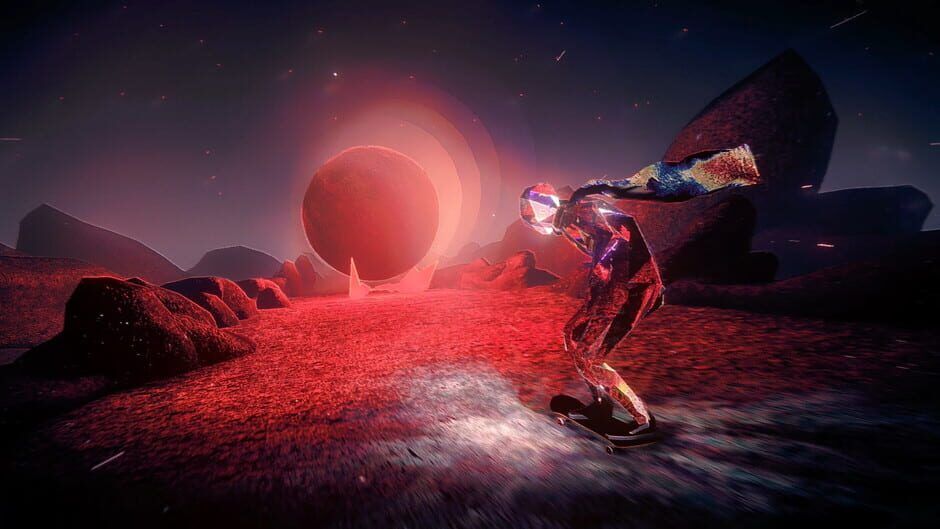
Skate Story is an underdog in every sense. Developed largely by one person, Sam Eng, and published by Devolver, it takes the familiar beats of a skateboarding game and drags them through a surreal underworld. You play as a demon made of glass and pain, literally shattering on every slam as you roll through smoky voids and neon‑streaked plazas. It is not aiming for the breezy satisfaction of Tony Hawk or the granular simulation of Session. It wants you to feel fragile, exposed, and a little lost.
When the game lines up all its pieces, it is astonishing. The problem is that it does not always stay upright. Early performance issues, especially on consoles, chipped away at that fragile magic, and even after several patches the experience is still better in some places than others.
Glass, ash, and the art of falling apart
Visually, Skate Story is one of the most striking games of the decade. The glass‑and‑pain aesthetic is not just a hook; it defines how the entire world feels. Your skater is a faceted crystal silhouette, lit by distant suns and flickering billboards. Each environment is a liminal space hanging in the void: concrete underpasses suspended in smoke, glowing rails floating over nothing, and pools of light that carve your path out of the darkness.
The art direction leans heavily on sharp contrast. Bright particle trails sketch your lines through the air while every slam sends shards flying in a way that makes each failure oddly beautiful. It is not realistic and does not try to be. Instead it extracts the internal feeling of skating, that mix of serenity, terror, and self‑destruction, and builds the world around it.
Animations sell the fantasy. Pushing off feels deliberate, weight shifts are readable, and tricks have a clean, almost calligraphic quality as your glass limbs flip the board. When you chain a long manual into a grind and back out into a clean landing, the way the lighting wraps around your figure sells the sense that you are carving your own graffiti into the underworld itself.
If there is a visual flaw, it is sometimes in clarity. The dense fog and heavy bloom can obscure small obstacles, particularly in darker stages, and particle‑heavy moments can still drop frames on consoles after patching. It is gorgeous, but it occasionally prioritizes mood over readability.
Controls that make every carve earned
Mechanically, Skate Story sits somewhere between arcade and sim. You are not wrestling each foot like in Session or Skate, but it is miles more deliberate than old Tony Hawk. On a controller, the triggers manage push and brake, while the face buttons and right stick handle flips, grabs, and manuals. Grinds are context sensitive but still require the correct angle and timing, and the game is unforgiving about sloppy inputs.
There is a real intentionality to the design. Pushing is not instant; you accelerate into speed, and carving into a turn has a subtle delay. The board feels like it has mass. That makes the first hour rough for anyone expecting pick‑up‑and‑play flow, but when it clicks you start reading lines in the environment instead of just reacting.
The most divisive element is how it handles failure. Catch a pebble, mistime a landing, or clip a ledge and your demon explodes into glass, sending you back to the last checkpoint almost instantly. There is no long reload, which keeps the pace brisk, but the punishment is binary: you are either flowing or shattered. For some players this creates a perfect loop of experimentation and instant retry. For others it will feel like being sucker punched every time you start to get in the zone.
What helps immensely is the consistency. Physics feel stable, inputs are responsive on both gamepad and keyboard, and once you understand how much leeway you have on landings, it becomes a question of execution rather than luck. On PC especially, with a steady frame rate, runs feel fair.
Difficulty: a gauntlet of glass and grit
Skate Story is not interested in coddling you. The core campaign is structured around zones with objectives that gate progress: hit a specific trick across a gap, maintain a combo for a set distance, or thread rails through brutal sequences of obstacles. These demands ramp up quickly.
The difficulty is less about technical trick lists and more about line discipline. You will often know exactly what you need to do after one or two attempts, but nailing every input over thirty or forty seconds of fragile momentum can take dozens more. There are no traditional lives, yet the repetition can grind down your patience in longer sessions.
The game is at its best when it layers its challenge with its metaphors. Boss‑like encounters where you skate through towering demon shapes or outrun collapsing structures feel like anxiety and self‑doubt made physical. Here, the difficulty feels purposeful, aligned with the narrative about pushing through pain and fear.
Where it stumbles is in a few late‑game segments that demand near‑perfect execution without offering much room for creative solutions. Instead of learning a flexible system, you are solving a single, unforgiving puzzle. Skill ceiling fans will love this, but more casual players might bounce off before seeing the story through.
There are some modest accessibility assists: tweaks for camera sensitivity, vibration, and certain visual effects. What you will not find are robust difficulty sliders or generous magnetism on rails and landings. Skate Story is very much take it or leave it in terms of challenge.
A soundtrack that makes hell feel holy
The soundtrack is the game’s secret weapon. Skate Story’s score leans into atmospheric electronic, ambient noise, and hazy beats from a roster of indie musicians. Tracks swell and recede instead of looping aggressively, turning long sequences into meditative journeys rather than pure tests of dexterity.
The music interacts subtly with the environment. Downtempo, echoing pieces accompany stretches in the void, while crunchier, more percussive tracks kick in during high‑pressure runs. The mix emphasizes your board sounds too: the clack of wheels on coping, the hiss of a grind, the sharp crack of a failed landing. Together, it creates an almost synesthetic sense of flow.
Even if you bounce off the difficulty, the soundtrack is good enough to stand alone. It sells the emotional arc of a demon slowly learning to love the act of skating, pain and all. It is rare for a skate game soundtrack to be more about introspection than swagger, and Skate Story absolutely nails that vibe.
Performance on PC: mostly smooth after patching
At launch, Skate Story on PC was solid but not flawless. Players reported inconsistent frame pacing on certain GPUs, hitching when entering new areas, and rare bugs with softlocks tied to respawns. Since release, multiple patches have targeted exactly these issues, and the current build is in a much healthier place.
On a mid‑range rig, you can expect a mostly locked 60 fps at high settings at 1080p, with occasional dips during effect‑heavy sections. The engine scales well across resolutions, and there are practical toggles for post‑processing, motion blur, and shadows. Turning down bloom and a couple of heavier effects can smooth out the last few bumps without gutting the aesthetic.
The Steam Deck and handheld PC experience, according to testing from specialized sites, is surprisingly strong. The stylized visuals play nicely with lower power hardware, and once capped at 40 or 60 fps with sensible settings, it runs consistently with short load times. Controls transfer cleanly to handheld layouts, and the instant‑retry loop suits portable play.
There are still minor rough edges. Some users continue to report sporadic stutters on certain AMD setups, and windowed or ultrawide configurations sometimes misbehave when alt‑tabbing. None of this feels catastrophic now, but if you are extremely sensitive to hitching, be prepared to tinker with settings.
Performance on consoles: better, but not flawless
The console story is more complicated. At launch on PS5, Xbox Series, and Switch 2, Skate Story struggled to keep its glassy world intact. Variable frame rates, occasional input latency spikes, and visible streaming hitches during fast lines hurt a game that lives and dies on precise timing.
Recent patches have helped across the board. On PS5 and Series X|S, the game now holds close to its 60 fps target in most areas, with minor drops when the screen is absolutely overloaded with particles. Input feels snappier, and the worst streaming stutters have been smoothed out. You still notice dips in a handful of set pieces, but they tend to be brief rather than constant.
Switch 2 is the most compromised version. Resolution is lower, some effects are dialed back, and frame rate targets a fluctuating 30. For a game so dependent on timing sensitive inputs, that hurts. The handheld form factor pairs nicely with Skate Story’s quick‑restart structure, but the inconsistent performance undercuts the satisfaction of perfecting lines. It is playable, but it feels like the version you settle for rather than the one you really want.
None of the console versions are broken in their current state, but the gap between a tuned PC build and a patched console build is still noticeable if you are paying attention to responsiveness.
Do the patches fix enough to recommend it?
If you are on PC with reasonably modern hardware, yes. The performance issues that once made Skate Story feel fragile in all the wrong ways have mostly been addressed. You still get occasional hitches, but they are the exception rather than the rule, and the underlying experience is strong enough that it shines through.
On PS5 and Xbox Series, it is now easy to recommend to anyone seriously interested in its art and premise, with a small caveat for performance‑sensitive players. You will run into uneven frame pacing and rare drops, but you will also get a largely stable, visually faithful version of a very unusual skateboarding game.
Switch 2 is harder to endorse. If it is your only platform, the game’s uniqueness might still make it worth the compromises, yet it is not the way to experience Skate Story if you have any other option. The combination of a low frame rate target and occasional stutters fights against the core flow in a way that the patches have not fully solved.
Verdict: a flawed but unforgettable ride
Skate Story is not for everyone, and it does not want to be. Its glass‑and‑pain aesthetic, poetic story, and uncompromising difficulty form a cohesive vision that will alienate as many players as it enchants. This is less a vibe game you zone out to and more a spiritual skate gauntlet about learning to coexist with your own fragility.
If you come looking for a forgiving, trick‑spam sandbox, you will probably bounce off its strict lines and brutal punishment. If you demand absolutely pristine performance on every platform, you will still notice the seams. But if you are willing to meet it halfway, learn its rhythm, and stomach a few technical blemishes, Skate Story offers something truly rare: a skateboarding game that treats skating as existential art.
On a solid PC or a patched PS5/Series console, it is easy to recommend to anyone who loves stylish indies, demanding controls, and soundtracks that linger in your head long after you have shut the game off. On less powerful hardware, or for players allergic to repetition and failure, consider this a cautious recommendation.
Either way, Skate Story earns its reputation as an art‑driven underdog. It may still wobble, but when it finds its balance, nothing else this year feels quite like bombing through hell on a board made of glass.
Final Verdict
A solid gaming experience that delivers on its promises and provides hours of entertainment.