
Review

By Apex
Premise: Forensics In A Murder House
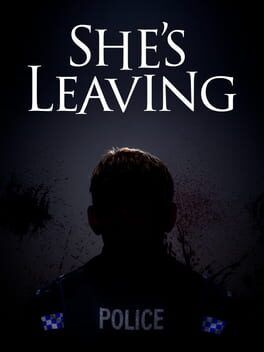
She’s Leaving is a first-person survival-horror debut from Blue Hat Studio, built around a strong elevator pitch: you are Charles Dalton, a blood spatter analyst called to the decrepit House Haywood after a massacre. On paper it sounds like a blend of CSI and classic haunted mansion horror, where your forensic eye matters as much as your trigger finger. In practice, the game comes surprisingly close to delivering on that promise, even if it never fully escapes the gravity of genre staples like Resident Evil 7 and Layers of Fear.
The entire game is set inside a single sprawling mansion. There are no cutaway sewer levels or obligatory outdoor detours. Everything, from your opening crime-scene sweep to the final confrontation, happens within the labyrinth of House Haywood. That tight focus is both its biggest strength and its most noticeable limitation.
Hunter And Hunted: The Dual-Role Mechanic
The hook Blue Hat leans on is the idea that you are simultaneously the investigator and the prey. Early on, She’s Leaving plays like a slow forensic adventure. You photograph blood patterns, reconstruct trajectories, and tag pieces of evidence. These aren’t throwaway prompts; the scenes you analyze subtly change what routes you feel safe taking later, what doors you unlock, and which hiding spots you actually trust.
As you move deeper into House Haywood, the power dynamic flips back and forth. In some sections you stalk an unseen intruder using UV tracers, luminol reactions, and noise cues, piecing together where they are in the house based on what you just examined. In others, that same intruder becomes the one hunting you, using the very paths you exposed during your investigation. The best moments are when the game makes you regret being thorough, as meticulously opened shortcuts become shortcuts for your pursuer.
Mechanically, this plays out through a mix of stealth, light resource management, and evidence-driven progression. You have no real weapons for much of the runtime, just tools: a camera, UV light, evidence markers, and basic defensive items you can improvise in the environment. When the game leans into this cat-and-mouse tension, it feels distinct. You are never just a victim hiding in a locker, but you are also never a traditional action hero clearing rooms.
The problem is consistency. Some chapters fully embrace the dual-role fantasy, giving you overlapping goals like cataloguing a crime scene while listening for floorboard creaks that signal your stalker’s approach. Others devolve into more familiar sequences where you simply sneak past a patrolling threat in a linear corridor. Those dips into standard horror design do not ruin the experience, but they dilute what could have been a defining mechanic.
Environmental Storytelling Inside One Mansion
House Haywood is the star of the show. Structurally, it is closer to the Baker estate in Resident Evil 7 than to a walking-sim hallway. The mansion slowly unfolds as you gain new keys and forensic tools, and you double back through spaces that subtly change as the night wears on. Locked doors that mocked you in the first hour become late-game shortcuts, and previously pristine rooms are later re-entered as fresh crime scenes.
Environmental storytelling is where She’s Leaving quietly excels. Instead of leaning on walls of text, the game uses blood patterns, broken furniture, and rearranged objects to tell its story. Bedrooms suggest strained family dynamics through worn photos and half-packed suitcases. A children’s wing layered with playful murals and dark stains evolves over the course of the game, hinting at a history of abuse without resorting to exposition dumps. The best detail work is in how rooms react to your presence; returning to a location after you have processed it as a crime scene often reveals retaliatory damage, as if the house or its inhabitants are pushing back against your investigation.
The mansion’s layout supports this storytelling. It has a believable sense of architecture, with servant corridors, hidden staircases, and maintenance crawlspaces that make logical sense. Backtracking rarely feels like padding because re-entering an area usually gives you a new forensic angle or forces you to navigate it under different threat conditions. When the game lets you pause and soak in the scenery, House Haywood feels like an actual place with a history, not just a horror maze.
That said, repetition creeps in. You are still in the same house for the entire game, and by the final act some rooms lose their impact. Blue Hat does what it can with lighting shifts, new blood trails, and escalating supernatural distortions, but a handful of late-game encounters rely on previously used tricks. Once you have seen the dining hall splinter and reassemble itself three times, you start to feel the level budget.
Scares, Pacing, And The Horror Market Problem
The horror genre on modern consoles and PC is crowded, especially on the first-person side. Against heavy hitters, She’s Leaving sits squarely in the second tier. It is often tense, occasionally genuinely frightening, but rarely unforgettable.
Its scare design favors slow-burn dread over constant jump scares. The audio mix is effective: distant knocks echo through vents, muffled crying bleeds through walls, and your own fumbled evidence tools make just enough noise to make you wince. A standout sequence sees you processing a bloodbath in the main foyer while your pursuer circles the upper balcony, their footsteps growing louder each time you use the flash on your camera. It is a terrific fusion of gameplay and horror, and it shows what the game is capable of.
Unfortunately, the pacing can be uneven. Several mid-game chapters are overly puzzle-heavy, asking you to re-scan the same rooms for barely visible clues to progress. When these sections collide with scripted stalker appearances, they shine, but when you wander the house in near silence for twenty minutes looking for one interactable smear on the wall, the tension evaporates. The final act sprints in the other direction, stacking chase scenes and loud, distorted imagery so aggressively that it starts to blur into noise.
In a market overflowing with PT-likes and indie mansion crawls, She’s Leaving does just enough to stand apart through its forensic layer and dual hunter/hunted shifts. It does not reinvent the genre, but it does feel more purposeful than yet another generic haunted asylum. Its focus on a single location, grounded investigative work, and the moral unease of poking at trauma give it a personality many mid-budget horror titles lack.
Visuals And Performance On Current-Gen Hardware
On PlayStation 5, Xbox Series X|S, and PC, She’s Leaving sits comfortably in the mid-budget space. It uses Unreal Engine lighting to good effect, selling the damp, rotting opulence of House Haywood through reflective surfaces, dust motes, and subtle volumetric fog. Texture quality on consoles is uneven when you press your face into walls, but in motion the game looks appropriately grimy and grounded.
Character models are a weak spot. Human faces in flashbacks and brief cutscenes flirt with the uncanny valley in a way that undermines the otherwise meticulous forensic work. The monster design for your primary pursuer is intentionally more ambiguous, often glimpsed in reflections or as a silhouette, which is a smart way to mask budget limits. When you finally see more of it, the design is solid if not iconic.
Performance is stable across current-gen consoles, with only occasional hitching when loading new mansion wings. On PC, the scalability is decent, and the confined setting helps maintain a strong frame rate even on mid-range hardware. There is nothing cutting-edge here in terms of tech, but the presentation is cohesive and supports the atmosphere.
Verdict
She’s Leaving is not the next foundational horror classic, but it is a confident, well-realized debut with a clear identity. Its forensic-investigation layer and shifting hunter/hunted dynamic give it enough of a hook to justify a playthrough for genre fans, and House Haywood is a richly realized setting that lingers in your mind after the credits roll.
If you are burned out on first-person horror, this game probably will not convert you. Some pacing ruts and familiar haunted-house tricks keep it from greatness. But if you still enjoy creeping through decrepit mansions on PS5, Xbox Series X|S, or PC and appreciate horror that asks you to think as much as react, She’s Leaving is worth your time. It proves that even in an oversaturated market, there is still room for new developers who know exactly what kind of nightmare they want to build.
Final Verdict
A solid gaming experience that delivers on its promises and provides hours of entertainment.