
Review

By Apex
Overview
Samurai Academy: Paws of Fury pitches itself as an all-ages, third person action platformer about a plucky dog samurai fending off the shogun’s invading cat army. It lands on PC and consoles as a budget title, and everything about it feels aimed at that sweet spot between Saturday-morning cartoon and party brawler.
It has charm. The art style is bright and readable, the animal cast leans hard into puns, and the premise of a canine underdog taking on a smug feline shogunate is inherently fun. The problem is that once the novelty of “dogs versus cats but they’re samurai” wears off, Paws of Fury runs out of tricks long before the campaign is done.
Platforms, performance and feel
I played on both PC and console. On PC the game runs comfortably on modest hardware at high settings, with only occasional hitches during big particle-heavy clashes. On current gen consoles it holds a mostly steady 60fps, dropping in split-screen co-op when four players are shredding hordes of cats at once.
Controls are fine across all platforms. Movement has a pleasing snap, jumps are predictable, and camera control is responsive. There is a slightly floaty feel to aerial movement that suits the slapstick tone but undercuts any illusion of weighty samurai steel.
The dog versus cat samurai gimmick
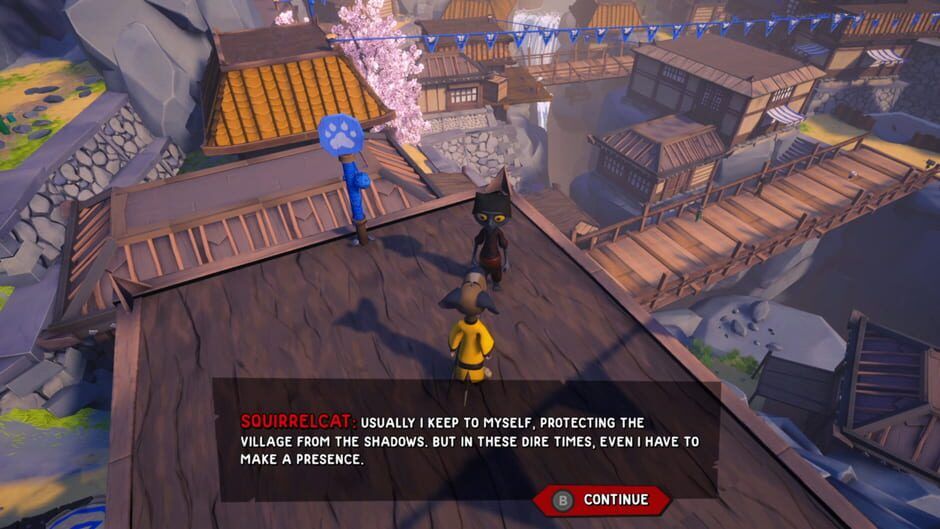
At first, the dog versus cat feud is the game’s best weapon. Enemy squads are built from cat archetypes that read instantly. Armoured tabbies with bamboo spears hold a phalanx line, hooded ninja cats teleport in smoke puffs, and sumo-like bruisers flatten you with belly slams. Your dog samurai hero and their allies, on the other hand, lean into earnest, tail-wagging optimism.
The visual storytelling here is sharp. You can look at any group of enemies and know who will dart in, who will block, and who will lob explosives. The trouble is that mechanically those differences do not run deep. The ninja cat behaves like every other fast melee foe. The spearman is just the shield guy but with a longer poke. After a few stages, the adorable animal theming is doing weight that the combat design should be sharing.
The writing follows a similar pattern. Early cutscenes and banter have a pleasant, breezy humour. There are some solid gags about ancient scrolls of walkies, code-of-honour jokes twisted around fetch, and some very committed cat puns from the shogun and his generals. By the middle of the campaign, however, the script leans on the same joke structures again and again. The tone stays light but the novelty fades, and the story never evolves beyond a basic “push back the cat army through themed regions” structure.
Combat depth
Moment to moment, Paws of Fury is a straightforward 3D brawler with light platforming. You get a basic three-hit combo, a launcher, a charged heavy strike, a dodge roll with generous invincibility, and a couple of special moves tied to a stamina meter. New moves unlock as you progress, but the core loop rarely demands more from you than mashing light attack with the occasional dodge.
Enemy encounters are largely built around arena lock-ins where waves spawn in at the edges. There is usually one obvious priority target to dodge around and a cluster of disposable fodder enemies to swat away. Even on higher difficulties the safest and fastest path through combat is almost always to spam your fastest combo, roll out of red telegraphs, and trigger your crowd control special when the cooldown is ready.
There are flickers of something sharper. Parrying is technically in the game, and nailing a perfect block triggers a slow motion counter window that feels great. The issue is that the timing window is incredibly forgiving, and most enemies telegraph their swings so broadly that almost any defensive input works. You never have to engage with the more interesting systems because they are never truly required.
Boss fights tease the idea of pattern recognition and more nuanced positioning, but then back away. Multi-phase duels against elite feline officers start strong, with specific attack strings you are meant to learn, only for later stages to devolve into arena clutter as additional mobs spawn in and clutter the fight. Again, the optimal approach is to kite, mash, and nuke.
Samurai Academy is clearly chasing accessibility, which is commendable, but it undershoots. Younger or newer players will have fun swatting cartoon cats around, but anyone hoping for a brawler with combo depth or character mastery will be done exploring the system long before the credits roll.
Progression and structure
The campaign is a linear trip through themed regions of Kakamucho, each with a handful of stages and a boss. Between missions you return to the titular academy, a hub area where you chat with NPCs, pick up side challenges, and spend earned currency on upgrades.
Progression is based on three basic tracks. You can improve your base stats, unlock new moves, and equip charms that tweak your playstyle. It sounds more flexible than it is. Stat upgrades are so cheap and incremental that you will usually max key attributes like health and attack well before the end of the story, turning late stages into a casual jog. New moves rarely add new tactical options and more often feel like alternate flourishes for existing combos.
Charms should have been where the buildcraft lives. Some do change things in useful ways, such as converting dodge rolls into short dashes that leave behind a damage trail or making parries restore stamina. Many, however, are forgettable bonuses like slightly faster item use or tiny increases to crit rate that barely move the needle. The game never encourages you to experiment either. Levels are tuned loosely enough that nearly any setup works.
Side content is surprisingly thin. Optional missions recycle campaign layouts with harder enemy compositions and trivial modifiers. These are fun enough in short bursts or co-op, but they never feel essential or rewarding beyond extra currency. There is no sense of discovering new systems through side quests, only more of the same fights.
Co-op and multiplayer
Co-op support is one of the game’s best features. Drop-in local co-op suits the knockabout tone, and chaotic four player brawls against dense cat hordes absolutely boost the experience. The looseness of the combat that feels dull solo becomes more entertaining when your screen is full of teammates juggling enemies into the air, launching cats across gaps and occasionally sending each other off cliffs.
Online play works, but latency can be noticeable during parry attempts and tighter platforming segments. Network stability is acceptable, with only occasional disconnects in longer sessions during testing. Cross-play between PC and consoles is not fully seamless but matchmaking across supported platforms significantly improves the player pool.
Even in multiplayer, however, the shallow progression rears its head. There are no meaningful co-op synergies to build toward. Characters do not fill distinct roles, and build diversity never really materialises. You are all the same dog with slightly different trinkets.
Art style, humour and campaign pacing
If there is one thing that consistently works in Samurai Academy: Paws of Fury, it is the presentation. Environments have a storybook quality, with soft lighting, exaggerated architecture and bold primary colours that read well at a glance. Enemy silhouettes are distinct, and attack telegraphs use clean visual language, which helps players of all ages understand what is happening.
Animations lean into slapstick rather than precise martial arts. Knockouts send cats flying in slow arcs, dogs skid comically when they miss a swing, and environmental hazards like bamboo traps and tumbling barrels add to the chaos. It suits the tone perfectly.
Audio is similarly playful. The soundtrack riffs on familiar samurai film motifs with flutes and shamisen, then undercuts them with bouncy percussion and sudden comedic flourishes. Voice acting is uneven but charming, with a mix of groan-worthy puns and surprisingly earnest little moments between academy students.
The problem is not the style but the length. This is a ten to twelve hour campaign padded by repeated encounter types and recycled environmental props. The jokes do not evolve, the enemy roster sees only minor variations, and late game regions start to feel like reskinned earlier zones. The presentation is strong enough to carry a compact four to six hour arcade-style brawler. Stretched to double that runtime, the budget shows.
Budget brawler or full campaign?
Taken as a full priced, full length single player action adventure, Samurai Academy: Paws of Fury struggles. Its combat is too simple to sustain the runtime, its progression systems are thin, and its structure leans on repetition rather than escalation. You will see nearly everything interesting it has to offer within the first few hours.
As a budget brawler or a casual co-op game, it fares better. Short play sessions with friends, especially younger or less experienced players, soften the monotony. The dog versus cat samurai gimmick remains a fun backdrop for an evening of couch co-op, and the clean visuals help keep things readable even in hectic fights.
Whether that is enough comes down to expectations and price. If you go in wanting a layered combat system with builds and a memorable campaign, you will be disappointed. If you treat it as a colourful, throwaway romp best enjoyed in bursts, it earns its keep.
Verdict
Samurai Academy: Paws of Fury has genuine charm and a likeable premise, but it is a shallow action game that does not do enough with its best ideas. The dog versus cat samurai conflict is visually clever, the art style is appealing, and the humour hits often enough to raise a smile. Underneath that, however, is a combat system that never truly evolves and progression mechanics that feel like an afterthought.
This is the kind of game that shines as a discount pickup for family co-op nights, not a marquee action title. The budget roots are obvious, and while there is fun to be had, it is fleeting.
Score: 6/10
Final Verdict
A solid gaming experience that delivers on its promises and provides hours of entertainment.