
Review

By Night Owl
A packed house on Ripple Island
Ripple Island: Kyle and Cal’s Restaurant walks into a very busy kitchen. Overcooked, Moving Out and PlateUp have already shown how cleverly designed chaos can turn a living room gathering into a night to remember. Sunsoft pitches this as the louder, bigger alternative: a cooking action game on Switch that lets up to sixteen players scramble around a restaurant at once, slinging food with the animal residents of Ripple Island.
In concept it is perfect party-game bait. The reality is a little messier. While the game nails the atmosphere of a bustling fantasy diner and occasionally finds that magical sweet spot of frantic fun, its control quirks and surprisingly shallow progression keep it from graduating beyond a decent side dish on your local multiplayer menu.
How 16-player co-op actually works
The headline feature is support for sixteen players locally. On Switch that means any mix of Joy-Con and controllers, each person controlling their own animal worker in the restaurant. To the game’s credit, getting everyone connected is straightforward. It reads single Joy-Con sideways, Pro Controllers and third-party pads without much fuss, and players can drop in at the start of any shift.
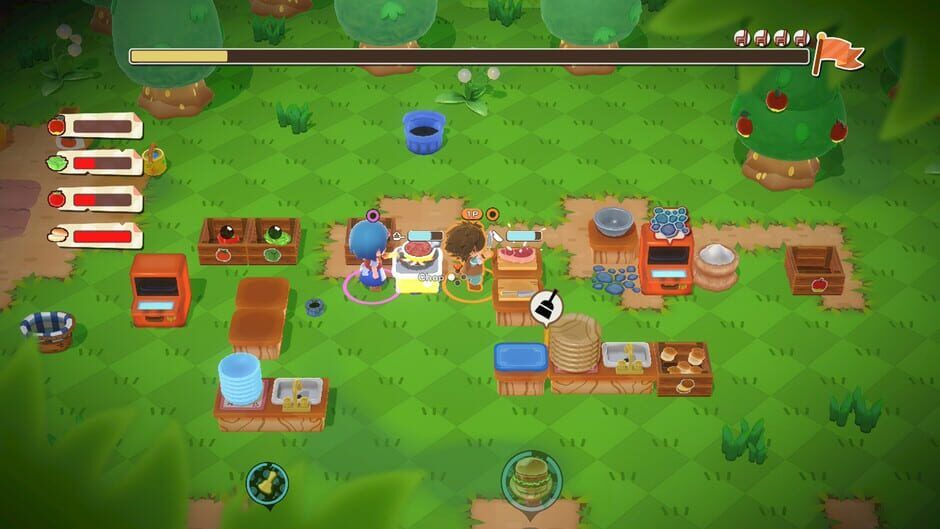
Once the round starts, the screen does not split. Instead, everyone shares the same top-down view of the restaurant. Character sprites are clearly colored and outlined, and the animals are distinct enough that you can usually track yourself even as the kitchen fills up. With four to six players it is hectic in a fun way, comparable to a busier Overcooked stage. With ten or more, it becomes complete visual noise where half your time is spent just relocating your character after a collision pileup.
The game tries to lean into that chaos. Orders flood in faster as player count increases, timers are tighter and the number of simultaneous stations in use ramps up. When a group clicks, there is a real thrill to carving out micro-roles on the fly. Someone hangs back to plate salads, someone babysits the grill, a pair run dishes, and a brave soul tries to manage the dessert station.
The problem is that the underlying systems are not tuned tightly enough to make this scale consistently fun. Collisions between players are generous and sticky, so bottlenecks form at narrow counters and doorways. A single mistimed turn can body-block three other players and cost an order, and this feels more like a physics accident than a skill issue. Compared to Overcooked’s elegant kitchen layouts, Ripple Island’s pathing simply is not smart enough to support its player ambitions.
With smaller groups the game fares better. Two to four players get a reasonably readable layout, clear tasks and enough room to improvise. In that range the game’s charm has space to breathe, and it becomes the light, chatty co-op experience Sunsoft clearly wanted.
Controls that never quite feel natural
Action cooking lives or dies on controls, and this is where Kyle and Cal’s Restaurant stumbles hardest. On paper the scheme is familiar. One stick moves, a face button interacts with stations, another handles picking up and dropping items, and a third triggers a dash. The game layers in a context-sensitive “smart” interact that changes function depending on what you are facing.
In practice that context sensitivity is too aggressive. Standing slightly off-axis from a counter might make the same button pick up the plate next to you instead of adding ingredients to the pan. Trying to dash through a doorway often snaps you into interacting with a nearby trash can instead. The result is a stream of tiny, infuriating misfires that only get worse as the kitchen grows busier.
Overcooked gives you clear verbs and expects you to line yourself up cleanly. Ripple Island keeps trying to guess what you meant to do, and it guesses wrong often enough that it becomes a running joke among players. The joke wears thin. The developers attempt to mitigate this with a generous pickup radius and mild input buffering, but that only makes the snapping feel more arbitrary.
The issues compound when you factor in the sheer number of players. Shared collision makes it easy to be nudged just out of alignment, and when the game is already overeager to auto-target nearby objects, simple tasks like stacking finished dishes or grabbing a specific ingredient become a fight against the controls.
Motion input is mercifully minimal. A few minigame-style stations, like furiously chopping or kneading dough, let you flick a Joy-Con instead of mashing a button, but this is entirely optional and does not change the flow of play. There is no support for touchscreen controls in handheld mode, which feels like a missed opportunity for solo or two-player sessions where precision would have been welcome.
Progression that burns out too fast
Structurally, Kyle and Cal’s Restaurant takes cues from the campaign flow of other party-cooking games but pares it down. You work through a series of themed restaurant days across Ripple Island, each represented by a short shift. Completing a shift with enough satisfied customers earns a rating and gradually unlocks new recipes, decorations and animal staff.
Early on, there is a pleasant sense of growth. Your basic diner expands with new cooking stations, the customer types diversify and you start seeing multi-step dishes that require coordination. The problem is that this curve flattens very quickly. Within a few hours most of the mechanical variety has revealed itself. New levels remix station placement and traffic flow, but do not substantially change what you are doing.
Progression across profiles is also thin. The game tracks star ratings and a simple currency used to buy decor and cosmetic outfits for Kyle, Cal and the animal helpers. These cosmetics are cute, and kids will likely enjoy dressing up their favorite critter, but they do not feed back into gameplay. There are no meaningful kitchen upgrades, no branching restaurant specializations and no mode that re-contextualizes the core loop in a fresh way.
Where Overcooked 2 keeps escalating with evolving hazards, dynamic stages and new prep mechanics, Ripple Island mostly reskins the same handful of tasks. You chop, cook on timed stations, plate, occasionally assemble combo dishes and deliver them. After a few long sessions you will have basically seen the toybox.
There is a modest attempt at a loose story. Short vignettes between days let you meet new animal patrons and learn why Kyle and Cal are running this restaurant. The writing is light, pleasant and entirely skippable. It is here to justify the next themed area more than to anchor the experience, and it never blossoms into anything that might keep you engaged once the mechanical novelty wears off.
Local multiplayer legs compared to Overcooked
The central question for a game like this is simple: will people ask to play it again next game night? Ripple Island has fun in it, but it struggles to earn that rotation spot over its better-tuned peers.
In its favor, the onboarding is smooth and approachable. Newcomers can grasp the basics in minutes, and the forgiving timers of early levels keep frustration in check. The pastel art and bouncy soundtrack make it an easy pitch for families, and the sheer absurdity of having a dozen people share one kitchen is worth at least a few memorable evenings.
However, the lack of depth becomes impossible to ignore over time. Once your group has found a comfortable synergy, there is little incentive to refine your play or push higher difficulties. The game does not ship with robust challenge modes or score-attack variants designed for serious replay. There are no clever rule sets that, say, lock certain stations, invert roles or introduce rogue-like progression the way PlateUp does.
What remains is a reasonably fun, slightly sloppy rush that feels interchangeable from one session to the next. Overcooked’s best levels become stories you tell for years, where the kitchen design itself forces outrageous adaptations. Ripple Island’s stages blur together into a single, mildly different floor plan with the same jobs to do.
If your regular crew has exhausted the Overcooked series and desperately wants a new dish in the same vein, Kyle and Cal’s Restaurant can temporarily scratch that itch, especially if you reliably gather more than four players. As a long-term local multiplayer staple, it is too light and too clumsy to sit at the head of the table.
Performance and presentation on Switch
Technically, the Switch version holds up fine. The simple, colorful art style scales cleanly in both docked and handheld modes, with only minor hitching when an especially busy shift ends and the game tallies your performance. Input latency is not the issue here; the problems lie squarely in design rather than performance.
Character designs are charming, if a bit generic. Fans of Sunsoft’s older Ripple Island will appreciate some nods and cameos, but this is more reinterpretation than nostalgic revival. Music loops are short and cheerful, though after a long play session you will probably wish for a bit more variety.
Online play is absent, and that limitation matters. Where Overcooked 2 allows distant friends to jump in for a quick session, Kyle and Cal’s Restaurant is fully committed to living room gatherings. For some that is ideal. For others it severely limits how often the game will see use.
Verdict
Ripple Island: Kyle and Cal’s Restaurant is a likeable but undercooked entry in the party-cooking genre. Its 16-player local co-op is a fun gimmick that leads to some gloriously ridiculous scenes, yet the sloppy controls and shallow progression keep it from reaching the layered brilliance of Overcooked or the systems-driven replay value of PlateUp.
If you often host big gatherings and just want something noisy and approachable for a mix of kids and adults, there is enjoyment here, especially in short bursts. If you are looking for a new go-to co-op staple with real depth and staying power, this restaurant runs out of new flavors long before the night is over.
Final Verdict
A solid gaming experience that delivers on its promises and provides hours of entertainment.