
Review

By Night Owl
A postcard from the real Moon
REAL MOON is a free lunar exploration title on PC built in Unreal Engine 5, developed by historia Inc. in collaboration with JAXA. Instead of chasing sci-fi bases or survival crafting, it tries to answer a simpler question: what if you could just walk around the actual Moon?
On a purely technical and scientific level, the project is a quiet triumph. As a game, it is far more conflicted.
The JAXA data: a digital Moon that actually feels real
The core of REAL MOON is a simulation environment based on real observation data and academic research. The devs use high-resolution DEM data for elevation, statistically modeled crater distribution, and realistic rock dispersion patterns. Even the relative positions of the Sun, Earth, and Moon shift correctly over time.
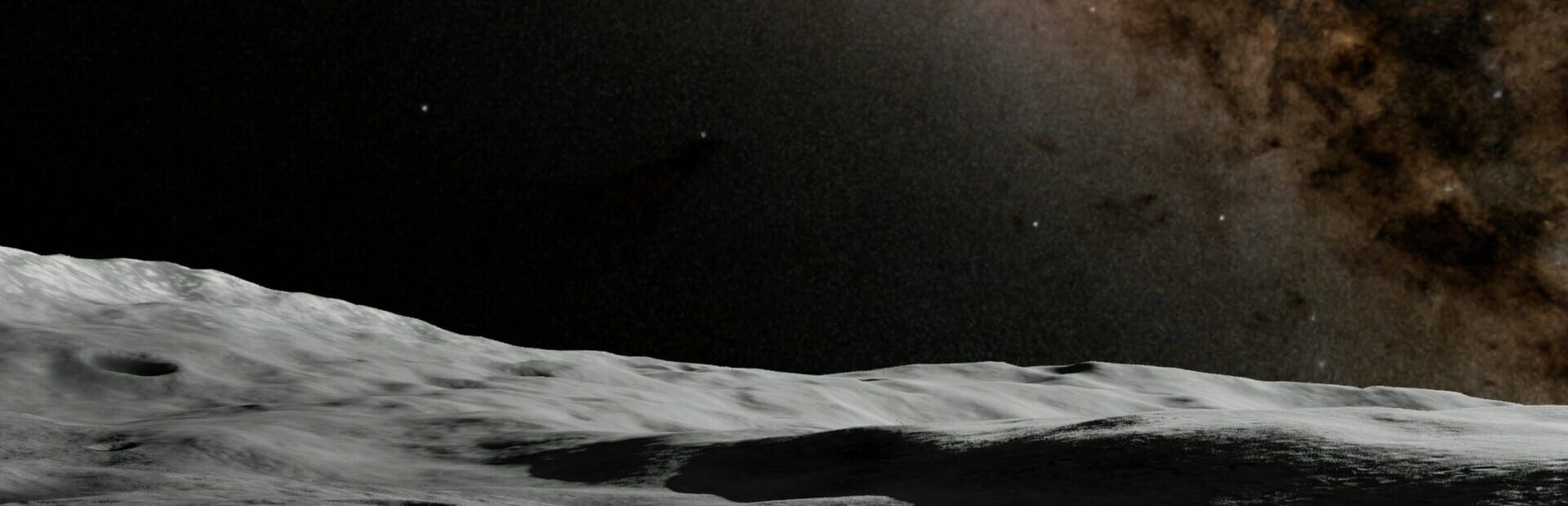
On PC this translates into a surface that finally looks like the photographs you have seen your entire life. Craters have convincing slopes instead of generic bowls. Boulders sit in believable clusters. The low, raking sunlight throws savage shadows across the regolith, so simply cresting a ridge at lunar dawn can be breathtaking.
The low gravity is equally convincing. Jumps have that slow, arcing float you expect from Apollo footage, and vehicles bite into the dust with a delayed, weightless response. It is not showy, but if you pay attention to your own movement and how dust and debris behave, you can feel the math humming underneath.
If your interest is purely in seeing and feeling a scientifically grounded Moon on a mid-range PC, REAL MOON absolutely delivers.
Sandbox structure: beautiful, empty silence
Where things get trickier is what you actually do there. REAL MOON calls itself a free-to-play lunar exploration simulator, and that is accurate in the narrowest sense: you explore, you simulate, and you do not pay anything.
There is no narrative arc, no long-term progression, and very little in the way of authored goals. You load into a landing site, walk or drive around, and optionally follow some basic tasks, like reaching a specific crater or capturing photographs. These are lightweight, more like sightseeing prompts than real missions.
Taken as a sandbox toy, that works up to a point. There is a fleeting joy to saying "I am going to hike along this ridgeline because a JAXA dataset says it should look this way" and then seeing that terrain unfold in front of you. The built-in photo mode is easily the most purposeful system in the whole package, turning the experience into a kind of astrophotography walking sim. Adjusting exposure, framing the distant Earth over a crater rim, waiting for the light to hit just right: in those moments, the game quietly shines.
The problem is that once you have soaked in the novelty, there is almost nothing left to push you deeper into the simulation. No base to build, no equipment tree, no resource logistics, not even a meaningful map-based sense of long-distance travel. It feels like a premium-quality environment that never quite figured out what kind of play it wants to host.
As a simulator: convincing physics, shallow systems
Labeling REAL MOON a simulator sets expectations it does not fully meet. When you hear "JAXA-backed lunar simulator," you might imagine something like Kerbal Space Program on the surface, full of granular systems modeling life support, traction, power, and mechanical failures.
That is not what this is. The simulation here is environmental rather than systemic. Terrain, lighting, and orbital positions are rooted in science, and character and vehicle motion respect low gravity, but the actual gameplay systems are minimal.
You do not manage oxygen levels in a way that creates real tension. You do not have to plan EVA durations, battery cycles, or communications windows. You do not need to think about slope stability when choosing a rover route beyond avoiding obvious cliffs. You exist in a consequence-light bubble, free to wander without worrying about the brutal realities that make the real Moon so dangerous.
For some players that approach will be a relief. It means you can enjoy the scenery without KSP-style spreadsheets. But if you came here for a serious simulation of lunar operations, you will probably bounce off quickly. The JAXA collaboration is incredible groundwork begging for more demanding systems that are simply not present.
As a sandbox toy: strong vibes, weak hooks
Treating REAL MOON as a digital toy makes more sense. It is a chill, almost meditative place to wander around. The lack of threat and time pressure, combined with that eerily accurate landscape, makes it a great "put on a podcast and roam" experience.
In that context, the minimalist design feels intentional. You choose a direction, walk, take screenshots, maybe hop in a vehicle and ride into the darkness. There is a gentle joy to discovering a particularly scarred crater wall or stumbling across a valley where the shadows swallow everything but the horizon.
Yet even as a toybox, the game is oddly constrained. There are no real tools to meaningfully poke at the environment beyond walking and driving. You cannot place markers, spawn structures, or layer in your own experiments. There is no robust free-camera mode that lets you orbit and study terrain from a surveyor’s perspective. The photo mode is nice but basic, and there is not much in the way of sharing or in-game curation of your expeditions.
The result is a sandbox that is compelling for an evening but struggles to earn a permanent slot in your "comfort games" lineup. Compared to something like a rich planetarium app or a detailed geology sim, it simply lacks the instruments that would turn idle play into sustained curiosity.
As an educational tool: strong potential, light scaffolding
REAL MOON’s partnership with JAXA and reliance on actual research data make it an obvious candidate for classrooms or space-curious players. In practice, it functions more as an evocative visualizer than a structured learning platform.
The good news is that what you see is grounded in reality. If you want to talk about crater formation, regolith slopes, or how low-angle sunlight exaggerates topography, you can literally walk students up to examples in real time. The shifting positions of Earth and Sun are a subtle but powerful way to convey orbital dynamics and day-night cycles on the lunar surface.
The missed opportunity is how little the software itself explains any of this. There is no in-game encyclopedia linking specific terrain features to real missions or scientific papers, no contextual overlays that sketch out why a particular crater is shaped the way it is, and no built-in guided tours curated by JAXA scientists. If you want to use it as a teaching aid, you will be doing all the pedagogical heavy lifting yourself.
For space-curious players who are happy to research on a second screen, REAL MOON is a fantastic backdrop. For anyone hoping the game would meet them halfway with structured lessons or interactive science, it falls short.
PC performance and presentation
On a technical level, the use of Unreal Engine 5 pays off. The lunar surface is dense with detail, and the lighting model sells the harshness of direct sun and the ink-black shadows of the terminator. On reasonably modern hardware the game runs well enough to preserve the mood, though some pop-in and occasional hitches remind you this is a free project first and a polished commercial release second.
Sound design leans into isolation. Your footsteps, suit noises, and rover engines are muted against an otherwise oppressive silence. It is not lush, but it fits the setting. Interface elements are sparse and utilitarian, consistent with the overall "simulation lab" aesthetic.
The platform fit is ideal. Mouse and keyboard work fine, controller support feels natural for couch wandering, and the lack of twitch mechanics means lower frame rate dips are not fatal. However, graphical settings could be better explained for non-technical users who might want to balance fidelity and performance.
Verdict: a brilliant Moon, an unfinished idea
REAL MOON is one of the most convincing digital representations of the lunar surface available to the public, and the fact that it is free on Steam makes it easy to recommend as a curiosity. For an hour or two it is unforgettable: you step off the lander, bounce across dust sculpted by real data, and watch the Earth hang impossibly still in a starless sky.
As a game, though, it never commits. It is not deep enough to be a true simulator, not playful enough to be a great sandbox toy, and not structured enough to be a strong educational platform. It is best understood as an interactive postcard from the future of scientific visualization, a glimpse at what happens when space agencies treat game engines as tools rather than novelties.
If you are space-curious, download REAL MOON, walk until the horizon curves away under your boots, and take a few photos. Just do not expect a long-term campaign, dense systems, or a guided tour of lunar science. The data is real, the Moon is beautiful, and for now, that is almost all there is.
Final Verdict
A solid gaming experience that delivers on its promises and provides hours of entertainment.