
Review

By Apex
A color-coded stress test for your friendships
POPUCOM does not care if you think you and your friends communicate well. It will prove you wrong in the most entertaining way possible. Hypergryph has built a co-op-first puzzle-platformer where match 3 logic, shooter-style aiming, and tight platforming collide into a neon sugar rush. For the holidays, when couches are crowded and controllers are finally charged, this is exactly the kind of pressure-cooker co-op that can dominate a living room.
What makes POPUCOM stand out is how utterly committed it is to cooperation. There is no proper single-player option, and it feels intentional. This is a 2 to 4 player experience through and through, structured around constant back-and-forth between partners rather than parallel play. If you are hunting for a festive couch co-op puzzler that actually needs everyone awake and engaged, POPUCOM is in that rarefied club.
Color-matching with real teeth
On paper, POPUCOM sounds like a familiar blend. You shoot colored bubbles, match at least three of the same color, and clear clusters of blocks or enemies. In practice, the system is far more layered.
Each player is armed with a color gun. You can cycle colors on the fly and fire at enemies, environmental blocks, or bubbles already in play. Matching colors pops threats, opens paths, or sets off chain reactions that ripple through the arena. Color switching is instant, so the challenge is not mechanical execution as much as mental awareness. In the middle of a hectic level, it becomes a rapid-fire test of reading the board, picking the right shade, and trusting that your partners will not sabotage the setup accidentally.
Where POPUCOM elevates the formula is in how it ties color to utility. Different colored elements might behave differently. Some are simple obstacles, some act as temporary platforms, others only react when cleared in specific orders. Later zones introduce enemies and hazards that punish lazy color spam. You are constantly deciding if you should pop a formation immediately or hold back because your teammate is about to chain something larger for a faster clear or a safer path.
The best moments feel almost like playing Overcooked and Puyo Puyo at the same time. One player is juggling incoming threats while another lines up delicate matches that will reconfigure the level. When it all lines up and a coordinated color cascade wipes out a room, the payoff is massive, both in score and in collective yelling.
Levels built for arguments and high-fives
POPUCOM is a proper campaign, not just a string of arenas. Stages are compact but dense, constantly remixing platforming, puzzle layouts, and combat setups. Video Chums and several other critics call out how well tuned the pacing is, and it is easy to see why. Early stages teach color basics quickly, but the game wastes little time before making cooperation non-negotiable.
You will see puzzles where one player must stand on a switch to rotate a structure while another snipes specific blocks from afar. Other levels force teams to juggle moving platforms while timing color matches that affect hazards across the map. There is a steady drip feed of new twists, from environmental gimmicks to power boosting artifacts that change how you interact with colors.
Importantly, levels are scored and often time sensitive, which matters a lot for holiday couch sessions. You can brute force your way through most areas, but doing it quickly and cleanly becomes the real hook. The structure invites replays to shave seconds off runs or chase higher rankings, which is exactly what you want when you have a rotating cast of players walking in and out of the room.
What sells the level design most is that victory almost never feels like a solo effort. Solutions are framed physically across space, so even when one person discovers the trick, the rest have to execute together. Nobody gets to coast.
Difficulty that scales with headcount
The question for any modern couch co-op puzzler is how it plays at different player counts. POPUCOM is surprisingly smart about this, though not perfectly smooth.
With two players, the game feels like a classic co-op campaign. Communication is intimate, and responsibilities naturally divide. One person might handle front-line popping while the other focuses on positioning and switches. Puzzles read clearly, and while there is still chaos, it is a manageable, almost rhythmic back-and-forth. If you are playing primarily with one partner, POPUCOM delivers one of the most satisfying two-player puzzle runs since titles like It Takes Two or Snipperclips, just with more arcade bite.
At three and four players, the game changes character. Rather than scaling difficulty in a crude way, the game layers in more simultaneous tasks and tighter timing. There might be extra switches to manage, additional hazard streams, or puzzle patterns that are far safer when there are more guns emptying colors into the field. Tech-Gaming and other reviewers note that adding humans multiplies both the fun and the chaos, and that holds up in practice. Four-person runs feel like POPUCOM at its wildest.
The downside is that clarity starts to slip as the screen fills. Visual spectacle is cranked up, and with four characters, multiple color bursts, and animated backgrounds all firing at once, some scenarios are simply hard to parse. Mistakes ramp up not because players fail to understand the puzzle, but because they lose track of who is where or which color is about to fire. For tightly coordinated groups, this turns into funny, excitable noise. For more casual holiday gatherings, it can occasionally tip from fun chaos into mild frustration.
Even so, the underlying scaling is smart. Levels that would be a slog for two players are reshaped with extra help in mind, and the game rarely feels like it is just inflating enemy health or turning the clock down. The campaign remains approachable enough for mixed skill groups, while optional goals and better ranks provide teeth for more serious teams.
Tools of teamwork: artifacts and abilities
On top of the core color guns, POPUCOM grants a roster of super artifacts that meaningfully deepen co-op strategy. These are not throwaway gimmicks. They change how roles can be assigned within a group.
Some artifacts allow wider shots or special ricochets that are perfect for a player who wants to exist on the perimeter, cleaning up awkward angles. Others create barriers, pulling double duty as defense and traversal tools. Controllers can be divvied up so that one player is effectively the utility specialist while another is the aggressive clearer.
This gear system is clever because it offers a soft form of difficulty tuning. Less experienced players can be given supportive tools that contribute without demanding perfect aiming or constant color juggling. Stronger players can take on more precise, high impact gear and shoulder the more complex tasks. During long sessions, swapping artifacts between runs keeps the game fresh and lets people experiment with new cooperative rhythms.
Couch-ready presentation
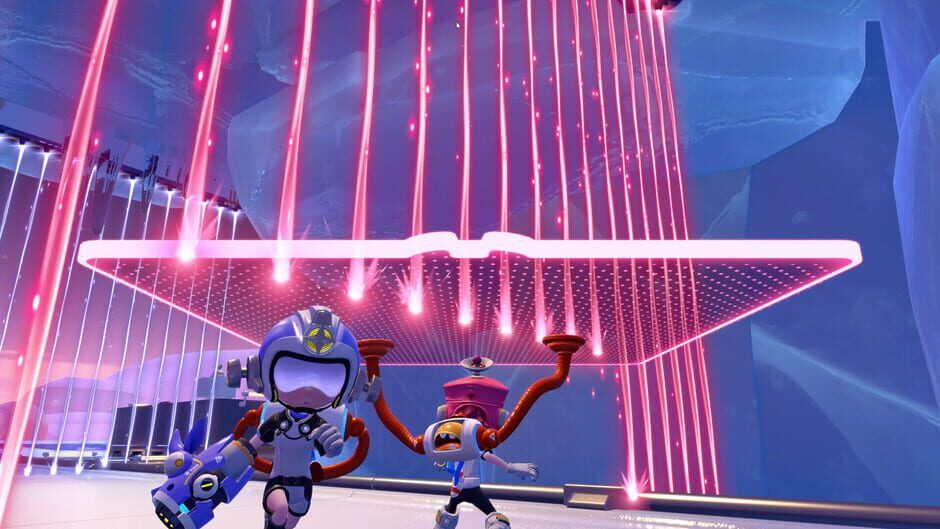
For a holiday party puzzler, feel matters. POPUCOM absolutely nails that side of the equation. The world is loud, sugary, and relentlessly upbeat. Characters are expressive, animations are snappy, and the whole thing has that Nintendo-adjacent sheen that several reviewers have rightly praised.
The soundtrack leans hard into bouncy tunes that sell the sense of a Saturday morning cartoon fever dream. Crucially, it never becomes as grating as it could have. Short stages and frequent breaks for post-level scores mean you are not trapped listening to a single track for too long. The sound effects for color pops, combo chains, and artifact triggers are crisp enough that they double as subtle feedback systems, which helps alleviate some of the visual clutter at higher player counts.
Load times are brief, which is a blessing when someone inevitably demands a restart after misreading a puzzle. For a couch co-op title, that frictionless loop of fail, banter, retry is vital, and POPUCOM keeps the pace up.
The co-op gripes
Despite its many strengths, POPUCOM has a few issues that might matter for specific groups.
First, the absence of a true single-player experience is a double edged sword. From a design purity standpoint, committing fully to co-op makes sense, and the game is better for it. From a practical standpoint, it means you cannot reasonably enjoy the campaign alone between group sessions. There is no well balanced solo mode that lets you practice or explore levels at your own pace. If your household rarely has a second player available, this is not the game that will change that.
Second, while the general difficulty curve is fair, there are intermittent spikes where the game suddenly demands very tight execution under heavy visual noise. These spikes often coincide with new mechanics that are not as clearly taught as the early fundamentals. Skilled teams will brute force their way through, but less practiced players might hit a few walls that feel abrupt compared to the smooth build up before.
Finally, the party mode add ons and mini games that some reviews mention are not as compelling as the core campaign. They work as brief palate cleansers, but they do not have the same staying power as the main cooperative gauntlet. This is not necessarily a problem, but anyone hoping for Mario Party style staying power from the side content may be disappointed.
Holiday verdict: a top tier couch co-op puzzler
Taken as a whole, POPUCOM is one of the most confident modern couch co-op puzzlers around. The color-matching mechanics are not just a cute hook; they are deeply integrated into smart level design that constantly asks players to talk, plan, and improvise together. Difficulty scales in a way that keeps both two player duos and four player squads engaged, even if the jump in visual chaos can occasionally outpace clarity.
For holiday gatherings, it hits the sweet spot. Sessions can be short or extended, success is loudly celebrated, failure is usually funny, and everyone has something meaningful to do. In a crowded space of lazy co-op modes bolted onto single-player designs, POPUCOM feels refreshingly built from the ground up for shared screens.
If you have regular access to at least one co-op partner and you enjoy puzzle-platformers with teeth, POPUCOM absolutely earns a place on the short list next to modern favorites like It Takes Two, Unrailed, or Death Squared. For this holiday season, as long as you bring the friends, this color-fueled chaos brings the rest.
Final Verdict
A solid gaming experience that delivers on its promises and provides hours of entertainment.