
Review

By Night Owl
A newsroom built on deadlines and duct tape
News Tower’s 1.0 release finally delivers on the fantasy that management sim fans have been quietly begging for: running a chaotic, cutthroat 1930s New York newspaper. It is not just a novelty theme pasted onto a generic tycoon game. The entire design is built around the rhythms of a weekly paper, the grimy logistics of getting words to print, and the uncomfortable compromises that come with trying to survive on newsstand sales in the middle of the Great Depression.
When the game is firing, the loop is electric. You are juggling leads across the city, arguing with your own conscience over which stories deserve the front page, cramming desks and bathrooms into a tower that is one elevator breakdown away from catastrophe, and then hitting “print” hoping you did enough. It is one of the most absorbing management sims on PC this year, but it also trips over its own ambition with finicky UI and tuning that can swing from cozy to punishing with barely a warning.
How the 1930s newsroom systems lock together
Everything in News Tower orbits three pillars: the newsroom management, the ethics and reputation layer, and the physical tower layout. They are not separate modes. They are three versions of the same pressure: time.
Each in game week begins with the city map lighting up with new leads. Politics in City Hall, mob hits by the docks, labor unrest in Brooklyn, movie star scandals in Manhattan, international crises trickling in over the wire. You send reporters out, each with specialties and personal quirks, and the clock starts. They spend in game hours and days working a story, and when they return, you are given an article that is more than just a pile of numbers.
Every piece has sliders for ethics, sensationalism, bias and audience appeal, and often an explicit moral angle. Did your reporter dig deep enough to expose corruption, or did they take the mob’s version of events at face value for a cleaner scoop? Do you print the nuanced piece that might not grab casual readers, or the lurid one that will sell but feeds extremists or emboldens gangsters? Early on it feels like a flavor layer, but as your circulation grows, the game starts tracking how your editorial line shifts opinion across districts and factions.
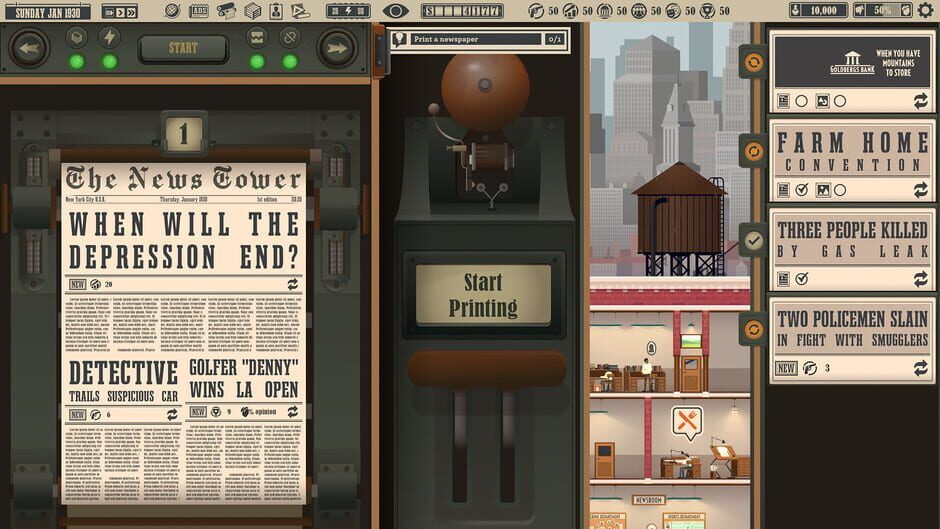
Then comes the paper itself. Layout is not a throwaway drag and drop. You physically fit stories into fixed templates of column inches, alongside ad blocks that keep the lights on. Squeezing in that extra investigation might mean kicking out a high paying cigarette ad; giving up that space in turn shrinks your next expansion budget. The sense of a real editorial meeting is strong, with every front page becoming a snapshot of what you have chosen to stand for that week.
All of this would be manageable if it existed in abstract menus. It does not. Everything feeds back into the tower.
The tower: plumbing, placement, and productivity
Your headquarters is a literal tower that you build floor by floor. It starts as a cramped two story affair. Soon you are bolting on new levels and horizontal wings, cramming in writing rooms, photography labs, archives, printing presses, mailrooms, break areas, offices, restrooms and maintenance closets.
The trick is that rooms are not just decoration. Workers have pathfinding, stamina, needs and stress thresholds. A brilliant reporter who sits three floors away from the archives and the elevator will spend half the day on their feet instead of at their desk. Photographers bottleneck at a single darkroom. Cleaners and repair staff can barely keep up if you set up a long, narrow skyscraper layout with a single staircase. The result is a management problem that feels closer to Project Highrise crossed with a pinch of Two Point Hospital.
This is the part of News Tower that quietly elevates it from a clever theme piece to a proper heavyweight sim. The way your floor plan affects everything, from how quickly leads are processed to whether your presses break down under overuse, feels immediate and tangible. Rebuilding a chaotic early tower into a compact, efficient, almost claustrophobic puzzle of offices is one of the most satisfying mid game projects.
The 1.0 release doubles down on this by adding alternate end game tower types and more specialized rooms. There is real replay value in trying different configurations, like a skinny skyscraper vs a low, sprawling block. Each has distinct choke points, and the game does not hide that from you. You feel the consequences on every deadline.
Ethics, factions, and the business of influence
Where News Tower most clearly distinguishes itself from other management sims is in the tangled web of ethics, factions and citywide influence. You are never just trying to make money. You are trying to decide what kind of paper you are running, and who you are willing to anger or placate along the way.
Stories have tags that appeal to, or infuriate, specific groups. Big business, labor unions, the police, the mob, the military, political parties and foreign powers all care what your front page says. In 1.0, the perception system has been overhauled into something that tracks not just popularity but ethical stance. Publish too many slanted hit pieces and you slide toward propaganda. Cater repeatedly to criminal syndicates and you will get favors and exclusive scoops in return, at the expense of your reputation and sometimes your staff’s safety.
This is where the best dilemmas live. That front page photo of a dockside massacre might expose a mob boss and win praise from reformers, but it could also get your photographer threatened or worse. Running a thinly sourced anti union screed might get you a windfall ad contract from factory owners, but you will crush your standing with workers and shrink your distribution in industrial districts.
What makes it work is that the perks and punishments are systemic rather than purely scripted. A mob favor might literally mean a faster distribution network to certain boroughs. A falling out with City Hall might turn a previously safe political beat into a hotbed of arrests and intimidation, costing you time and staff. The best runs feel like you have carved out a distinct identity for your publication, not just min maxed a morality bar.
Where the balance stumbles
For all the elegance in how the systems feed into each other, News Tower’s balance is far from perfect. The core economy can be unforgiving to the point of frustration, especially in the early and late game.
The opening hours are overloaded with micromanagement before your income stabilizes. You are barely scraping by, simultaneously learning how the paper layout works, trying to understand which stories serve which districts, and shoving desks into any available gap just to keep a few more bylines flowing. Some of this pressure is the point, but certain tuning decisions amplify the pain. A single failed edition or production hiccup can set you back several weeks of progress, and there is not much room to improvise your way out beyond grinding out safe, low paying content.
Later, once you have a decent circulation and a mature tower, the curve bends in the opposite direction. Money ceases to matter as much, but staff stress and event chains can abruptly spike, producing sharp difficulty cliffs. There are weeks where it feels like the game stacks every possible misfortune at once, from equipment failures to faction demands to random crises, and the only realistic answer is to reload. The perception of fairness wobbles.
The ethical layer can also be min maxed in a way that slightly undercuts the intent. With enough game knowledge, you can often thread the needle by running a mix of ethically solid investigative pieces and a few carefully chosen sensationalist headlines to game reader satisfaction without ever truly committing to an editorial line. That does not break the experience, but it makes some of the intended moral weight feel more like calculus than conscience.
UI: functional, but too often in your way
If there is one area where News Tower clearly needs a post launch pass, it is the interface. The game is data heavy, and the UI struggles to keep up with the sheer volume of information you need in the late game.
Assigning reporters to leads works well enough at small scale. Once you are juggling multiple teams across different beats and continents, the city map and staff lists become cluttered. Filtering tools exist, but they are buried and a little too coarse. It is too easy to misclick and send the wrong reporter to a job they are poorly suited for, or to overlook an exhausted staffer who is about to collapse mid investigation.
Paper layout also reveals some awkwardness. Dragging stories into page templates can be oddly finicky, with snap points that do not always behave and tooltips that obscure the very numbers you are trying to read. The game does not do a great job of surfacing, at a glance, how a given combination of stories will affect every relevant audience segment and faction. You can dig through the panels and tease it out, but that should be front and center for a game about editorial tradeoffs.
The tower view fares better, with clear icons for room types and staff roles, but even there, pathfinding diagnostics are underdeveloped. When your employees are wasting half their day in transit, the game leaves you to infer the problem from observation rather than giving you strong visual cues or overlays. Players who like to tinker and iterate will get there, but it is more friction than it needs to be.
None of this is fatal. You can acclimate, and the underlying systems are strong enough to carry the game. Still, compared to the genre’s best in class interfaces, like Two Point Hospital or Frostpunk, News Tower feels more like a very good early access UI that never quite got the final round of smoothing it deserved.
Does it belong among the year’s standout management sims?
Even with those rough edges, the answer is yes. News Tower’s 1.0 launch lands as one of 2025’s most distinctive management sims, because it hits three rare marks at once.
First, the theme is not a gimmick. The 1930s newsroom setting seeps into every part of the design, from the jazzy soundtrack and art deco UI flourishes to the historical arcs that loosely mirror real events without turning the game into a lecture. When you run a series on organized crime or creeping militarism, it feels grounded in the era.
Second, the interlocking systems support one another instead of competing for your attention. Decisions made on the city map affect what happens in the newsroom, which in turn are constrained by the physical tower, which loops back into what you can cover next week. There are weak points in the tuning, but as a piece of systems design, it is impressively cohesive.
Third, it has genuine replay value. Different editorial stances, tower layouts and faction alliances lead to meaningfully different campaigns. You can chase ruthless circulation numbers at any cost, try to be the rare paper that holds the line on ethics, or play both sides of the city’s power structure and see how long you can ride the tiger. Each approach stresses different parts of the simulation.
If you are allergic to micromanagement or expect pristine interfaces, News Tower will test your patience. You will fight the UI, and a few balance spikes will feel unfair. But if you want a management sim that does something fresh with both its theme and its mechanics, this is an easy recommendation and a serious contender for one of the year’s standouts.
In a market crowded with cozy factory lines and copy pasted city builders, News Tower sticks its neck out. It is messy, occasionally overwhelming, and absolutely worth your time.
Final Verdict
A solid gaming experience that delivers on its promises and provides hours of entertainment.