
Review

By Headshot
Neath Early Access Review: A Clever, Crooked Heir To Rogue Legacy
Cellar Door Games built its reputation on kinetic, immediately readable action in Rogue Legacy and its sequel. Neath aims for something stranger: a slow-burn, eldritch tactical roguelike where you script not only your squad’s turns but your enemies’ too. It is an audacious pivot, and in early access it already shows more systemic ambition than many finished tactics games, even if it occasionally buckles under its own ideas.
Tactical Depth: Playing Chess With Yourself
The core of Neath is a timeline-driven, turn-based system where every action is a trade of "moments." You spend time to move, attack, channel spells, or delay. Crucially, you can also hijack enemy turns, queuing their actions in a way that turns the whole battle into a programming puzzle.
At its best, this is outstanding. Setting up a sequence where you move a fragile occultist into bait range, delay her turn, then schedule an enemy brute to lunge through her into his own ally feels like cheating the universe. The interface telegraphs these chains clearly enough that you can plan three or four moves ahead without drowning in chaos, and that alone puts Neath in rare company. It is the kind of system that makes you replay encounters just to see if you can solve them more elegantly.
The downside is that early access lacks the encounter variety to fully showcase this brilliance. Too many fights hinge on similar enemy packages and familiar tricks: pull the archer out of cover, force the berserker into friendly fire, kite the caster. The underlying puzzle language is rich, but the game is not yet speaking enough dialects of it. Compared with Rogue Legacy’s constant remix of platforming and class gimmicks, Neath’s early hours can feel repetitive once you grasp the basic turn-hijack tools.
Still, as a foundation for long-term tactical depth, Neath is promising. The ceiling here is high. If Cellar Door keeps layering on enemy archetypes that truly subvert your expectations rather than simply scaling numbers, this could easily stand alongside Into the Breach as one of the most legible yet demanding tactics designs around.
Roguelike Progression: Clever Meta, Uneven Runs
Rogue Legacy turned random runs into a generational saga, softening permadeath with a steady drip of castle upgrades and oddball heirs. Neath attempts a more austere structure. Your squad ascends an inverted, irradiated tower, constrained by divine "Taboos" that act like run modifiers. You wipe, you climb again, gradually unlocking new classes, relics, and meta-boons.
On paper it is a strong fit for a tactics game. In practice, early access progression feels conservative. Unlocks tend to be incremental stat bumps or modest skill variants rather than genuine run-warping twists. When you finally earn a powerful new discipline, it changes your decision space in satisfying ways, but those moments are too rare in the current build.
The Taboo system is more interesting. Each run, the tower is governed by a handful of godly rules that change encounter rhythm: enemies retaliate whenever you move adjacent, healing inflicts corruption after a threshold, or delayed actions resolve in reverse order. These modifiers do a lot of heavy lifting in keeping the same pool of enemies fresh. Planning around a Taboo that reverses resolution order turns what used to be safe delays into terrifying gambles.
Yet the runs themselves can drag. There are mid-ascension stretches where the difficulty curve flattens and the rewards do not justify the time investment. Rogue Legacy understood the value of quick failures and snappy restarts; Neath sometimes crosses the line into attrition, where you are nursing a half-ruined squad through filler floors on the off chance the next shrine contains something exciting.
The bones of a strong roguelike loop are here, especially for players who enjoy mastering a tight set of tools over hundreds of attempts. But for a game trading on Rogue Legacy’s name, Neath’s early-access progression feels a little too dry and grindy, more interested in slow mastery than in giving you wild, broken builds to chase.
Horror Atmosphere: Inverted Tower, Right-Side-Up Dread
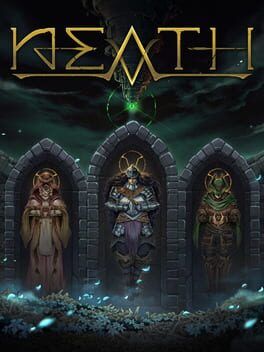
If Rogue Legacy flirted with gothic whimsy, Neath dives headfirst into rot and radiation. The inverted tower looming overhead, filters of sickly green and bruised purple, and enemy designs that twist familiar silhouettes into something subtly wrong all contribute to an oppressive mood. It is not the loud, screamer type of horror; it is closer to the quiet nausea of walking through a space that should not physically exist.
The art direction leans hard into uncomfortable asymmetry and negative space. Environments feel oddly hollow, with just enough detail in the background to convince you something is shifting when you are not looking. The character sprites are small but readable, their animations sold through abrupt, almost puppet-like motions that fit the idea of mortals moving under a god’s arbitrary rules.
Where Neath stumbles is in sustaining that dread across long runs. Dialogue snippets and lore entries hint at cosmic-scale indifference, but the writing has not yet found the razor-sharp dark humor that made Rogue Legacy’s text so memorable. There are flashes of personality; a god who comments on your failures with clinical curiosity, cultists who seem more terrified of your interference than of their own rituals. For now, though, the horror is more successful visually and mechanically than it is thematically.
The soundtrack does its part, with droning pads and sparse percussion that accent fight rhythms without overwhelming them. Some tracks loop a bit too quickly during extended battles, but the overall soundscape supports the feeling that you are trying to solve a puzzle while something in the room is quietly watching you.
Expectations vs Reality: From Platforming Lineage To Tactical Lab
Given Rogue Legacy’s place in the roguelike pantheon, it is impossible not to arrive at Neath with expectations. Cellar Door’s hallmark has always been immediacy: responsive controls, simple inputs, and depth that emerges from quick reads rather than intricate systems. Neath inverts that design philosophy as surely as its tower inverts gravity. It is intentionally thinky, borderline cerebral, and willing to sacrifice pace for planning.
Against that backdrop, Neath succeeds more as a fascinating tactics laboratory than as a spiritual sequel to Rogue Legacy. The studio’s trademark clarity of feedback is intact. You can see the timeline, the projected outcomes, and the consequences of your choices far more clearly than in most grid-based games. That is the Rogue Legacy DNA at work, transplanted into a radically different genre.
What is missing, at least in early access, is that same sense of playful chaos. Rogue Legacy delighted in giving you broken heirs and absurd traits that could wreck a run while still feeling like a joke you were in on. Neath is colder, stricter, and narrower. Its promise lies in mastering a disciplined system rather than embracing RNG-fueled nonsense.
Whether that is a disappointment will depend on what you wanted from Cellar Door’s next act. If you came looking for a direct evolution of Rogue Legacy, this will feel like a side path into stranger territory. If you are willing to trade jump arcs and crit builds for timelines and deterministic puzzles, Neath is already a more compelling tactics playground than many of its peers.
Early Access Verdict
As an early-access or launch-window tactics roguelike, Neath is in strong shape. Its central mechanic of controlling both allies and enemies is genuinely fresh, and the tower’s Taboo system hints at the kind of long-term variety that can keep a game like this alive for years.
At the same time, it still lacks the breadth and swagger that made Rogue Legacy an instant classic. Progression is a bit too stingy, runs can sag in the middle, and the horror atmosphere has yet to fully fuse with the narrative in a way that sticks with you after you close the game.
If you care about tactical depth and you are comfortable buying into a work in progress, Neath is absolutely worth your time already. It feels like the early stages of something special. Whether it ultimately earns the same reverence as Rogue Legacy will depend on how boldly Cellar Door builds on this strong, unsettling foundation between now and full release.
Final Verdict
A solid gaming experience that delivers on its promises and provides hours of entertainment.