
Review

By The Completionist
A Finale That Knows Its Fans, But Not Its Own Limits
My Hero Academia: All’s Justice arrives as the capstone to Byking’s trilogy of 3D arena fighters, and it wears that "final chapter" banner loud and proud. This is the game that finally lets the series go all-in on the Final War arc, with Deku, Shigaraki, and an army of heroes and villains smashing through the endgame of the manga.
As a sendoff for fans who have ridden with the anime and the earlier One’s Justice games, All’s Justice is often thrilling. The combat is the tightest it has ever been in this series, the roster is huge, and the story mode finally has the budget and direction to feel like more than a glorified recap slideshow. But as a fighting game launching into a crowded 3D arena space, it also drags forward a lot of familiar baggage. New modes like Team Up Mission and Hero’s Diary add variety around the edges without truly refreshing the core formula, and the online suite is only partially ready for the competitive audience that kept this series alive.
Final War Arc: Spectacle First, Context Second
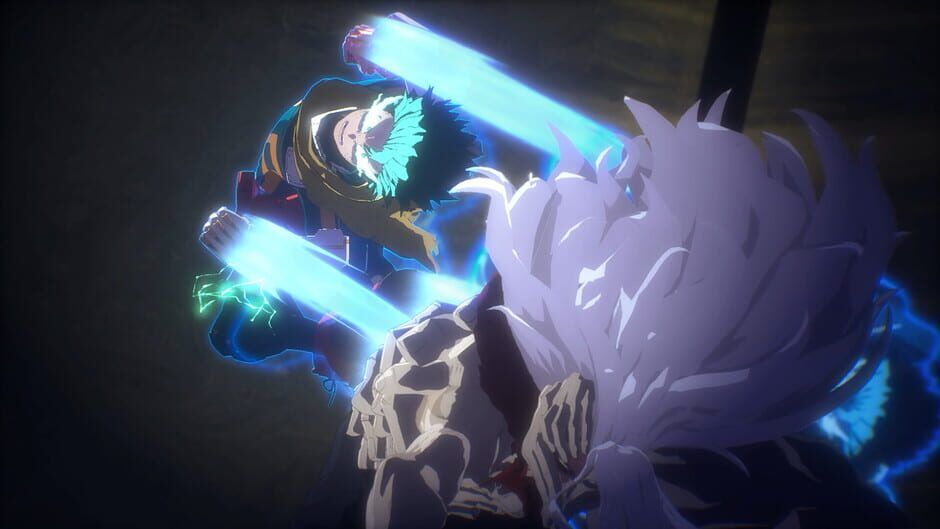
Story mode is the main event, a single long campaign that tunnels through the Final War arc with very little hand-holding. If you are not caught up on the anime or manga, the narrative might as well be written in another language. Characters warp in and out of the conflict with zero introduction, massive sacrifices land with a dull thud, and the game assumes you already know why Deku is trading blows with this particular version of Shigaraki on a floating ruin.
For fans, though, the adaptation is easily the strongest Byking has done. The old, static manga panels from the first two games are mostly gone, replaced by motion-manga style sequences and surprisingly elaborate 3D cinematics. The opening push across multiple battlefronts feels properly chaotic, and several key fights, like Endeavor’s confrontation with Dabi or the last stand against All For One, get bespoke cutscenes and in-engine transitions that mesh smoothly with the actual bouts.
Where the adaptation falters is in pacing and mission design. Too many encounters boil down to "beat this single enemy" on a bare stage, sometimes padded out by waves of disposable mobs that barely fight back. There are bright spots that lean into the characters’ quirks, such as stealthy setup missions with Deku’s support teams or high-mobility aerial battles that emphasize verticality, but they are outnumbered by forgettable filler clashes. When All’s Justice leans into scripted, cinematic brawls, it nails the Final War’s sense of escalation. When it defaults to routine arena skirmishes, you can feel the budget being stretched across a very long arc.
Roster Depth: The Biggest, Messiest Casting Call Yet
If there is one thing All’s Justice unquestionably delivers, it is a massive cast. This is Byking emptying the bench: multiple eras of Deku and All Might, a disturbing number of Shigarakis and All For One variants, Class 1-A and 1-B holdovers, pro heroes, League of Villains alumni, vigilantes, and a few late-arc surprises that would have been unthinkable in the early games.
The good news is that most of these characters feel distinct. Rising-era Deku plays like a glass cannon with terrifying range and control, while his earlier Shoot Style version is more grounded and rushdown focused. Rewind All For One is a horrifying ranged bully, lacing the screen with oppressive projectiles and command specials, whereas his older form leans into brutal close-quarters grapples. Even long-running staples like Bakugo and Todoroki have clear, thoughtful kit revisions that reflect their power growth by the end of the series.
The bad news is that Byking still cannot resist padding the roster with slightly tweaked duplicates. Some variants justify themselves with changed movement options, altered Rising mechanics, or new supers that matter in high-level play. Others are glorified costume swaps with one or two rebalanced properties. Fans who wanted every last student and pro to finally make it in will likely be disappointed when they realize a few entire support squads are still MIA, while Deku’s umpteenth specialization takes up yet another slot.
Balance, at launch, is as wild as you would expect. Characters with massive, screen-controlling quirks and strong Rising traits already dominate ranked play, and several slower bruisers feel like relics from a pre-Rising era. That might be part of the charm if you enjoy power fantasy first and competitive parity second, but it is going to ask a lot from post-launch patches.
The 3D Arena Formula: Polished, But Not Reinvented
Core combat remains the recognizable 3v3 tag arena structure, closer to My Hero One’s Justice 2 than a ground-up reinvention. Every team is a point character and two supports, with active tag mechanics, Rising gauge management, and cinematic Plus Ultra finishers that will be familiar to series veterans.
On the positive side, movement is substantially improved. Dashing, air-dashing, and wall-running are more responsive, and new universal defensive tools like better sidestep invulnerability windows make neutral less of a random button-mash. There is a little more push and pull now, as zoning characters can actually be challenged by smart spacing and reads rather than being run over instantly.
The Rising system, which acts as a flexible comeback and customization layer, is the closest All’s Justice gets to a true evolution. Each character gains Rising traits that modify how they build meter, alter certain specials, or unlock new powered-up states mid-match. There are some clever interactions here, like characters whose Rising state gives them temporary armor on specific moves or opens up combo routes that were not possible before. It creates a sense of narrative progression inside a single round, mirroring how the Final War arc constantly escalates everyone’s power ceiling.
Still, even with these tweaks, it is clear that Byking is not trying to reinvent the 3D arena wheel. Combos remain mostly route-based and easy to execute, with a heavy emphasis on cinematic supers and flashy environmental destruction. If you bounced off the earlier games for being too chaotic or too shallow at high levels, All’s Justice will not suddenly win you over.
Team Up Mission: A Fun Sandbox With Shallow Roots
Team Up Mission is billed as one of the big new pillars for All’s Justice, and on paper it sounds like exactly what this trilogy needed. You grab a team of heroes, sidekicks, and even villains, drop into open-ended mission maps, and tackle challenges that promise a mix of combat, exploration, and light build crafting.
The reality is more mixed. There is something undeniably enjoyable about roaming a small city block as a handpicked trio, swapping leaders on the fly and responding to radioed objectives. The structure, with branching mission chains and escalating difficulty tiers, does a nice job of pulling in deep-cut pairings and "what if" scenarios the main story does not have room for.
However, after a few hours, the cracks show. The mission variety is limited, leaning too heavily on simple enemy clearances, escort paths that rarely feel dangerous, and time trials that are more about camera wrangling than actual mastery. The promised team synergies mostly boil down to picking characters whose quirks let them wipe crowds faster. There are some clever, optional objectives that force you to adjust your lineup or playstyle, but they are the exception, not the rule.
Progression is equally undercooked. You earn currencies and modifiers that tweak your Rising gauge, damage output, or defensive stats in this mode, but their impact is modest and does not meaningfully loop back into the main versus ecosystem beyond cosmetic and unlockable rewards. It ends up feeling like a pleasant side dish, good for a weekend of co-op and experimentation, but not the transformative mode that could have redefined what a My Hero arena game looks like.
Hero’s Diary: Charming Filler With Real Heart
Hero’s Diary unlocks after you put in time with Team Up Mission, and functions as a narrative scrapbook full of short character vignettes. Where the Final War story funnels everyone into apocalyptic battles, Hero’s Diary pulls the camera back to smaller, often quieter moments. You will see character pairings that never got enough breathing room in the anime, explore insecurities and minor arcs that got overshadowed by the endgame, and unlock goofy slice-of-life scenes that contrast sharply with the Final War’s constant screams and debris.
Mechanically, it is very light. Most entries are short, fully voiced scenes followed by small-scale battles or objective fights that recycle arenas and enemies from the rest of the game. If you are here purely for systems, this mode does very little for you; it is not a roguelike, it is not a challenge ladder, and it is not where you will learn tech.
As fan service, though, Hero’s Diary works well. The writing leans into character quirks without turning everyone into a caricature, and the framing, as journal entries and recollections, fits nicely with the idea of looking back from the climax of the series. It is the rare case in All’s Justice where the new content genuinely adds emotional texture that the earlier Byking titles struggled to capture.
Online Performance: Plus Ultra One Match, Minus Ultra The Next
Given how much of this series’ staying power has come from its competitive and casual online communities, All’s Justice’s netcode and matchmaking are critical. On PC and PlayStation 5, launch performance is inconsistent.
When it works, it works surprisingly well. Matches within your region, especially wired-to-wired connections, feel snappy enough to support the game’s movement and Rising mechanics. Input delay is noticeable but manageable, and visually the rollback system does a decent job of smoothing out minor spikes without turning the fight into a slideshow.
The problem is reliability. Cross-region matchmaking is a coin flip, swinging from playable to unwatchable in a heartbeat. Even within the same region, there are too many matches where rising animations stutter, projectiles warp across the screen, or tag-in supers desync audio and visuals in distracting ways. Lobbies routinely disconnect when swapping teams or rematching, and ranked matchmaking has long queue times during off-peak hours, sometimes matching you with wildly disparate skill levels just to get a game going.
On the technical side, All’s Justice is also unusually picky about connections. Players on wi-fi or with moderate jitter create far more obvious rollbacks than in some competing anime fighters, which will make community-run events and remote tournaments a headache until patches arrive. It is not unplayable, but for a trilogy sendoff, "not unplayable" is a pretty weak bar to clear.
A Capstone With Cracks
Taken as the closing chapter of Byking’s My Hero arena saga, All’s Justice is a solid, sometimes spectacular effort that cannot quite escape the limits of its own formula.
The Final War arc adaptation is the most visually and structurally ambitious story the series has seen, even if it leans on too much filler combat. The roster is both the game’s greatest asset and its most obvious sign of bloat, packed with fan favorites and redundant variants in equal measure. Combat is refined, smoother, and a bit more tactical, yet remains fundamentally the same accessible, fireworks-first 3D arena fighting that defined the previous two entries.
Team Up Mission and Hero’s Diary are welcome additions, with the former offering a breezy cooperative playground and the latter delivering earnest character moments for long-time fans, but neither mode truly reinvents what you will be doing minute to minute. Online performance, meanwhile, is in that frustrating middle ground where it is too good to ignore, but too flaky to fully trust.
If you loved the earlier Byking titles and just want one more Plus Ultra encore set against the climax of My Hero Academia, All’s Justice will absolutely deliver many evenings of chaotic fun and emotional payoffs. If you were hoping this "final" entry would be the game that finally pushes the genre forward in a meaningful way, you will find a polished, content-rich experience that is also playing things disappointingly safe.
It is a finale that knows exactly what its fans want, and gives them plenty of it, but rarely dares to go beyond that.
Final Verdict
A solid gaming experience that delivers on its promises and provides hours of entertainment.