
Review

By Pixel Perfect
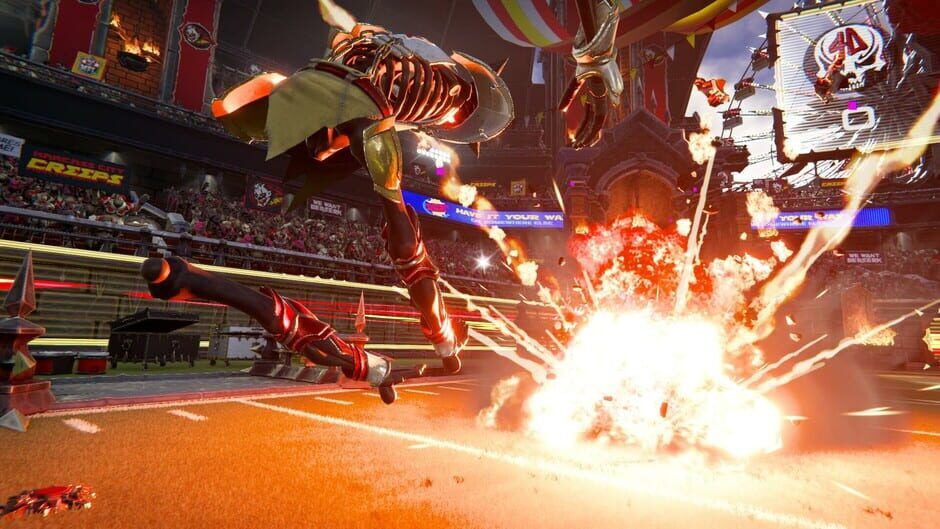
Mutant Football League 2 is not interested in simulating Sunday football. It wants to blow it up, set the field on fire, and then drop you into the flames with a playbook. The sequel takes the cult-hit original’s premise of cartoonishly violent, rules-optional football and rebuilds it into something sharper, faster, and surprisingly strategic, without losing the joy of watching a skeleton quarterback get eaten by a land shark at midfield.
8v8 arcade chaos that actually rewards smart play
The switch to 8-on-8 is the backbone of how Mutant Football League 2 plays. On paper it sounds like an excuse for more bodies colliding in smaller spaces, and yes, drives often end in smoking craters of limbs and armor. But once you get past the spectacle, the smaller team size forces you to think about every body on the field.
Formations feel tighter and more legible than the first game. Offense has fewer warm bodies to hide behind, so calling a risky deep route means you really are putting your mutant QB in harm’s way. Defensively, you feel the impact of each player you assign to blitz, spy, or sit in coverage. If you overcommit to pressure, there is no hidden safety three icons away to bail you out.
The controls are snappy and responsive, closer to a classic arcade sports game than a modern sim. Jukes, dirty tricks, and special abilities all come out cleanly on a controller, and the canned tackle animations flow well enough that you rarely feel like you were robbed by the engine. Hits carry a satisfying sense of weight, selling the idea that these monsters actually have mass and momentum, not just exaggerated models.
Where the original could feel like random chaos, Mutant Football League 2 lets you read the field. Telegraphed hazards, clearer player silhouettes, and improved camera work make it easier to plan two or three beats ahead, even while lava erupts from the 30-yard line or a buzzsaw rolls across your pulling guard.
Buildcrafting: from gimmick to genuine meta
The biggest surprise is how deep the buildcrafting has become. The first Mutant Football League flirted with RPG-lite progression, but most teams blurred together once you knew which dirty tricks were overpowered. This sequel leans into customization and finally turns your roster into a proper sandbox.
Each team and player archetype can be tuned around specific playstyle identities. You can lean into a nimble, high-risk passing attack that lives on trick plays and stat-buffed receivers, or sculpt a slow, armor-stacked meat grinder that expects to lose every drive’s first down but win the war of attrition by literally murdering the opposition’s skill players.
Traits and equipment now interact in interesting ways. A bruiser back with a late-game berserker trait pairs beautifully with gear that boosts survivability, letting you build a closer whose job is simply to still be standing when the opposing roster is in tatters. Likewise, a glass-cannon receiver with insane speed and fragile bones changes your play-calling, encouraging motion, stacked routes, and misdirection to keep them alive long enough to matter.
Importantly, this is not just a numeric arms race. The sequel’s balance pushes you toward tradeoffs instead of flat upgrades. Loading a squad with maxed-out killers might help you dominate the first half, but the fatigue and penalty systems make it much harder to maintain discipline. Go too far into finesse and you will get bullied in the trenches and lose three starters before halftime.
There is a real meta here, especially online. You will quickly learn to recognize archetypal builds: the blitz-obsessed players who sacrifice coverage for pure pressure, the slow-bleed coaches who live for environmental kills, and the surgical pass maestros who use hazards as zone coverage. The systems support these identities instead of flattening them.
A stadium editor with teeth
Mutant Football League 2’s stadium editor is where the series’ personality really stretches out. This is not a throwaway cosmetic mode. You are not just changing end-zone logos and skyboxes. You are building deathtraps with rules.
The editor lets you place hazards with meaningful mechanical consequences. You can line the sidelines with acid pits that punish stretch runs and kick returns, or pepper the middle of the field with landmines that turn conservative inside runs into terrifying gambles. Environmental modifiers like low gravity, reduced traction, and intermittent lightning storms layer extra texture on top of the basic field layout.
Crucially, these elements are integrated into matchmaking and rule sets. Playing in a user-created stadium feels like learning a new defensive scheme. You need to study the map, understand where the safe lanes are, and adapt your playbook. Some designs are a bit much, like fields that are basically obstacle courses, but the game gives you solid filters so you can stick to “competitive” layouts if you want something closer to football with teeth instead of full-on platforming.
The editor interface is accessible on controller, with good grid snapping and preview modes. You can test-drive kickoffs, run sample plays, and see how hazards interact before publishing. Once you start encountering great community creations, it becomes difficult to go back to vanilla stadiums, which speak volumes about how central this tool can become for long-term play.
How the sequel improves the original
As a sequel, Mutant Football League 2’s biggest achievement is how comprehensively it addresses the first game’s pain points.
Modes are noticeably richer. The core season and playoff structures return, but they are joined by deeper franchise-style management that takes advantage of the new buildcrafting systems. There are more meaningful front-office decisions, including how to budget resources between recruiting, healing, and upgrading your favorite psychos. A more robust tutorial and challenge structure also does a better job onboarding newcomers who might otherwise bounce off the series’ gleeful brutality.
Balance is miles ahead of the original. Overpowered dirty tricks that once decided games on their own have been toned down, and there is more counterplay across the board. Whether you care about “fairness” in a game where chainsaws are a legitimate defensive option is debatable, but the tighter tuning definitely helps the experience feel competitive instead of random.
The AI has been improved as well. Single-player opponents mix up their calls more intelligently, disguise blitzes, and actually use the stadium hazards instead of blundering into them every drive. They still occasionally have that old-school sports-game tendency to rubber-band late in matches, but it is no longer the default solution to difficulty.
Online stability is a quiet triumph. The first game’s multiplayer could be spotty, with lag spikes turning promising drives into comedic disasters. In Mutant Football League 2, matches feel much more stable. Inputs translate cleanly even in hazard-dense stadiums with heavy particle effects, and disconnects are rare enough to be notable when they happen instead of expected.
Netcode still shows its seams if you stretch it across long distances or weaker connections, but the overall improvement is significant. For a game that lives or dies on split-second jukes and last-frame sacks, this upgrade alone makes the sequel the definitive way to play.
An over-the-top alternative to sim football
Fans looking for a serious NFL simulator will not find it here, but that is precisely the point. Mutant Football League 2 thrives as an antidote to the stiff, licensed sim formula. It has no interest in real-world licensing or television-style presentation. Instead it gives you a punk-rock version of the sport where the rules are flexible, the bodies explode, and the strategy is as much about survival as it is about yardage.
What makes it work is that beneath the juvenile jokes and gore there is a real, readable game of football. The 8v8 structure keeps playscapes compact and comprehensible. The buildcrafting systems encourage experimentation and long-term thinking. The stadium editor lets the community iterate on what “football” even means in this universe. And the sequel’s improvements in balance, modes, and online reliability make it easier to commit to for a whole season instead of just a weekend curiosity.
Mutant Football League 2 will never be mistaken for a sim, but as an over-the-top alternative, it is smarter, meaner, and more enduring than its gnarly exterior suggests. If you are tired of safe, sanitized gridiron, this is the most gloriously reckless way to get your fix.
Final Verdict
A solid gaming experience that delivers on its promises and provides hours of entertainment.