
Review

By Apex
Neon déjà vu
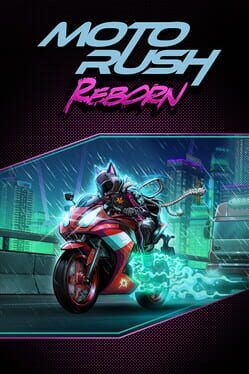
Moto Rush Reborn arrives on Switch with a slick new demonic-bike hook and a striking Neo-Tokyo veneer, but it is still very much Moto Rush GT at its core. That is both its selling point and its ceiling. If you bounced off the original’s traffic-dodging, lane-splitting arcade flow, Reborn will not convert you. If you liked Moto Rush GT and just wanted a cleaner, faster, sharper version with a bit more structure, this is the game that finally listens.
For this review I focused on the Switch version for its launch week, putting in time across handheld and docked play and directly comparing to the original Moto Rush GT. What stands out quickly is how much more confident Reborn feels in your hands, even before you notice what has changed around it.
Handling: same language, better grammar
Moto Rush GT already had punchy, tilt-sensitive handling and a clear emphasis on threading gaps in traffic rather than classic circuit racing. Reborn keeps that DNA but tightens almost every part of the control model. The bike has a firmer center point now, so small stick or tilt adjustments correct your line instead of flinging you across three lanes. There is a more readable weight transfer when you lean into sustained turns or quick weaves, and the game lets you live with micro-mistakes rather than turning every brush with a bumper into a wreck.
Braking and easing off the throttle have been re-tuned as well. In GT, feathering speed often felt binary: either you were full-send or you were surrendering your combo. Reborn’s analog input curve is noticeably smoother, so tapping the brake or pulsing the accelerator to slip between cars actually becomes part of the rhythm rather than a last resort. It finally feels like you are driving a machine with a bit of suspension and grip, not just a cursor on a three-lane highway.
The new demonic-engine framing is not just flavor text. A rage-style overdrive meter builds as you cut through traffic and shave past vehicles. Triggering it gives a short burst of acceleration and slightly stickier steering, letting you commit to squeeze through gaps you would never dare at normal speed. It is a smart risk-reward layer that enriches the existing handling instead of overwhelming it, and it goes a long way toward making Reborn feel like more than a texture swap.
Track design: from endless road to curated gauntlets
Where Moto Rush GT often felt like a randomizer slapping traffic patterns onto straight roads, Reborn finally treats its tracks like bespoke challenges. The Neo-Tokyo setting is not just neon dressing. Roads twist, branch, and occasionally funnel you through claustrophobic tunnels or elevated sections that force you to fully use the new handling nuance.
Early routes introduce concepts gently: staggered trucks teaching you to time overdrive, slow vans parked in blind spots that push you to watch far ahead instead of staring at your front fender. Later tracks start mixing verticality and lane density, like drops into underpasses where the lighting temporarily crushes your visibility or multi-level flyovers where traffic overlaps in your peripheral vision.
It is still built from modular chunks, but the seams show far less than in GT. Sequences of bends and traffic waves feel authored, with a rising and falling tension that lines up with your progression through the story. This pays off especially in mid-game “trial” tracks that strip away most visual clutter and just dare you to maintain a no-crash run for brutal distances.
If there is a disappointment, it is that environmental variety does not extend far beyond Neo-Tokyo variants. GT had a slightly broader toy-box of global backdrops, even if they were more generic. Reborn picks a theme and commits to it, and while that commitment helps build a cohesive tone, by the time credits roll you will have seen a lot of the same towering billboards and glowing tunnels. It trades breadth for depth, and your tolerance for that trade will depend on how much you value atmosphere over scenery variety.
Performance on Switch: finally tuned for speed
The most immediate improvement over Moto Rush GT on Switch is how much more stable the game feels in motion. Where GT had noticeable frame dips when traffic density spiked or particle effects stacked up, Reborn targets a steady 60 frames per second and mostly gets there. In handheld mode the game looks a bit softer than in docked, with some aliasing around distant light sources, but the tradeoff is a fluidity that keeps the core fantasy of speed intact.
Crucially for a lane-splitting racer, input latency feels lighter. Side-to-side corrections register quickly, which is essential when you are committed to threading a gap you absolutely should not survive. Even in busier late-game tracks, the frame pacing holds well enough that your crashes feel earned rather than technical.
There are still a few rough edges. Certain weather-tinged sequences, particularly those with heavy rain and dense traffic, can introduce mild stutter when explosions or screen-filling effects kick off. It is not as disruptive as the worst of Moto Rush GT’s hiccups, but when so much of the appeal is clean reaction play, any hitch stands out. Loading times are also a touch longer than they should be for a game built on short repeatable runs, especially when restarting a challenge after a crash.
Overall though, this is clearly the most stable and visually cohesive version of the Moto Rush formula the Switch has seen. The retro-futuristic lighting works in its favor, letting Baltoro lean on contrast and color rather than raw geometry or texture detail.
Progression and structure: an actual reason to keep riding
The original Moto Rush GT wrapped a strong arcade core in a structure that felt like a mobile game port: scattered objectives, light currency grind, and a sense that you were playing to fill meters rather than to master tracks. Reborn takes a clear swing at fixing that, and for the most part it lands.
At the heart of the new structure is a story campaign that follows your rider after a career-ending crash and the discovery of a demon-possessed engine. In practice, this is a string of racing and challenge events built around chapters, each capping with a set-piece run that ties back into the narrative. The writing is pulpy and occasionally melodramatic, but it gives the game just enough context to sell why you keep risking your neck on the same haunted highways.
Progression now revolves around two intertwined systems. First, you have bike upgrades that meaningfully adjust acceleration, top speed, and stability, earned through performance in events rather than purely through grinding currency. Second, you have engine attunements, which act like minor perks that tweak how the overdrive meter behaves, how forgiving close calls are, or how crashes affect your score. Together, they encourage you to replay tracks with specific builds in mind instead of simply chasing raw numbers.
Compared with Moto Rush GT, unlock pacing feels more deliberate and less stingy. You still repeat tracks, but usually to improve a rank or test a new build rather than because the next upgrade demands an arbitrary pile of credits. Reborn borrows from the best arcade racers on Switch in this regard, striking a comfortable loop where a failed run still moves some meter in a direction you care about.
There are still vestiges of the old design hanging around. A few mid-campaign difficulty spikes feel tuned as if the game expects you to grind out another upgrade tier, and some side challenges veer into frustration by demanding near-perfect runs without giving enough reward to justify the effort. These are outliers, but they are reminders that Reborn is not a ground-up rework so much as a very thorough refurbishment.
How much does it really improve on Moto Rush GT?
The honest answer is that Moto Rush Reborn is more evolution than revolution, but it is an evolution in almost all of the places that mattered most. Handling is tighter and more expressive, track design is far more deliberate, performance finally respects the speed fantasy, and progression shifts from scattershot objectives to a cohesive path.
If you lay the two games side by side, the similarities are obvious. You are still weaving through traffic at reckless speeds, chasing score chains, and repeating short courses to shave fractions of a second. The core systems are familiar enough that returning players will instantly feel at home. The crucial difference is that Reborn understands why people liked Moto Rush GT in the first place and builds structures that highlight those strengths instead of burying them under repetition and technical compromise.
Is it transformative enough to justify a double dip for everyone who owned GT on Switch? That depends on how much time you spent with the original. If Moto Rush GT was a fleeting curiosity, Reborn will feel like the version that was always supposed to exist and is worth starting over with. If you already wrung dozens of hours out of GT, the improvements are real but incremental. You will appreciate the better handling and smoother frame rate, but you may also feel you are riding through a very familiar city with nicer lights.
As a fresh purchase in 2026, though, Moto Rush Reborn stands as the better game in almost every measurable way. It finally pairs Baltoro’s strong feel for speed with infrastructure that respects your time.
Verdict
On Nintendo Switch, Moto Rush Reborn is a sharp, focused arcade racer that refines rather than reinvents Moto Rush GT. The upgraded handling and more curated tracks make minute-to-minute play substantially more satisfying, while performance and progression changes smooth out many of the original’s rough edges. It does not escape the shadow of being an enhanced do-over, and its single-city fixation may wear thin for players who crave environmental variety, but as a launch-week package it delivers a confident and compelling take on high-speed, traffic-dodging motorcycle action.
If you ever felt Moto Rush GT was one good update away from greatness, Moto Rush Reborn on Switch is that update pressed into a standalone release.
Final Verdict
A solid gaming experience that delivers on its promises and provides hours of entertainment.