
Review

By Night Owl
A Boomer Shooter Built on Velocity
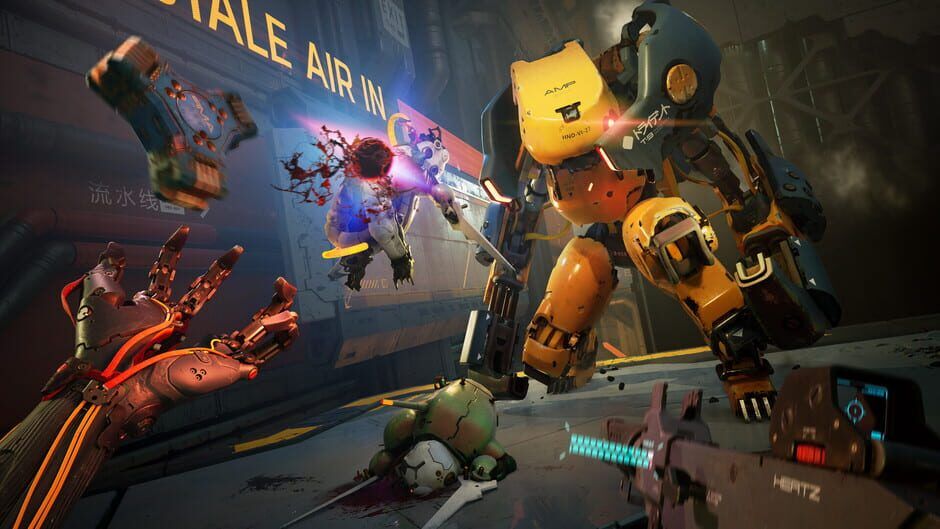
Metal Eden does not care about your feelings, your lore terminal quota, or whether you can remember more than three proper nouns. It cares about speed, crosshair placement, and the split second where you swap from a smoking shotgun to a charged railburst and delete half a room. As a pure-feel boomer shooter, it is one of 2025’s standouts, even as its narrative face-plants into the nearest neon billboard.
Reikon’s previous work hinted they understood crunchy gunplay, but Metal Eden is that understanding distilled into a vertical, cyberpunk bloodsport. Levels are short, looping arenas that stack combat puzzles on top of movement lines, and almost everything good about the game flows from that focus.
Gunfeel: Heavy Metal in Your Hands
Metal Eden’s arsenal reads like a greatest hits album for 90s shooters, remixed through a cybernetic filter. You start with the Hyper Pistol, but calling it a starter weapon sells it short. It has a snappy fire rate, minimal recoil, and a hair-trigger alt-fire that dumps the mag in a pinpoint burst. Popcorning drones across a skyline with this thing feels closer to an arena shooter like Unreal Tournament than a modern mil-sim.
The shotguns are the stars. The Shredder is a tight, mid-range monster that turns shielded bipeds into scrap if you angle for center-mass weak points. The alt-fire pumps a slug that pierces multiple targets, rewarding you for lining up corridors instead of panic-firing. Later, the Atom Sawmill trades precision for spectacle, showering pellets in a wide arc that synergizes beautifully with the game’s crowd-control tools. In big mixed packs, weaving in and out of melee range, alternating primary and alt-fire, never gets old.
Energy weapons bring a different rhythm. The Coil Lance is a charge-and-release railgun that overpenetrates targets, but the real genius is how it slots into the overall combat loop. You are constantly sprinting, sliding, wall-running, and snapping onto vertical perches; charging a Lance shot while air-dodging over a pit, then threading it through a row of Engineer snipers, simply feels incredible. The heat system forces you to break charge habits and swap to ballistic weapons when you overdo it, which keeps fights from devolving into railgun camping.
Explosive tools, from micro-missile pods to sticky plasma grenades, complete the picture. None of them feel like afterthoughts. Enemy armor types and shield colors clearly telegraph when you should lean on explosives, and the game loves to throw mixed waves that demand actual weapon cycling rather than comfort-weapon spamming.
What sells all of this is the feedback. Recoil is tuned so every shot feels punchy but never obscures your view. Hit-stop on weak-point kills is microsecond-short yet noticeable, like a tiny nod from the game that you did it right. Sound design finishes the work: alloy limbs blast apart with a clanging roar, headshots crack like a dropped anvil, and the music actually ducks just enough on big kills to let the carnage dominate.
Enemy Design: Smart Roles, Dumb Story
Metal Eden mostly fights you with robots and augmented husks, which on paper sounds dull. In practice, the roster is tightly role-driven and clearly readable in the chaos. Basic drones are pure aim practice and movement fodder. They push you to clear airspace, keep your reticle honest, and build a headshot rhythm. Heavier bipeds soak more damage and carry directional shields, forcing you to flank or crack them with explosives.
The Engineers are where the game flexes. These mid-tier elites buff nearby fodder, project hard-light barriers in clever choke points, and aggressively reposition when you pressure them. They are designed not as bullet sponges but as flow disrupters. Ignore them and the room turns into a mess of overlapping shield walls and suppressing fire. Focus them and you are constantly vaulting over cover, surfing wall-runs, and gambling health to land a clean execution.
Aerial enemies and melee rushers round out the mix, ensuring that every arena has at least two axes of threat: vertical harassment and close-quarters pressure. The best encounters blend these with environmental hazards like laser grids and shifting platforms, which could have felt gimmicky but usually serve to keep you moving.
Not everything hits. Some late-game enemy variants simply add more health and particle clutter without changing behavior. In heavy scenes it can be hard to read telegraphs behind a storm of neon projectiles. On higher difficulties this shifts a few encounters from skill-testing to cheap. The AI also has occasional pathing meltdowns, particularly with bulkier enemies that get snagged on geometry while you juggle their friends.
Still, as a boomer shooter first and a sci-fi epic second, Metal Eden gets the most important part right: enemies exist to push your weapon kit and movement system to the limit, not the other way around.
Level Flow and Movement: Doom Meets Mirror’s Edge
The selling point that got Metal Eden early buzz was its parkour-infused level design, often compared to a mashup of Doom and Mirror’s Edge. The comparison holds up. Campaign stages are built as stacked, looping killboxes where sightlines, jump pads, wall-run strips, and zip-lines all conspire to keep you at speed.
Encounters are rarely static room-clears. You are constantly encouraged to circle back, take a higher lane, or dive through a side corridor to pick up a damage buff, shield battery, or ammo cache. Arena gates lock down fights, but the spaces are multi-layered enough that they feel like playgrounds rather than cages. The best maps have two or three “ideal” movement lines that you slowly discover after dying a few times, and once you internalize them, the whole game starts to feel like a high-speed time trial.
Metal Eden’s movement tech is shockingly generous. Slides carry you far, double jumps are forgiving, and wall-runs have a wide angle window, so you rarely get that infuriating “I pressed jump, why didn’t it stick?” feeling. Air-dashes and ledge grabs give you corrective tools when you misjudge a gap, so the game leans into flow rather than punishment.
Where the level design stumbles is in pacing between big fights. Transition corridors are sometimes overlong and lightly populated, as if the game is scared you will get exhausted if forced to fight constantly. Instead of tension building, you get stretches of nothing, listening to exposition over comms about MOEBIUS protocols and Eden cores you will forget as soon as the next arena door slams shut.
The occasional on-rails sequence, where you tear through industrial skylines on a mag-train or sprint across the outer hull of the city, is a highlight. These set pieces nail the fantasy of hurtling through a cyberpunk megastructure while juggling weapon swaps mid-air. They are also too rare. For every thrilling traversal gauntlet, you get two or three straightforward facility runs that could have been cut in half without hurting the game.
Narrative: Chrome-Plated Noise
Metal Eden clearly wants to be about something. There are hints of corporate techno-utopianism gone rotten, citizen “cores” commodified as resources, and a protagonist wrestling with their own engineered body. None of it lands.
The story is mostly barked at you through comm chatter during fights or dumped into collectible logs tucked into corners you have no reason to visit. The writing leans on capitalized concepts like METAL EDEN and MOEBIUS without giving them texture. In a genre already crowded with disposable sci-fi, it needed a sharper hook than “orbital city gone bad.”
More damningly for a game this fast, the narrative occasionally throttles the action with slow walks and forced listening segments. These are mercifully short but always feel like someone hit the brakes on a sports car so you could admire the dashboard. Metal Eden is not a story game, and the moments where it pretends to be one are the weakest in the entire package.
If you show up for lore, you will be disappointed. If you show up to delete chrome cultists in 90-second bursts of pure adrenaline, you will barely notice the writing at all.
Difficulty, Modes, and Replayability
As a pure-feel shooter, Metal Eden is tuned to be mean but fair. The default difficulty already expects you to understand circle-strafing, corner peeking, and priority targeting. Cranking it up tightens enemy accuracy, ups projectile counts, and makes resource management matter. Health and armor pickups are placed thoughtfully rather than generously, encouraging aggression over hoarding.
Metal Eden’s unlock structure plays into that aggression. Completing levels quickly or stringing together stylish kills feeds a ranking system that opens up weapon mods and movement perks. These range from simple damage boosts to more interesting tweaks, like mid-air reloads or slide-activated shockwaves. While the pool is not as wild as something like a full roguelite, it is enough to make a second playthrough on a higher difficulty feel different, not just harder.
Time trial and score attack variants of key arenas are where the game’s design truly shines. Stripped of cutscenes and chatter, these modes reveal how carefully the arenas are laid out for speedrunners and high-score chasers. If the campaign is the mosh pit, these modes are the solo stage where you can push the systems to their absolute edge.
Placing Metal Eden Among 2025’s Retro FPS Crowd
2025 has been absurdly good for shooters, especially on the retro-leaning side. Between throwback gorefests and inventive arena shooters, Metal Eden walks a middle path. It is not as puzzle-box intricate as some boomer shooters that obsess over secret hunting, nor as gimmick-driven as titles that live or die on a single twist. Instead, it doubles down on three pillars: guns that feel sublime, enemies that pressure you into using every tool, and levels that reward moving fast.
Stacked against its peers, Metal Eden stands near the top on raw gunfeel. Few shooters this year deliver such consistently satisfying weapon cycling and impact. Its movement system and vertical arena design also give it a distinct identity within the retro space, avoiding the tired “brown corridors and keycards” problem many throwbacks still indulge.
Where it trails the best of 2025 is in personality outside the gunplay. The worldbuilding and characters never achieve the memorable swagger of the genre’s champions. You will remember the way a fully modded Shredder sounds more than you will remember any character’s name or the specifics of the MOEBIUS catastrophe.
For a pure-feel boomer shooter, though, that trade is mostly worth it. The gunplay does compensate for the narrative’s weakness, because Metal Eden is at its best when the story disappears behind a wall of muzzle flash and hydraulic shrieks.
Verdict
Metal Eden is a ferocious, finely tuned retro FPS that understands what makes the genre sing. Its weapons are brutally satisfying, its enemy encounters smartly constructed, and its movement system invites a level of flow-state play that few shooters reach. The story is a forgettable blur of capitalized sci-fi jargon, and level pacing occasionally sags between all-out brawls, but those flaws rarely intrude on the core experience.
If you come to shooters for narrative, Metal Eden will feel like a hollow power fantasy wrapped in cool branding. If you care about how a shotgun kicks, how an arena loops, and how it feels to clear a room without touching the ground, this is one of 2025’s must-play boomer shooters.
Final Verdict
A solid gaming experience that delivers on its promises and provides hours of entertainment.