
Review

By The Completionist
A real sequel at last
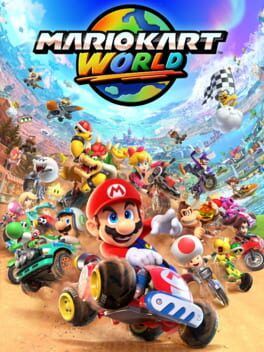
Nintendo has been content to polish and resell Mario Kart 8 for more than a decade, so Mario Kart World arrives on Switch 2 carrying a lot of weight. It has to feel like a true follow up to MK8 Deluxe rather than another pass of track packs and balance tweaks. The good news is that it largely sticks the landing. World feels familiar where it should, but its handling, course design, and online framework finally justify a new entry.
Handling: less float, more intention
If you can drive in MK8 Deluxe you can drive here, but you will notice the differences within a single cup. Kart weight and tire grip matter more, anti-grav sections no longer feel like frictionless glide paths, and mini-turbo management has more nuance. Standard karts sit heavier on the track, which cuts down on the slightly loose, toy-like float of MK8 Deluxe and makes cornering feel cleaner.
Drifting now has a wider range of viable angles. You can commit to a deep, aggressive drift and trust that the kart will bite into the apex instead of sliding unpredictably outward. Blue and purple boosts are still present, but the charge thresholds are tuned a bit higher, rewarding players who can hold a line under pressure. Motorbikes in particular benefit from this change, with less twitchy steering and a more readable lean.
The trade-off is that Mario Kart World is marginally less immediately pick-up-and-play than MK8 Deluxe. New players will staff off a few walls as they learn braking drifts and feathering the accelerator on tighter hairpins. Once it clicks, though, this is the sharpest handling model the series has had, somewhere between MK8’s accessibility and the more demanding feel of Mario Kart Wii.
Track design: more world, less theme park
The headline feature is the World Tour cups, a set of brand new circuits that stitch together neighboring biomes into what feel like miniature road trips. Instead of hard cuts between themes, one lap might start in Toad Town at sunset and, by the final stretch, you are slingshotting through a nighttime airship armada without ever hitting a loading screen.
Nintendo leans on verticality much harder than in MK8 Deluxe. Courses like Skyline Samba stack highways, rooftop gardens, and low-flying blimps on top of each other, with branching lines that reward experimentation in time trial. There is still the occasional autopilot glider section that mostly exists to look pretty, but there are fewer stretches where you feel like you are watching more than driving.
The new anti-grav philosophy is smart. Rather than flipping you sideways just to show off, anti-grav strips are used to create alternate layers. One route might cling to a waterfall while another corkscrews through a cavern behind it, and the two recombine in chaotic intersections that feel like a controlled mess rather than random pileups.
Retro tracks return, but they avoid the lazy, near-1:1 ports that padded out some of MK8’s DLC. Classic tracks are rebuilt with World’s new routing and item economy in mind, often adding new shortcuts or anti-grav lanes that change how veterans approach them. Moo Moo Meadows is a standout, expanded into a countryside tour that swings through a village market and underground dairy tunnels before re-emerging on the familiar farm straightaway.
Items and balance
Mario Kart World does not reinvent the item wheel, yet it does refine it. The dreaded lightning and blue shell still exist, but their frequency in standard 12-player races is toned down. In their place are more tactical tools such as the Warp Whistle, which snaps you to an alternate route ahead of the pack if you time it near a route split, and the Bubble Flower, a temporary shield that doubles as a one-hit bumper.
Importantly, item trails have slightly shorter active windows, so you cannot brainlessly drag a shell for half a lap. This change encourages more active defense and offense rather than passive turtling. Front-runners still live and die by their awareness of red shells and hazards, but a well driven race feels less likely to be decided by a single chaos chain near the finish.
Online stability and structure
On Switch 2, Mario Kart World finally feels like a modern online game instead of something from the early 2010s. Matchmaking lobbies fill quickly and, during testing, races were stable with only rare, minor hitches even on cross-region play. Disconnections are far less common than in MK8 Deluxe, and when they do happen, the game recovers gracefully, sliding in bots to keep the race moving.
The real win is in how the online suite is structured. You can build persistent racing clubs with custom rulesets and seasonal ladders, then jump into their lobbies from the main menu with a single tap. Spectating works smoothly, and the post-race replay sharing is surprisingly robust, letting you upload clips directly for others to view in-game rather than relying on external capture.
There is still no in-race voice chat unless you use Nintendo’s mobile app, which will disappoint anyone hoping Switch 2 would finally solve that relic of a problem. At least the ping system is reworked with more useful, context-aware callouts, and pre-race communication feels less like spamming canned voice lines.
Battle mode: closer to its SNES roots
MK8 Deluxe’s Battle mode was a big improvement over the Wii U version, but it still felt weirdly compartmentalized. Mario Kart World pulls Battle mode a bit closer to classic arena chaos. Maps are tighter and more interconnected, with multi-level sightlines that reward map knowledge and quick route changes.
Balloon Battle returns, joined by Knockout Clash, a mode where every hit removes a racer until only one is left standing. It is frantic, often over in a flash, and much more watchable as an online spectator event. Shine Thief and Bob-omb Blast come back as rotating playlists, with better item distribution that keeps the focus on reading opponents instead of hoarding the right powerup.
The biggest shift is progression. Battle mode now feeds into the same cosmetic unlock track as standard racing. Your time in arenas counts toward kart parts, character variants, and banner customizations, which makes it feel less like a side dish and more like a full pillar in the experience.
Does it justify being more than "Deluxe 2"?
The central question is whether Mario Kart World needed to exist as a numbered-feeling sequel instead of an enormous DLC pack for MK8 Deluxe. Mechanically and structurally, the answer is yes. The stiffer, more deliberate handling model, the world-touring courses, and the overhauled online infrastructure are foundational changes rather than bolt-on features.
That said, World is not a wholesale reinvention. Battle mode, while better, is still built on familiar templates. The roster is generous, but only a handful of brand new characters join a sea of returning favorites and variant costumes. The new modes, such as the elimination-focused World Tour Knockout, are fun but not as radical as they initially sound.
Whether the jump feels worth it will depend on how deep you are into MK8 Deluxe. If you are a casual fan who bought the Booster Course Pass and still plays occasionally, Mario Kart World is a confident refinement that will feel fresh but not alien. If you live in time trials and high-level online rooms, the tightened physics, revised items, and competitive tools make it very hard to go back.
As a flagship Switch 2 launch title, Mario Kart World does exactly what it needs to. It shows off the new hardware with denser environments and rock-solid performance, fixes decade-old online frustrations, and nudges the series forward in ways that matter once you are past the first few cups. It may not be the boldest reinvention imaginable, but it is the most complete, future-facing Mario Kart yet.
Verdict
Mario Kart World is not content to be "MK8 Deluxe: More Tracks." It braces up the handling, emboldens the track design, and finally drags the series’ online suite into the modern era. Some conservative choices hold it back from outright revolution, but as a foundation for the next decade of kart racing, it absolutely earns its spot on the grid.
Final Verdict
A solid gaming experience that delivers on its promises and provides hours of entertainment.