
Review

By MVP
Overview
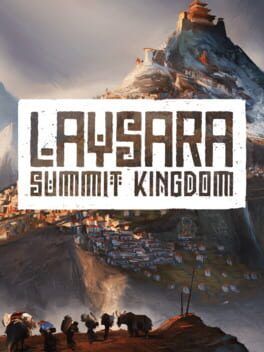
Laysara: Summit Kingdom is what happens when someone looks at the flat grids of traditional city builders and asks, "What if all of this clung to a cliff?" Now out of Early Access, the 1.0 release fully commits to that idea. You are not laying out neat suburbs on fertile plains. You are stapling fragile settlements onto sheer rock faces, threading supply chains along switchback paths, and praying an avalanche does not erase your grain district.
For PC strategy fans, this is a smart, focused, systems-first builder. It is less about sandbox sprawl and more about spatial puzzles and risk management. The core mountain-building loop is excellent, the production chains are tight, and the campaign finally provides enough structure to teach the game without smothering it. The tradeoff is a difficulty curve that can feel spiky and a late game that, while better than in Early Access, still leans a little too hard on repetition rather than new ideas.
Mountain-building mechanics: vertical city planning that actually matters
The selling point is verticality, and Laysara delivers. Terrain is not just a visual flourish; it is the main mechanic. Every mountain is a layered puzzle of ridges, plateaus, cliffs, and chutes where snow and rock will eventually come roaring down. You are constantly making meaningful choices about height, distance, and slope.
Basic buildings and roads consume limited flat tiles, so most of your mental energy goes into carving terraces, nudging roads along safer contours, and deciding where to accept inefficiency to stay out of danger. The pathfinding model forces you to care about how far haulers must walk, and it is immediately obvious when you misjudge. Production stalls, storage fills, and suddenly a minor bottleneck at a bridge starves the entire upper district.
What makes it sing is how every system is braided into the terrain. Crops prefer lower, milder slopes, while higher altitudes host ore and stone. Population housing wants relatively safe locations, but it also needs proximity to services and markets. Avalanche paths slice through the mountain like the city builder version of a minefield, making "optimal" placement feel like solving a sliding-block puzzle. The best layouts feel earned.
Compared to more traditional builders, it plays closer to a series of interlocking spatial problems than a free-form creative toy. This might disappoint players who love huge, decorative cities, but as a pure strategy experience it is compelling and refreshingly different.
Disasters and risk: avalanches as a real design constraint
Avalanches are not just occasional random events. They are predictable, telegraphed threats that shape how you build. As snow accumulates in certain chutes and bowls, you can see danger zones on an overlay, watch the risk meter tick up, and choose how you want to handle it.
You can simply avoid building in those tiles, but space is tight enough that abstinence is rarely a full solution. Instead, you invest in avalanche barriers, retaining structures, and sometimes sacrificial districts. The strongest moments in Laysara come from accepting some risk for efficiency. You push a warehouse closer to the danger line to tighten a supply loop, then reinforce everything and hope your calculations were right.
The key is that failures are readable. When a disaster wipes out a mid-level district, you usually know exactly which corner you cut: the unupgraded barrier, the cluster of high-value buildings in a single kill-zone, the steep shortcut road that funneled snow directly into your markets. Losing a run feels like a lesson learned, not arbitrary punishment.
Difficulty curve: sharp edges on the climb
The full release improves the onboarding over Early Access, but this is still a game that expects you to pay attention. The campaign serves as an extended tutorial, easing you into basic resources, service buildings, and avalanche management before handing you more complex maps and multi-peak regions.
The early missions are well paced. You get clear objectives, modest maps, and just enough pressure to force good habits. The problems start once the game opens up. Difficulty does not climb in a gentle slope; it jumps in steps. One scenario might be fairly relaxed, then the next throws you a jagged peak with scarce farmland, harsh weather, and brutal avalanche lanes all at once.
For seasoned strategy players, that spike is welcome. The satisfaction of finally stabilizing a treacherous mountain, where a single misrouted path can wreck a supply chain, is fantastic. For more casual city builder fans, it can feel like hitting a wall, especially because some failure states appear late. You might think you are stable only to realize, one year later, that your population growth subtly outpaced your food infrastructure and the entire run starts to unravel.
The game is at its best when it shows you short-term feedback for long-term systems. When it does not, frustration creeps in. A bit more transparency in forecasting demand, or clearer early warnings on some cascading shortages, would soften the roughest spikes without dulling the challenge.
On the plus side, difficulty options and sandbox settings let you tame some of this. You can ease disasters, loosen constraints, and focus more on chill construction than sweaty crisis management. Taken together, Laysara is flexible enough to be punishing or relaxing, though its design heart leans toward the former.
Production chains and three-caste society
Beneath the mountain gimmick lives a classic resource management core. You gather raw materials, refine them into processed goods, and satisfy the layered demands of a three-caste society. Lower castes need basic food and shelter, middle tiers want better goods and services, and the elite expect luxuries and advanced infrastructure.
What stands out in 1.0 is how tightly the developers have tuned these chains. There is little fluff. Almost every building exists to solve an understandable problem, and production loops rarely balloon into unmanageable complexity. That gives you room to focus on placement, adjacency, and logistics rather than memorizing dozens of obscure recipes.
The caste system adds a nice dynamic tension. Elevating too many citizens too quickly can collapse your economy, because the higher tiers consume more refined goods that require more space and careful logistics to support. Staying overly conservative leaves you short of population and income. It is a constant balancing act, and on a map where every tile counts, deciding where to house which caste is a surprisingly crunchy decision.
Late-game variety and multi-peak regions
In Early Access, Laysara’s biggest problem was how runs started to blur together after you solved the first few mountains. Version 1.0 does not fix this entirely, but it is meaningfully better.
The introduction of multi-peak regions is the headline change. Rather than a single mountain, you may be juggling two or three adjacent peaks in one scenario, each specializing in different roles. One might be your agricultural foothill, another an industrial spine, and a third a precarious housing terrace. Linking them with transport routes and trade systems creates a natural escalation in complexity without simply throwing more disasters at you.
This does a lot for variety. Your late-game decisions are no longer just "expand the same pattern higher" but "shift production to the safer peak," "rebuild a devastated district on a backup mountain," or "accept long-distance trade inefficiency to keep crucial goods out of avalanche zones." The feeling of running a regional network rather than a single mountain town gives long sessions more shape.
That said, the sense of novelty still tapers off faster than the genre’s best. Buildings and resources plateau in terms of new mechanics several hours in, and from that point on you are mainly iterating on known solutions with higher stakes. For players who love optimization, that is plenty to chew on, but do not expect Against the Storm levels of constant scenario twists or Frostpunk-style late-game narrative gut punches.
Presentation and performance on PC
On PC, Laysara runs well on modest hardware. The stylized visuals are clean and readable, with distinct silhouettes that make complex settlements easy to parse at a glance. The real stars are the mountain models and animation: watching avalanches break loose and flow through the routes you misjudged is as instructive as it is terrifying.
The interface is mostly solid, with good overlays for elevation, risk, and resource flow. There are still occasional moments where the UI feels a bit busy, especially once multiple peaks and trade routes are in play, but the 1.0 version is smoother and more informative than earlier builds. Controls with mouse and keyboard feel natural, and pausing and time controls are responsive enough to let you turn tricky sequences into satisfying mini-puzzles.
The audio design supports the tone nicely. A calm soundtrack underlines the meditative aspects of planning, while disaster cues and tension-building tracks keep major avalanches from feeling routine. It is not a soundtrack that demands your attention, but it fits the loop well.
Verdict
Laysara: Summit Kingdom 1.0 is one of the most interesting twists on the city builder in years. By making terrain and verticality the core of the game rather than a backdrop, it forces you to think about space in a way most builders simply ignore. For PC strategy fans who enjoy slow-burn optimization and hard trade-offs, it is easy to recommend.
The caveats matter. The difficulty curve can be uneven, and the late game, while improved, still leans on repeating similar patterns across harsher maps instead of unveiling genuinely new systems. If you want deep narrative arcs, expansive decorative freedom, or endlessly novel scenarios, you may find the peak a little lower than you hoped.
But judged as a pure mechanical sandbox about taming lethal mountains with clever logistics, Laysara reaches a very respectable summit. It is focused, readable, tense, and rewarding, and it carves out a distinct niche in a crowded genre.
For strategy-minded PC players looking for a challenging builder where every tile really counts, this is absolutely worth the climb.
Final Verdict
A solid gaming experience that delivers on its promises and provides hours of entertainment.