
Review

By Big Brain
Overview
Juufuutei Raden's Guide for Pixel Museum is one of those delightfully specific pitches that only Jupiter could pull off. It is a Picross-style nonogram collection fronted by Hololive DEV_IS talent Juufuutei Raden, framed as a stroll through a pixel art museum where every solved puzzle reveals another piece of art history trivia or an in-universe exhibit.
Across Switch, PC, and the new PS4 port, the core experience is identical. You solve grids, you unlock adorable pixel illustrations, and Raden chatters away as a mellow curator. The question is whether this particular package stands out when Jupiter already floods every platform with excellent puzzle collections, and whether there is anything here for players who do not know a single thing about VTubers.
Picross That Knows Its Audience
Mechanically, this is Jupiter through and through. The nonograms snap into place with clean, readable grids, snappy feedback, and the quality-of-life options that the studio has quietly perfected over decades of Picross releases. On all three platforms, inputs feel tight, hint rules are clearly explained, and the difficulty curve ramps up in small, satisfying increments.
If you have played any recent Picross S entry, you will be instantly at home. The rule set is orthodox: no strange gimmick modes, no half-baked twists. Normal and Mega-sized puzzles dominate the museum wings, with occasional larger panels that stitch together into museum pieces. The pacing is well judged, throwing you quick 10x10s for a commute session and 20x15 or larger layouts for more serious play.
What makes it distinct is context. Every puzzle you clear fills in a small painting, sculpture, or decorative object tied to a particular wing of the Pixel Museum. Raden steps in with a short explanation that might be an actual art-history note, a tongue-in-cheek Hololive reference, or a mix of both. It is not a deep scholarly dive, but it consistently gives you something to latch onto beyond “this is a cat in pixel art.”
Art-History Theming That Mostly Works
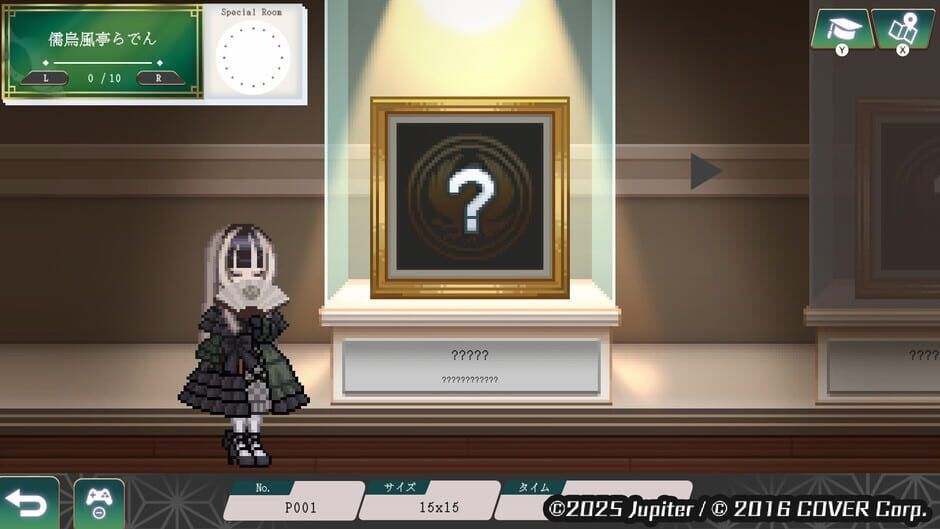
The museum framing is more than a menu reskin. Wings are structured like exhibits, with thematic throughlines that loosely mirror real-world museum categorizations such as classical works, decorative arts, or modern pieces. Each solved nonogram reveals a small description plaque, complete with the playful, slightly tipsy persona Raden is known for.
The art-history angle is closer to a friendly docent tour than a textbook. You will not walk away ready to pass an exam on Renaissance painting, but the game consistently does two smart things. First, it uses recognizable silhouettes and motifs so you can usually guess what a piece is before the last rows are filled in, which is surprisingly motivating. Second, it uses simplicity to invite curiosity. A quick line about a style or an era often nudges you to look things up yourself later.
If you are a regular in Jupiter’s output, this already feels fresher than yet another generic “Animals & Food” puzzle pack. The museum conceit gives coherence to the grind of clearing hundreds of boards, and Raden’s commentary, short as it is, keeps the exhibits from feeling sterile.
Hololive Fan Service: Flavor, Not Crutch
Given the branding, there is always the worry that this would be barebones puzzles wrapped around a wall of in-jokes. Thankfully, Jupiter shows restraint. Raden is present throughout as a pixel art curator, posing in the UI, sharing quips between wings, and occasionally slipping in fan-pleasing lines. There are nods to Hololive, sure, but they are seasoning, not the entire dish.
If you know Raden, her characterization feels on point. The writing leans on her cultured but mischievous persona, playing up her enthusiasm for both fine art and the slightly disreputable edges of museum lore. If you have no idea who she is, she simply registers as a charming, slightly eccentric guide. Her presence never blocks progress; you can breeze past dialogue if you only want numbers and grids.
Crucially, the actual puzzle designs are not overloaded with fan art or streamer references. The vast majority of completed images read as straightforward museum pieces, with the occasional cheeky wink. This keeps the game approachable to anyone looking for a clean Picross package while still giving Hololive fans plenty of screenshots to share.
Platform Comparison: Switch, PC, And PS4
On all three platforms the content is the same: the same museum wings, the same puzzle count, the same unlock cadence. Differences come down to how comfortable it is to actually solve nonograms on each system.
On Switch, handheld mode remains the sweet spot. The grid size plays nicely with the screen, especially if you enable cursor snapping and automatic line fills. The ability to put it to sleep mid-puzzle makes it ideal for short sessions. Touch controls are supported and workable, but the game is clearly tuned around button and stick input, which remain the most precise way to play the larger boards.
The PC version benefits from mouse controls, which are as close to perfect as nonograms get. Dragging clean lines, right-clicking to place X marks, and using keyboard shortcuts for fast toggles makes extended sessions painless. Visually, crisp scaling on monitors means even the dense late-game grids remain readable, something small handheld screens can struggle with if your eyesight is not perfect.
The PS4 port sits somewhere between the two. It matches the Switch docked in clarity on a TV and uses the same controller-focused interface, but the hardware’s higher resolution output gives the pixel art a little more breathing room. There is minor text scaling on big screens so plaques stay readable from the couch. Load times are comparable to Switch, and there are no obvious cutbacks or missing options.
If you have a choice, PC is the platform of record for sheer input comfort, with Switch a close second for convenience. PS4 is absolutely fine and a welcome option if you prefer to keep your puzzle time on a big screen without fussing with a PC.
Presentation And Museum Vibes
Jupiter’s artists know how to make tiny grids feel expressive, and this project gives them strong material. The museum’s rooms are rendered in warm, slightly muted palettes, the exhibits pop with clean silhouettes, and Raden’s pixel sprite work sells her theatrical personality with a few well-chosen frames.
The UI inherits Jupiter’s usual clarity. Timer, mistake counter, and assist indicators are neatly tucked along the edges without crowding the board. Options are deep enough to let you tweak assist levels, input behavior, and animations so both newcomers and Picross veterans can settle into their preferred rhythm.
The soundtrack leans into mellow gallery ambience. Soft piano lines and light, almost jazzy background tracks support long puzzle sessions without cloying repetition. Occasional stings when you complete a piece or finish a wing are understated but satisfying. This is one of those games you can happily play while half-listening to a podcast, but it holds up even if you keep the volume up.
Standing Out In Jupiter’s Catalog
Jupiter’s biggest problem these days is not quality but identity. Between the endless Picross S sequels and branded spin-offs, it can be hard to remember which collection offered what. In that context, Juufuutei Raden's Guide for Pixel Museum carves out a clearer niche than you might expect.
It is not as mechanically experimental as something like Picross S Genesis & Master System Edition, and it lacks the sheer bulk of puzzles you get from the numbered Switch entries. What it has is a strong framing device that stays committed from title screen to credits and a mascot character who adds to the experience instead of overwhelming it.
For Hololive fans, the value proposition is easy. You get a full-featured nonogram set dressed in lovingly crafted Raden theming, effectively a playable art book where your oshi guides you room by room. For non-fans, the strength of Jupiter’s underlying design still carries the game. The museum hook is approachable, the commentary is never insider-only, and the art-history nods make this feel more curated than disposable.
If you own several Picross S titles already, this will not revolutionize your relationship with nonograms, but it is one of the more distinctive side projects Jupiter has released in years.
Verdict
Across Switch, PC, and PS4, Juufuutei Raden's Guide for Pixel Museum delivers exactly what it promises: a polished set of Picross puzzles wrapped in a cozy museum tour hosted by a Hololive curator. The puzzle quality is as high as ever, the art-history skin gives the grind real texture, and the VTuber branding adds flavor without locking anyone out.
If you cannot stand VTubers on principle, the sheer prominence of Raden in the framing might still put you off, but that has more to do with taste than with the execution. Strictly as a puzzle game, this is an easy recommendation, particularly on PC and Switch, and it stands comfortably alongside Jupiter’s better licensed offerings.
It may not be their most ambitious project, but it is one of their most charming.
Final Verdict
A solid gaming experience that delivers on its promises and provides hours of entertainment.