
Review

By Parry Queen
John Carpenter’s Toxic Commando review
Saber Interactive knows how to build a crowd. That much is obvious within minutes of John Carpenter’s Toxic Commando, a co-op zombie shooter that throws writhing swarms, exploding sludge creatures, and bad-taste one-liners at the screen with admirable confidence. At its best, it feels like a slightly greasier cousin to World War Z, built around ramshackle road trips through monster-infested mud, frantic objective defense, and the simple joy of unloading far too much ammunition into far too many bodies.
The trouble is that the launch build burns through its best ideas early. What starts as a knowingly stupid, high-energy co-op romp gradually reveals a thin mission structure, uneven difficulty tuning, and solo support that feels more like an obligation than a real way to play. There is fun here, especially with a coordinated squad and a willingness to laugh at the game’s shameless B-movie nonsense. There is just not enough freshness to make that fun last as long as the game needs it to.
Mission variety is the biggest letdown
The core loop is easy to grasp. Drop into a large map, drive or fight your way between objectives, hold ground while hordes pile in, complete some light interaction or escort work, then survive a heavier final stand. Early on, the addition of vehicles helps this structure feel more dynamic than the usual run-and-gun corridor crawl. The maps have enough open space, rough terrain, and ambush potential to create a sense of movement and escalation.
But after the first few missions, it becomes obvious how often Toxic Commando is remixing the same handful of ideas. Defend this point. Fuel that machine. Survive another wave. Drive to another marker. Restart the gizmo while specials crowd the area. Saber does its best to disguise the repetition with louder effects, more enemies, and occasional set-piece chaos, but the actual objectives rarely evolve in interesting ways. There are moments when a level hints at more, particularly when vehicle routing and environmental hazards briefly matter, though those sparks never become the rule.
That sameness hurts the game more than it would in a tighter, leaner arcade shooter because Toxic Commando clearly wants to be replayed for builds, classes, and co-op runs. Repetition is not fatal in this genre, but repetition without enough tactical variation absolutely is.
Class synergy is where the game earns its keep
If the missions are too familiar, the classes do a lot of work to keep each run from going fully stale. Saber smartly leans into role definition without turning each commando into a one-note specialist. The result is a squad system that rewards coordination but still lets everyone participate in the carnage.
The most satisfying sessions are the ones where the team composition actually matters. Support-oriented abilities can stabilize a defense line just long enough for heavier damage classes to erase a surge. Crowd-control tools create pockets of safety when the battlefield turns into a sludge-choked panic room. Utility skills, deployables, and class-specific perks give teammates reasons to stack effects rather than simply race for the highest kill count. It is not the deepest class system in the genre, but it is readable, useful, and regularly effective.
That readability matters because Toxic Commando is strongest when four players understand their jobs without needing a spreadsheet. A good squad can recover from near-disaster with a combination of area denial, healing, explosive bursts, and smart positioning. In those moments, the game finds an identity beyond its movie-poster branding. It becomes less about Carpenter flavor and more about the rhythm of a team barely holding the line together.
Vehicle combat is the hook, and mostly a good one
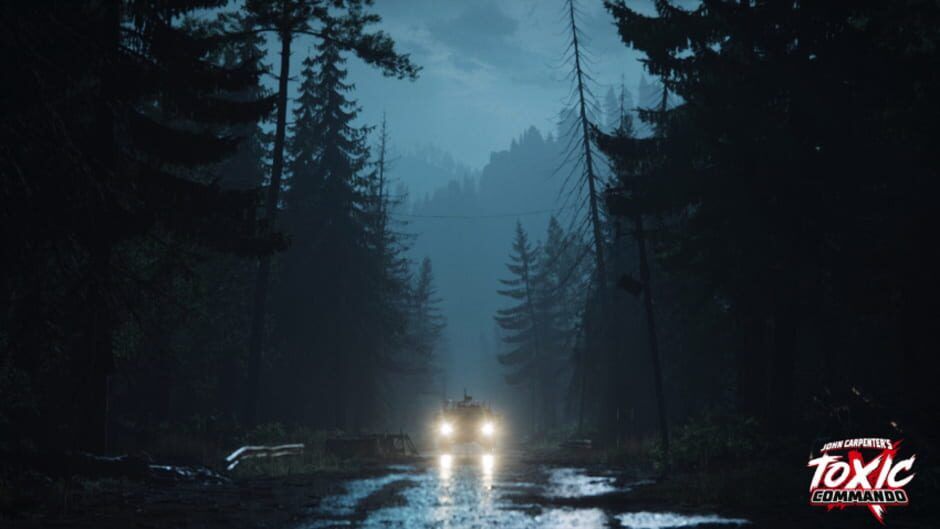
Vehicles are the clearest differentiator. They are not just lobby dressing or a one-off gimmick. They sit at the center of traversal, pacing, and some of the game’s best stories. Plowing through a horde in a battered truck, leaning out to fire into the crowd, or dragging the team through filthy terrain while everything goes wrong gives Toxic Commando an enjoyable road-warrior streak.
The best vehicle sections have a wonderful scrappy energy. Cars and trucks feel like improvised survival tools rather than untouchable power fantasies. They can heal, lure enemies, mow them down, or simply get everybody out of a collapsing situation. Terrain also matters more than expected, with mud and rough paths creating just enough friction to keep driving from becoming trivial. When the whole squad is scrambling to protect a vehicle, clear the road, and avoid being overrun, the game hits the kind of pulpy chaos it has been promising all along.
The downside is that vehicle combat is not consistently developed enough to carry the whole package. Some missions use it brilliantly and some merely use it as downtime between familiar defense arenas. You keep waiting for the game to build more elaborate convoy scenarios, more dramatic chases, or more complex route decisions than it actually delivers. The mechanic is strong. The campaign around it is merely adequate.
Matchmaking is functional, not frictionless
For a co-op shooter, matchmaking needs to disappear into the background. In the launch build, Toxic Commando gets part of the way there. Cross-play support is valuable and absolutely broadens the pool, which helps a lot for a game like this. Getting into sessions is generally possible without a full friend group, and when you do land with competent randoms, the game is immediately better.
Still, the overall flow feels a step behind the genre leaders. Match quality can be uneven, party continuity is not always as smooth as it should be, and the game does not consistently make regrouping after a good run feel effortless. That may improve as the population settles and post-launch patches arrive, but judged as a launch product, the online experience is more dependable than elegant.
This matters because Toxic Commando needs multiplayer to flatter it. A merely decent matchmaking stack is enough to expose how heavily the game leans on the presence of other humans.
Solo play is rough
This is not a great solo shooter. It is a co-op game that technically allows solo access, and the difference is obvious. Without reliable human synergy, mission repetition stands out more, objective pressure feels clumsier, and the combat loses a lot of its improvisational spark. Encounters that are amusingly hectic in a group can become flat or irritating alone.
That would be easier to forgive if the game compensated with especially sharp gunfeel, stronger AI support, or more adaptive encounter design for lone players. It does not. The shooting is solid enough, but not so crisp that it can carry long stretches by itself. Special enemies and swarm pressure are designed to create interdependence, which is great in co-op and much less appealing when you are the only meaningful brain in the match.
If you are buying this with the intention of mostly playing solo, lower expectations immediately. There are better single-player-friendly horde shooters, and there are better pure co-op games. Toxic Commando lands awkwardly between them unless you have people to bring along.
Difficulty scaling can swing from limp to cheap
The balancing in the launch build is serviceable but inconsistent. With a competent team on standard settings, large chunks of the campaign can feel almost too manageable until a mission spikes in intensity and tries to claw back tension through sheer volume. With weaker teammates or smaller groups, that same content can lurch in the opposite direction and become more exhausting than exciting.
Part of this comes down to how dependent the game is on class coverage and player communication. When the squad has that, the systems click and the challenge feels fair. When it does not, difficulty can feel less like a measured curve and more like an ugly pileup. The best horde shooters make escalation feel inevitable. Toxic Commando sometimes makes it feel arbitrary.
There is still pleasure in the chaos. Saber remains extremely good at staging massed enemy pressure, and the sheer density of bodies can be impressive. But impressive scale is not the same as elegant tuning, and the latter is where the game falls short.
Performance is mostly solid, with some caveats
On current-gen hardware and modern PCs, Toxic Commando generally performs well enough to support its biggest selling point, namely giant swarms and noisy, cluttered combat spaces. Saber’s engine experience shows in the way the game handles crowd counts and large effects without constantly collapsing under them. On a good rig, there is plenty of headroom, and on consoles the overall experience is stable enough to remain playable even during ugly late-mission pileups.
That said, this is not an immaculate technical showcase. The visual presentation is competent rather than stunning, and the occasional hitch, animation oddity, or rough edge keeps showing through the grime. Console players on PS5 and Xbox Series X|S should get a respectable version of the game, but not one that feels especially polished compared with the best current-gen action shooters. PC users will likely have the best path to smoother performance and cleaner image quality, assuming they have the hardware to brute-force the heavier scenes.
In short, performance is good enough for the genre, but it is not a reason to buy the game by itself.
The B-movie tone is fun, until it has to do real work
The biggest question hanging over John Carpenter’s Toxic Commando was always whether the name meant anything beyond marketing. The answer is mixed. The game absolutely understands the surface pleasures of cheap horror, dirty action, and knowingly dumb dialogue. It loves excess. It loves sludge, neon, bad attitudes, and absurd violence. In flashes, that is enough.
But the tone is broader than it is sharp. The quips land inconsistently, the writing rarely gives the characters much beyond archetypes, and the aesthetic does not dig deep enough to make the world feel truly distinct. The B-movie vibe is a garnish that occasionally becomes a feature, not a full creative spine running through the campaign. It can sell a trailer and brighten a mission intro, but it does not elevate the whole experience the way a stronger identity might have.
That is probably the game’s most frustrating quality. It is never boring in the total sense. It is too loud, too busy, and too eager to entertain for that. But it often feels like it is one layer short of becoming memorable.
Verdict
John Carpenter’s Toxic Commando is a decent co-op zombie shooter with two genuine strengths: class teamwork that encourages useful squad roles, and vehicle combat that gives the action a grimy road-trip personality. When those systems align, the game is a blast. You get spectacular horde moments, frantic recoveries, and exactly the sort of trashy co-op storytelling that keeps a friend group laughing.
The problem is everything around those highs. Mission variety is thin, solo play is poor, matchmaking is merely functional, and the difficulty curve does not always know how to challenge players without leaning on brute-force chaos. The B-movie tone helps, but it is not strong enough to disguise how routine the campaign becomes.
For a dedicated group of friends looking for a new horde shooter, this is worth a look, especially if the vehicle angle grabs you. For solo players or anyone hoping the John Carpenter label would push the game into something special, this launch build comes up short. It is a fun mess, but still a mess.
Score: 6/10
Final Verdict
A solid gaming experience that delivers on its promises and provides hours of entertainment.