
Review

By Headshot
If your family couch already has grooves worn in from Snipperclips and It Takes Two, Jelly & Toast slides in as a charming, low-stakes follow-up. Nibb Games’ food-themed puzzle-platformer finally lands on Nintendo Switch with Ratalaika handling publishing, and it feels like it was always meant to be a handheld co-op staple.
You play as the titular duo, tiny food heroes sprinting through kitchens to reclaim stolen magical ingredients. The hook is simple but effective: each of the 50 levels is a compact puzzle-platforming scenario built around running, jumping, and throwing. You can toss boxes, hit switches with projectiles, or even yeet your partner across gaps, then follow up with some precise platforming to regroup.
Co-op is absolutely the main course here. In handheld with split Joy-Con, Jelly & Toast works beautifully as a parent-and-kid game. Early stages keep things generous: platforms are wide, hazards forgiving, and most solutions boil down to “stand here, throw that.” The game smartly frontloads clarity, teaching you that Jelly’s arc and Toast’s positioning matter more than twitch reflexes. Kids can mash jump and experiment while adults nudge them toward the correct sequence without much frustration.
By the time you’re into the mid- and late-game kitchens, though, the puzzles tighten up. Timed switches, bouncing off pots, and chaining throws together demand much better coordination. These later levels finally lean on the physics just enough to feel satisfying instead of slapstick. Adults or older kids who enjoy deconstructing puzzle spaces will appreciate how often stages give you multiple viable approaches, especially in two-player co-op. Solving a tricky setup by improvising a “throw me into that fire jet, I’ll bounce into the button” plan is genuinely fun.
Solo play is better than you might expect, but clearly the side dish. Controlling both characters by swapping between them mid-level works fine and the level design supports it, with most objectives built around sequential actions instead of strict simultaneity. Still, you lose the spontaneous chaos and communication that make the co-op shine, and some of the later puzzles feel slightly fiddly when you’re juggling both characters alone.
The 50-stage campaign is paced well overall. The first third is breezy tutorial territory that younger kids can clear with minimal help, making it a comfortable on-ramp. The middle stretch is the sweet spot, where the challenge ramps just enough to get everyone talking and planning. Only the final batch of levels occasionally overreaches, asking for tight timing on moving platforms and hazard dodging that might frustrate the youngest players. If you’re gaming with very small kids, expect to “carry” a bit in those closing stages.
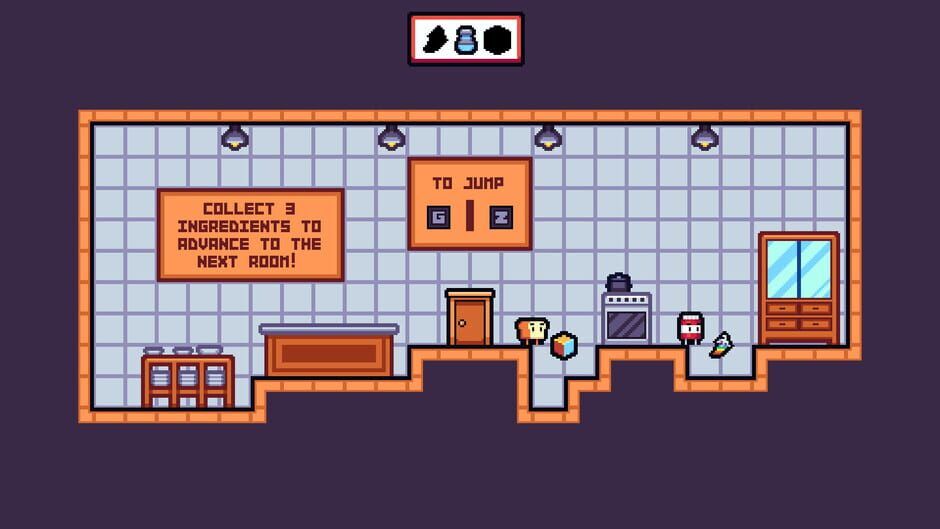
What keeps the experience palatable throughout is the presentation. The pixel-art kitchens are colorful and clean, with just enough personality to sell the food-world theme without visual clutter. Flaming stoves, swinging knives, splashing pots and grumpy enemy chefs all read clearly at a glance, which matters a lot when two players are scrambling to stay alive. Jelly and Toast themselves animate with a bouncy, squishy energy that makes failure feel funny rather than punishing.
Performance on Switch is solid. In both docked and handheld play, the game holds steady with no noticeable frame drops or input lag. Controls feel responsive enough that when you miss a jump, it’s usually on you, not the hardware. Load times are short, making repeated attempts on tougher puzzles painless.
As an early-2026 eShop pickup, pricing is crucial, and Jelly & Toast lands in that budget-friendly bracket where expectations are modest but good ideas shine. You’re getting 50 curated stages, a strong local co-op focus, and a clear, kid-friendly aesthetic at a price closer to impulse buy than major release. There is no deep meta-progression or huge unlock tree, but the core set of levels delivers a complete and cohesive little adventure.
Jelly & Toast is not the next genre-defining co-op puzzle-platformer, but it doesn’t need to be. It’s a compact, well-constructed, family-ready platformer with a cute food hook, smart level design across a generous 50 stages, and a difficulty curve that starts at “Saturday morning cartoon” and ends at “lightly spicy.” If you want something on Switch that two people can pick up, grasp instantly, and still find engaging a few hours later, this is a very easy recommendation at its budget price.
Final Verdict
A solid gaming experience that delivers on its promises and provides hours of entertainment.