
Review

By The Completionist
A logic puzzle built around tiny anxieties
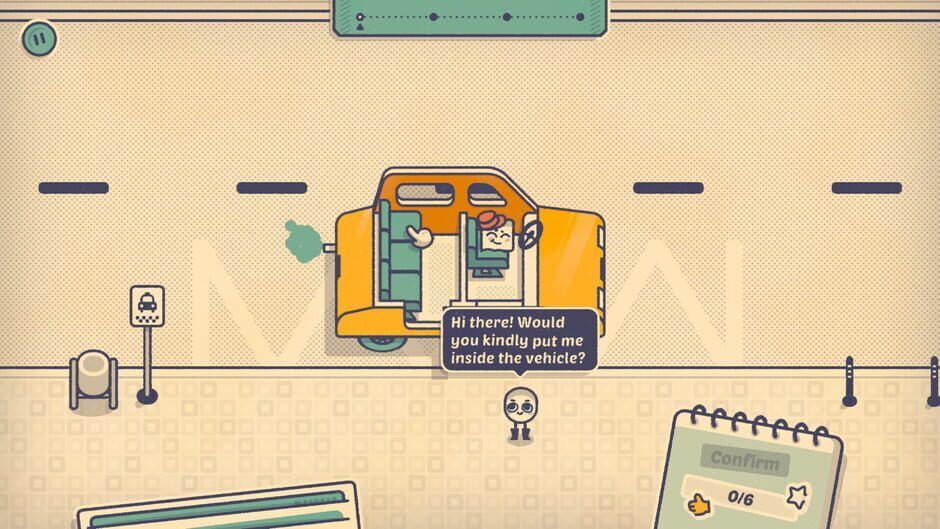
Is This Seat Taken? turns an awkward everyday question into a sharp little logic workout. Across trains, cinemas, weddings, offices, and more, you drag a cast of fussy characters into just the right seats, juggling their likes and dislikes. It sounds almost trivial, but Poti Poti Studio builds that premise into a compact, surprisingly dense puzzle set that feels right at home on both phones and PC.
Crucially, it understands its own scale. This is not a 40‑hour epic; it is a five‑ish‑hour snack you can nibble over a week. The design is all about clarity, low friction, and puzzles that resolve with a neat little "of course" click in your brain.
Character rules that actually scale, not just stack
At its core, each level is a logic‑grid puzzle disguised as a seating chart. Early on you meet simple, readable archetypes: someone who wants a window seat, someone who refuses to sit next to a stranger, someone who only sits in the front row. Their rules are expressed visually by icons and tiny animations, not walls of text, and the boards are small enough that you can brute force your first few solves without feeling punished.
The clever part is how the game ramps up. Instead of just dumping more rules onto the same grid, it keeps introducing new social quirks that interact in interesting ways. A shy character wants an empty seat between them and anyone else. A gossip wants to sit between two specific people. A wheelchair user requires an accessible spot, which reshapes how you think about the entire layout. Later, you are juggling friend groups, couples that want to sit together but not on the aisle, and people who flatly refuse to be near each other.
What stops this from becoming an unreadable mess is the restraint in each puzzle. Levels rarely exceed a handful of characters, and every rule meaningfully constrains the solution space rather than simply bloating it. By the final chapters, you are effectively solving multi‑step deduction chains worthy of a pen‑and‑paper logic book, but your path there is built on intuitive visual language rather than tutorial essays.
On PC with a mouse, dragging and swapping characters around is snappy and precise. On mobile, it feels even better. Flicking a grumpy commuter onto a different subway seat has a toy‑like tactility, and the boards are clean enough that fat‑finger mistakes are rare.
Onboarding without drowning you in text
For a game built on conditional rules, onboarding could have gone horribly wrong. Instead, Is This Seat Taken? might be one of the more approachable logic puzzlers in recent memory.
The first world quietly doubles as an extended tutorial. Every time a new rule type appears, the game pauses just long enough to highlight the relevant icon and show a one‑line tool tip, then immediately lets you test it on a tiny, low‑risk puzzle. Fail states do not come with scolding; you just hit undo or reshuffle and try again. There is no fail screen, just a gentle nudge that you have not satisfied everyone yet.
Importantly, the designers resist the urge to explain every edge case in words. Instead, they let you discover behavior through constrained examples. A character who dislikes crowds is first introduced in a layout where the only way to seat them is next to a single other person, telegraphing the rule far better than any paragraph could. By the time worlds three and four throw more tangled combinations at you, the visual shorthand is second nature.
On mobile, this bite‑sized teaching style shines. Each level is a thirty‑to‑ninety‑second problem, and you can knock out a few while waiting in line without having to re‑read instructions. On PC, the breezy text works out too, but the game is clearly tuned for short, cozy sessions rather than marathon tutorial segments.
If there is a minor onboarding misstep, it is that the later, more exotic character types appear in quick succession. The game trusts you to keep up, and for players brand new to logic puzzles, that last arc might feel like a steeper climb. For anyone who has ever enjoyed a nonogram or a Picross grid, though, the curve feels just right.
The 3‑star chase and replay value
Each level technically has two success thresholds. You can seat everyone in a way that "works" and move on, or you can go for the perfect solution that grants three stars by meeting every character preference to the letter. The gulf between "good enough" and "perfect" is where most of the game’s longevity lives.
Casually dropping people wherever they fit will usually clear the stage, but you will end up with one or two folks grumbling about their view or neighbor. It is only when you start paying attention to those last few icons that the deduction really kicks in. The moment you slide a character one seat over and see the final star pop into place is quietly addictive.
Because the stars unlock optional side routes and a few bonus scenarios, they are more than just a cosmetic rating. The game never hard‑gates the story behind flawless play, but if you want to see the trickiest boards, you will need to double back and clean up your earlier work. On mobile, that loop is ideal for quick replays when you have a spare minute. On PC, it becomes easy to fall into a "just one more perfect run" rhythm as you sweep through old chapters.
That said, the 3‑star chase is not infinitely deep. Once you have perfected everything, there are no daily puzzles or randomized boards waiting beyond the credits. The logic is all hand‑crafted, which is part of why it feels so satisfying while it lasts, but it also means that after five to six hours there is not much reason to return unless you are showing the game to someone new.
Presentation tailored to both pocket and desktop
Visually, Is This Seat Taken? lands somewhere between a cozy illustration and a clean UI mockup. Characters are simple but expressive, with tiny flourishes that hint at their preferences long before you tap them. Themed venues keep things fresh: cramped buses, airy theaters, intimate cafés, and stiff corporate conference rooms all put gentle twists on the board geometry.
The color palette is soft and readable, which helps on smaller phone screens. Important rules and highlighted seats pop clearly, and there is sensible use of outlines and contrast to make sure nothing gets lost when you play in bright daylight. On PC, the art does not suddenly blow you away, but it scales nicely to larger resolutions without feeling like a stretched mobile port.
The soundtrack leans into mellow, looping tracks that fade into the background. It does not have the melodic punch of the best puzzle OSTs, but it supports the "one more puzzle before bed" vibe effectively. More importantly, the audio feedback is sharp: placing a character, satisfying a condition, and securing that third star all have distinct, pleasant chimes that quickly teach your brain what success sounds like.
Performance-wise, it is as smooth as you would expect from a 2D puzzler. On an older Android phone, levels load instantly and battery drain is modest. On PC, it barely nudges CPU usage and feels like the perfect game to alt‑tab into between tasks.
Mobile or PC: where does it sit best?
Mechanically, the game is identical across platforms, but the experience feels slightly different. On mobile, it thrives as a micro‑dose of logic: a couple of puzzles during a commute, a few levels in bed before sleep, always picking up exactly where you left off. The minimal UI and near‑instant load times make it feel built first for touch.
On PC, you gain precision and the comfort of a big screen for denser late‑game layouts. If you like to really stare at a puzzle and consider possibilities, the desktop version gives your eyes and hand some breathing room. It is also the better way to binge more than an hour at a time.
Whichever platform you choose, cloud saves or simple level selection make it painless to revisit old puzzles for that elusive full clear.
Verdict
Is This Seat Taken? is a smart, tightly scoped logic puzzler that understands exactly what it wants to be. Its character preference rules scale in genuine complexity without ever losing clarity, its tutorialization is mercifully light on text while still being welcoming, and its 3‑star system gives just enough bite to keep completionists hooked through to the end.
It will not satisfy players hunting for endless content or daily challenges, and once you have perfected every board, the seats are, in a sense, all spoken for. But during its brief runtime, this is one of the most polished and approachable logic games you can tuck into your pocket or park on your desktop.
If your idea of a good time is turning social awkwardness into clean, satisfying deductions, Is This Seat Taken? deserves a reserved spot in your library.
Final Verdict
A solid gaming experience that delivers on its promises and provides hours of entertainment.