
Review

By MVP
More Than One Joke This Time?
The original High on Life was a strange success story. Critics shrugged at its clunky combat and thin level design, but Game Pass players turned it into a surprise hit, binging it for the nonstop, in-your-face comedy. It was a cult favorite, not a universally loved one, and a lot of people bounced off the constant chatter and basic shooting.
High on Life 2 is built like a direct response to those complaints. Based on extensive preview coverage and long uncut gameplay demos, this sequel looks far less like a meme delivery system with a gun attached and much more like a fully featured shooter-adventure. The question going into a day-one review is whether these upgrades in gameplay variety, writing, and level design actually elevate it into something that can stand on its own for players who do not already love the brand of humor.
Gameplay Variety: From One-Note Blaster To Real Sandbox
The most obvious shift from the first game is how much more there is to do in moment-to-moment play. High on Life 2 keeps the talking guns and the colorful, low-fi sci fi aesthetic, but nearly every system has been layered with new options.
Combat is faster and more expressive. Encounters encourage constant weapon swapping because each Gatlian now has clearer, more complementary roles. One gun leans into crowd control with sticky projectiles, another focuses on precision weak-point pops, and alt-fires create specific setups for juggling enemies or breaking shields. In the original, you could sleepwalk through a lot of fights with a favorite gun. In the sequel, the arenas, enemy types, and damage values are tuned to punish that kind of laziness.
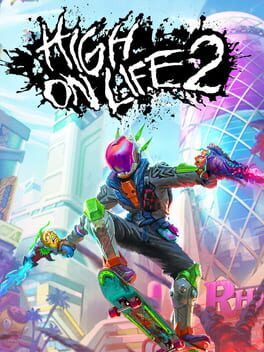
Mobility is the star. Wall-running, boosted jumps, and the heavily marketed skateboard all factor into both combat and traversal. Fights are no longer stationary circles around bullet-spongy aliens. Instead they resemble compact arenas designed for you to dash, bounce, and grind across rails, stringing kills together while staying off the ground. It is kinetic in a way the first game never really achieved.
Crucially, the skateboard is not just a gimmick. Previews show whole sequences built around weaving through traffic in an alien city, chaining grinds to maintain speed, and launching off pipes to access secret paths. That matters for a review because it suggests Squanch is willing to build proper set pieces around new mechanics rather than just tossing them in for a one-off joke.
Outside of pure combat, mission structure has broadened. There are hub-style areas where you pick up main contracts and side gigs, optional detours that function as mini-stories, and light puzzle and traversal challenges that break up the shooting. High on Life 1 had exploration, but it was thin. High on Life 2 looks closer to a loosened-up hub-and-spoke adventure in the vein of a more comedic, smaller-scale Borderlands or Ratchet and Clank.
For a day-one review, the main concerns will be whether that variety sustains itself over a full campaign and whether objectives lean on busywork. The early signs suggest a real attempt to escape the repetition that dragged the first game down.
Writing: Same Filthy Mouth, Sharper Brain
If you hated the original’s humor, you are probably already skeptical. High on Life 2 does not throw away its identity. It is still aggressively juvenile, gleefully gross, and unashamedly loud. Guns never stop talking, aliens never stop oversharing, and the game will happily derail a mission for the sake of a bizarre digression about some cosmic bodily function.
The difference is in how that barrage is edited and structured.
The script in the sequel appears tighter. Jokes are cut before they overstay, conversations have better rhythm, and the game finally understands the value of contrast. Previewers describe more character-driven bits, quieter beats between missions, and a wider range of punchlines than just “scream the weird thing louder and longer.”
The variety of comedy styles is also promising. There are still fourth-wall gags and overt video game parodies, but you also see more situational humor, environmental jokes baked into the level dressing, and longer setups that pay off several missions later. Murder mysteries, bizarre alien legal dramas, and micro-sketches hidden in side content show a writer’s room more interested in layering the absurdity instead of just machine-gunning quips.
The cast of talking weapons and NPCs benefits from stronger characterization too. The original leaned heavily on a few loud archetypes. High on Life 2 appears to use its ensemble more carefully, letting specific characters own particular comedic lanes. For new players, that can mean the chatter feels more like a modern animated series and less like one long, improvised bit that never stops.
That said, this is still going to be polarizing. Any day-one review has to be clear: if you bounced off the first game’s sense of humor entirely, the sequel’s sharper writing is an improvement, not a total course correction. It is refinement, not replacement.
Level Design: From Corridors To Playgrounds
Where High on Life often felt like a string of gaudy hallways punctuated by arenas, High on Life 2 looks substantially more ambitious in layout. The big structural change is a new hub-based design. Rather than simply warping from one bounty planet to the next, you return to and expand central locations that act as social spaces, quest boards, and gateways to larger biomes.
Those biomes are strikingly more complex. You can see layered routes that loop back into each other, verticality that rewards mobility upgrades, and branching paths that hide side objectives and collectibles. Importantly, enemies are placed to take advantage of this complexity. Fights unfold across ramps and ledges instead of flat ground, using the skateboard lanes and traversal tools as meaningful options rather than background art.
The game’s tone leans naturally into environmental storytelling. Levels are stuffed with throwaway gags in signs, posters, shop dialogue, and background animations. In the first game this was already a strength, but because the levels themselves were shallow, the world could feel like a theme park skin on top of basic FPS design. In the sequel, it looks like the art and level design teams are in sync, building places that are fun to navigate as well as funny to look at.
Preview missions jump from grotesque medical facilities to neon-drenched streets to more organic, alien wilderness. That variety, combined with the skateboard and traversal toolkit, suggests a campaign that might finally keep pace with the relentless personality of the writing. The risk is that the game could spread itself too thin with too many gimmick stages that only work once. A launch review will need to pay close attention to whether later levels deliver on the same thoughtful encounter layouts shown in the opening hours.
Platform Impressions: Xbox, PC, and PS5
Squanch is clearly targeting current hardware this time. Cross-gen baggage is gone, and it shows.
On Xbox Series X and PS5, previews indicate a smooth, clean presentation that finally matches the concept art. High on Life 2 trades the first game’s scruffy performance profile for sharper image quality, denser crowds, and more complex lighting. It is not gunning for cinematic realism, but within its cartoon sci fi lane, it looks noticeably more polished.
The Xbox Series S version will be important to examine at launch, especially given how heavily the game leans on Game Pass. Performance consistency during fast traversal and dense firefights will make or break that version. For now, footage suggests stable performance, but a review will need to test streaming-heavy areas and open hubs.
On PC, the big questions revolve around optimization and scalability. The original High on Life had a rocky start on some setups. High on Life 2 appears to benefit from a more mature engine implementation, but a final verdict will depend on how it handles a broad range of hardware and whether settings meaningfully let players tune between responsiveness and visual flair.
Load times on consoles look short, which should help the constant back-and-forth with hubs and side jobs feel snappy instead of frustrating. Given how the game leans into replayable contracts and optional content, quick restarts and fast travel are key parts of the experience across every platform.
Can It Be More Than A Cult Favorite?
High on Life 2 looks like a sequel that actually listened. Gameplay is deeper and more varied, the writing is sharper and more disciplined, and the level design has graduated from garish corridors to genuine playgrounds. Across Xbox, PC, and PS5, it has all the ingredients to be a legitimately strong shooter-adventure instead of a novelty that rides purely on its jokes.
The ceiling for this game is much higher than its predecessor. With the new hub structure, the skateboard and traversal suite, and a more robust mission mix, High on Life 2 has a real shot at standing shoulder-to-shoulder with other mid-budget FPS campaigns rather than just being “that talking gun game from Game Pass.”
The floor, though, is still defined by how you feel about its vibe. The humor is not going away. It is more polished, more varied, and more thoughtfully deployed, but it is still loud, still crass, and still absolutely uninterested in subtlety. For some players, the improved gameplay and design may be enough to finally pull them in. For others, the style will remain a hard stop.
A day-one review will probably land on this: as long as the full campaign can maintain the breadth and cohesion that the previews promise, High on Life 2 will almost certainly surpass the first game as an actual videogame. Whether it climbs out of cult-favorite status into broader acclaim will depend less on its mechanics and more on how many players are in the mood to be yelled at by their guns for another dozen hours.
Final Verdict
A solid gaming experience that delivers on its promises and provides hours of entertainment.