
Review
By Apex
A second hit that finally respects the trigger
High on Life 2 arrives with a lot to prove. The first game was a cult success that lived and died on its Rick-and-Morty-adjacent comedy while the actual shooting felt like a blunt instrument. The sequel does not abandon its wall-to-wall weirdness, but this time the guns and encounters finally feel like they belong in a real shooter rather than a joke delivery system that occasionally fires bullets.
Across PC, PS5, and Xbox Series consoles, this is still a single-player, campaign-first FPS built around talking weapons, gaudy alien biomes, and overcaffeinated cutscenes. The big question is whether the core loop finally holds up once the punchlines stop landing. In most respects, yes. When the game is allowed to be a shooter first, it can be a riot. When the comedy and bugs get in the way, it still kneecaps itself.
Weapon feel: from prop gags to a proper arsenal
The smartest evolution from the original is how the guns finally feel like firearms instead of stand-up comics strapped to your HUD. Squanch leans into a Doom Eternal style rhythm where swapping weapons mid-fight is essential, and for the first time the feedback actually supports that idea.
On mouse and keyboard, hit-scan primaries snap cleanly to weak points and enemies stutter convincingly under fire. Impact sounds are meatier, and every weapon has a more legible role. The rapid-fire pistol analogue carves through fodder, a chunky shotgun alternative blows armor plates off elites, and the returning knife is now more of a mobility and execution tool that chains cleanly out of dashes.
Crucially, alternate fires and traversal gimmicks are baked into combat instead of feeling like side-show tricks. One gun’s lobbed sticky shots combo with airborne juggling, another lays down ricochet fields that turn cramped arenas into pinball tables. The sequel finally commits to cooldowns and synergies instead of having you spam one favorite gun while everyone else monologues.
This all feels slightly looser on controller, but in a good way. The Xbox and PS5 versions have smart aim-assist curves that kick in when you are strafing quickly, helping the fast movement not turn every room into a whiff fest. PS5’s DualSense implementation in particular stands out with firm adaptive trigger resistance on charged shots and subtle haptics when your guns argue or react to near-death moments. It is a rare case of the chatter actually enhancing the tactile feedback rather than drowning it.
The downside is that some of the more experimental weapons are funnier than they are useful. A late-game gun that rearranges enemy AI routines is a fantastic bit when you first try it, but its damage is too low for higher difficulties and the animation locks are punishing. When the game forces you into using these gimmick guns for specific puzzle-box arenas, the previously slick combat starts to feel like a designer trying too hard to make a bit land.
Encounter design and difficulty tuning
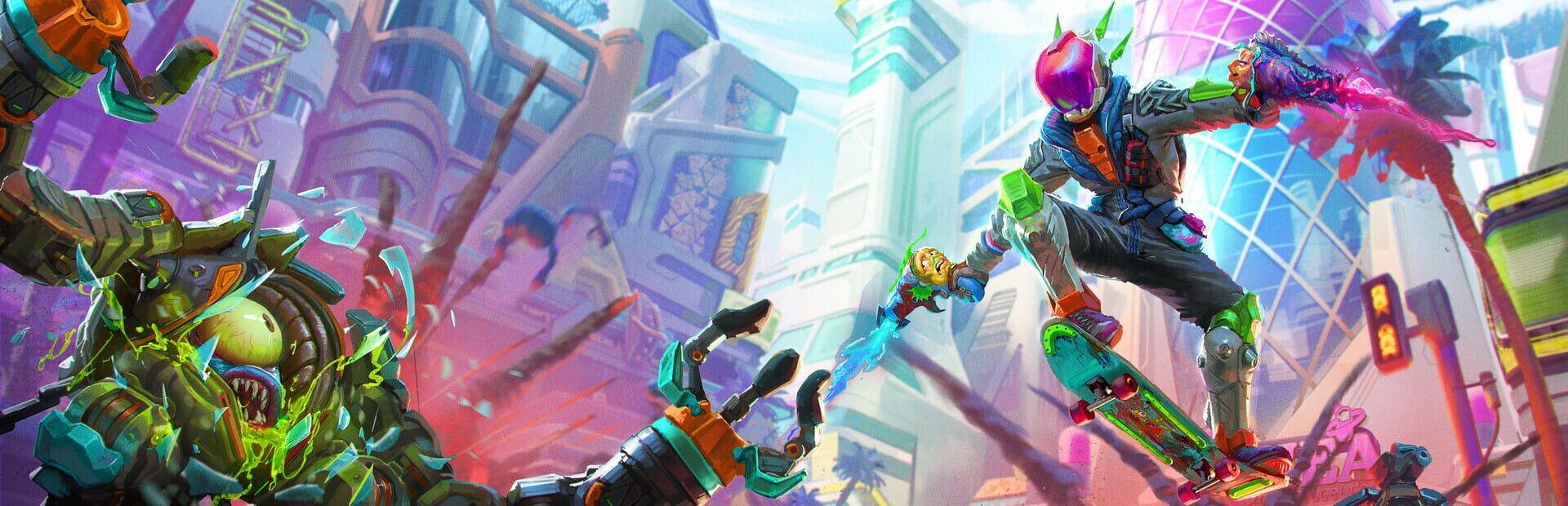
The original High on Life had encounters that felt like empty arenas pasted between dialog hubs. High on Life 2 is not suddenly a masterclass in encounter design, but it is far more deliberate. Most combat spaces now layer vertical rails, grapple points, bounce pads, and destructible cover so fights are about motion and improvisation rather than just circle-strafing a single flat plane.
Early missions on Normal are forgiving to the point of being a little sleepy. Fights function more like tutorials for your traversal and crowd-control tools. The campaign only really finds its teeth a few hours in, when mixed enemy waves start demanding weapon swapping and active use of gadgets. Once you crank the difficulty up, the game reveals an almost arena-shooter identity that many critics have compared to Doom Eternal and that comparison is mostly deserved.
On higher settings, enemies no longer politely wait their turn. Melee bruisers chase you off high ground, flying pests punish you if you stop rail-grinding, and shielded snipers force you to weave in sticky shots or mobility abilities to crack their bunkers. Time-to-kill is tuned so that you are rarely safe standing still and the arenas are built to support that constant state of motion.
The boss fights are where the design really sharpens up. Multi-phase duels with large targets mix bullet-hell patterns, environmental hazards, and periodically summoned mobs. They are more readable and fair than in the first game, telegraphing big hits clearly while still forcing split-second decisions. The final third of the campaign strings together several large-scale set pieces that make better use of your whole kit than anything in the original.
The caveat is that difficulty spikes can be uneven. There are a handful of optional platforming gauntlets and murder-con style side arenas balanced like they were pulled from a different game. They are creative, but if you are mainly here for jokes and story they will feel like brick walls. Accessibility options help a bit, but more granular combat sliders would have gone a long way.
Humor: sharper, broader, but still divisive
Critically, the first High on Life’s humor was the lightning rod. For some, it was cathartic, vulgar nonsense that carried a mediocre shooter. For others, it was an unskippable podcast of shrill improv smothering every other element.
High on Life 2’s writing team clearly heard that feedback. The volume knob on pure riffing is turned down, and the spectrum of jokes is wider. There is more situational and environmental humor, more specific character-driven bits, and fewer stretches where a single gun will scream the same gag in your ear for an hour. Several outlets have highlighted that this feels less like a Justin Roiland vanity project and more like a proper writers’ room finding different comedic voices.
Some of the best sequences simply let the world be absurd without calling attention to itself. A corporate theme park planet that quietly buries labor satire under saccharine mascots, or a bounty hunt that derails into attending a fan convention for a murder documentary, land because they are written as scenarios first and sketch premises second.
That said, the humor is still extremely “on,” and if you bounced off the first game’s style entirely, the sequel is not going to convert you. Kotaku’s review calls out how the constant noise and juvenile edge can still wear thin, and that criticism is fair. The game does provide sliders to reduce gun chatter frequency, but not a clean way to tell specific characters to cool it. When you are stuck repeating a buggy encounter while your guns recycle the same lines, it becomes actively hostile to your patience.
The key difference from the original is that when the jokes are not working for you, there is now a competent shooter beneath to carry you through. The comedy is no longer the fig leaf covering bad combat.
Under the hood: performance on PC, Xbox, PS5 and Steam Deck
On PC, High on Life 2 is demanding but scalable. On a modern mid-range rig, a mix of high and medium settings at 1440p can hold close to 60 fps, though heavy combat and large crowds cause noticeable dips. There are options for upscaling and dynamic resolution, which help smooth out the worst fluctuations, but shader compilation stutter and occasional hitches when entering new biomes are still present at launch.
The console picture is a little cleaner but not spotless. Xbox Series X and PS5 both target 60 fps in their performance modes at a dynamic resolution that typically resolves somewhere between 1440p and 4K reconstruction, depending on the scene. Visual quality between the two is broadly similar, though Digital Foundry-style breakdowns point to slightly more consistent frame pacing on Xbox in some dense areas, while PS5 leans on its controller features as a compensating perk.
Series S takes the biggest hit. It still targets 60, but dynamic resolution can crater toward 720p in stress tests, and the result is noticeably softer image quality with more shimmering. It remains playable, just not pretty.
PS5 and Series X both offer a quality mode that sharpens things up at a 30 fps cap. For a game built around frenetic aiming and movement, this tradeoff is hard to justify unless you are unusually sensitive to image breakup. The performance modes are the way to go on both big consoles, even with the occasional frame wobble or asset streaming hitch.
Steam Deck is where things get interesting. The game is Deck-playable rather than Deck-ideal. With aggressive optimization dropping settings to low and leaning on FSR at a modest 720p, you can get a mostly stable 40 fps cap. That is good enough for casual play and story progress, but the busiest fights and particle-heavy bosses will trigger stutters and dips. The smaller screen hides some of the visual compromises, but text and UI elements can feel cramped.
Where things get frustrating is memory management. Extended handheld sessions can trigger slowdown and rare crashes as the game chokes on larger hub areas. Quick resume behavior is also inconsistent. The experience is acceptable for Game Pass tourists treating the Deck or a similar handheld PC as a secondary platform, but it is not the definitive way to play.
Accessibility options
High on Life 2 makes some progress on accessibility but still feels behind the curve compared to first-party shooters.
On the positive side, the basics are here. There are subtitle options with font scaling, background opacity, and speaker labels. There are separate volume sliders for music, effects, and voices, plus a toggle and slider to reduce overall gun chatter frequency. You can remap most key and button inputs, and there are multiple aim-assist presets including strong magnetism options for players who need more help tracking fast enemies.
There are also colorblind presets that meaningfully adjust enemy highlights, projectile glows, and UI indicators. Motion blur, camera shake, and head bob can be reduced or disabled, which is important given how kinetic the camera work is in late-game encounters.
However, advanced features are lacking. There is no full narrated UI, limited support for one-handed play, and no robust combat difficulty customization beyond broad presets. The game could particularly benefit from sliders that independently tune enemy health, damage output, and platforming leniency, considering how spiky certain side challenges are. For a title so aware of its broad Game Pass reach, the accessibility story feels good enough rather than great.
Should newcomers play the first game first?
If you are looking at Game Pass and wondering whether to binge the original before diving into High on Life 2, you can safely skip straight to the sequel.
The narrative is set several years after the first game, and it certainly references your past bounty-hunting heroics, but the story is more soft sequel than dense continuity. You are given enough context through opening chatter and optional conversations to understand who you are, why the galaxy is a mess again, and what your dysfunctional found family dynamic looks like now.
More importantly, the sequel is simply a better video game. The gunplay is sharper, the encounter design is more ambitious, and the humor, while still divisive, is better paced and more varied. Going back to the original after spending time with High on Life 2 makes the first game feel like a rough prototype with weaker combat, clumsier pacing, and more one-note writing.
If you are a completionist or deeply curious about how the series evolved, the first game is still on Game Pass and the campaign is short enough to blast through over a weekend. But for most players, especially those primarily interested in how the shooter plays, High on Life 2 is the correct starting point.
Verdict
High on Life 2 finally brings the underlying shooter up to the same decibel level as its personality. The arsenal feels substantial, fights can be legitimately thrilling, and the campaign delivers several inventive set pieces that were unimaginable in the lumbering original. It is still messy, and the humor will remain a deal-breaker for some, but this time the game is not coasting on vibes alone.
On PC and the current consoles, it is an easy recommendation for anyone who has a tolerance for crass sci-fi comedy and a soft spot for fast, ability-driven FPS combat. On Steam Deck and lower-end hardware, it is more of a curiosity and a test of your patience with performance woes.
If you bounced off the first game entirely, this sequel will not change your mind about the universe Squanch is selling. But if you ever wished that the talking guns would shut up and shoot better, High on Life 2 is the course correction you were waiting for, even if the jokes and the tech still trip over each other on the way to the punchline.
Final Verdict
A solid gaming experience that delivers on its promises and provides hours of entertainment.