
Review

By Apex
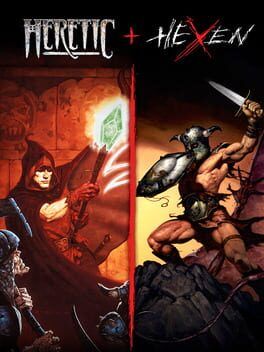
Nightdive Studios has made a habit of walking a thin line between preservation and modernization, and Heretic + Hexen might be its most precarious balancing act yet. These are not just old shooters; they are aggressively, almost confrontationally ‘90s in their sensibilities. The bundle collects Heretic: Shadow of the Serpent Riders, Hexen: Beyond Heretic, Hexen: Deathkings of the Dark Citadel, and bolts on two substantial new episodes, Faith Renewed for Heretic and Vestiges of Grandeur for Hexen. The question is whether this is a museum piece, a renovation, or something that can honestly stand alongside today’s best boomer shooters.
Preserving the ‘90s feel without embalming it
Boot into either game with the default settings and it hits almost exactly like it did on a CRT in 1995. The chunky sprites, labyrinthine level layouts, and crunchy, occult aesthetic are intact. This is not a reinterpretation or a loose remake; it is the original codepath running in Nightdive’s KEX framework, with widescreen and modern systems wrapped around it.
Heretic still plays like the missing dark-fantasy cousin to Doom, faster and looser than Hexen, with an arsenal that leans heavily into magical carnage. The feel of the weapons survives intact: the Elvenwand’s staccato plink is still anemic until you grab Tomes of Power, the Dragon Claw still shreds corridors, and the Phoenix Rod still threatens to kill you if you get cocky. Movement remains brisk, strafe-running is untouched, and enemy AI is just as simple and aggressive as you remember. Nightdive resists the temptation to tune damage numbers or enemy counts, so all the original encounter pacing is preserved.
Hexen is the more divisive half of the pair, and the remaster wisely does not try to pretend otherwise. The hub-based structure, switch hunts that span multiple maps, and class-based combat all survive exactly as they were. The Fighter still dominates early on, the Mage is still fragile but devastating with the right artifacts, and the Cleric still feels like the odd, support-flavored middle child. If you bounced off Hexen in the ‘90s because you spent half your playtime lost and annoyed, the core of that experience is still here, just with better guardrails.
What makes this package work is that Nightdive uses modern tech not to re-author these games, but to sand away the most needless friction around them.
Visual options that respect the CRT brain
On every platform, Heretic + Hexen supports modern resolutions all the way up to 4K, ultrawide, and proper widescreen weapon sprites. This last bit is not a cheap stretch; Nightdive actually commissioned new weapon sprite art so that guns and staves fill the wider field of view correctly instead of looking like blurry postage stamps hanging in the middle of the screen.
You can run it sharp and clean, with razor-edged pixels and uncapped frame rates, or you can lean into the nostalgia and turn on CRT-style filters and subtle blur. There are aspect ratio toggles between 4:3 and 16:9, several HUD scaling presets, crosshair customization, and brightness and gamma sliders that finally make these games readable on modern LCDs.
Crucially, none of the visual options break the mood. This is still a grimy, brown-green, hellish fantasy world rather than a glossy reinterpretation. The new lighting is restrained, sticking close to the software-rendered originals, and the KEX renderer does a solid job of avoiding shimmering or texture warping without making the environments feel fake-modern. If you want it to look as close as possible to DOS output, you can drop to lower internal resolutions and lean on filters; if you want it to look like a razor-sharp source port, that is just a couple of menu flips away.
The remastered and rearranged soundtracks are a more subjective matter. You can freely swap between the original MIDI-style music and the new recordings. In Heretic, the updated tracks mostly hit, adding weight without losing the eerie mysticism. In Hexen, the remaster sometimes overshoots and muddies the oppressive, haunted ambience that made the original so striking. The important part is that the choice is yours; purists can lock in the classic audio and pretend nothing has changed.
Quality-of-life: cutting frustration, not depth
Nightdive’s best work on this collection lives in the margins. A modern, fully remappable control scheme finally makes both games playable on controller without gymnastics. On PC, mouse look is properly, natively supported, and sensitivities and dead zones are where you expect them to be in 2025, not 1995.
The big flashpoint is navigation and progression, especially in Hexen. By default, the remaster includes subtle in-world arrows etched into the floor in certain hub areas and a more informative automap. These nudges are just enough to keep you from running the same five-room circuit for 40 minutes because a switch on the other side of the hub opened a single door two maps away. Better still, almost all of this help is optional. If you want the pure, no-handholding experience, you can toggle the assists off and go full archaeology.
Other tweaks land just as well. Quick saving and loading are instant. There is a proper level select that clearly marks which episode and hub you are in. Weapon cycling is snappier and less fussy, and item usage has been streamlined so you are not wrestling the UI in the middle of a crowded fight. Online and local co-op and deathmatch are smooth, cross-platform where possible, and feel far less janky than cobbling together old LAN setups or fan ports.
Performance, at least across PC and current consoles, is basically a solved problem. Heretic + Hexen runs at high frame rates with no meaningful hitching, even on handheld hardware like Switch and Steam Deck. This is the kind of stability you want in a retro revival; the only deaths you suffer here are on you, not on dropped inputs or hitchy frame pacing.
New episodes: more than a victory lap
The big “new” hook of this collection is its pair of original episodes: Faith Renewed for Heretic and Vestiges of Grandeur for Hexen. These are not lazy bonus maps. They feel designed by people who not only understand the originals, but have watched decades of modders, WADs, and source ports evolve the formula.
Faith Renewed plays like a greatest-hits tour of everything Heretic does well, with more confident encounter design and smarter use of verticality. Enemy mixes are deadlier without becoming unfair, and the episode leans heavily into artifact-driven power spikes, nudging you to chain Tomes of Power, Rings of Invincibility, and Morph Ovums in spectacular bursts. Crucially, it understands that Heretic is at its best when it feels like fast, airborne, magical Doom. The layouts are still old-school, but they flow better than many of the original campaign’s more meandering maps.
Vestiges of Grandeur for Hexen is thornier and more experimental. Built with help from veteran Doom and Hexen community mappers, it pushes the hub structure into more readable, bite-sized chunks. Puzzle chains are still elaborate, but they communicate slightly better what your last action did. It lives up to Hexen’s reputation: if you already like this style of sprawling, switch-driven exploration, Vestiges is a treat that teases out the best of that design. If you think Hexen has always been a brilliant combat sandbox welded to an infuriating adventure game, this new episode largely confirms that rather than fixing it.
Together, the new episodes feel like a bridge: they invite modern boomer-shooter fans in with tighter design while giving long-time players a reason to return beyond nostalgia.
For boomer-shooter veterans
If you grew up on DOS prompts, front-loaded shareware episodes, and bespoke source ports, Heretic + Hexen is almost absurdly generous. The remaster rolls in every campaign and expansion, layers on the new episodes, and then adds curated add-on support so console players can taste some of the community content PC fans have enjoyed for decades.
More importantly, the feel is right. Mouse look is natural, inputs are snappy, and the games finally play on modern TVs and monitors without hacks. Nightdive’s work compares favorably to the best fan source ports, and while ultra-hardcore tinkers might miss specific esoteric features from their favorite forks, this is easily the best all-in-one, plug-and-play way to keep these games in your rotation.
The biggest potential gripe for veterans will be ideological rather than technical. The navigation aids in Hexen, the extra tutorialization, and the gentler ramp in the new episodes might feel like a concession to modern tastes. Since most of it can be turned off, this is more a philosophical disagreement than a practical problem.
For newcomers raised on modern shooters
The tougher question is whether someone coming in cold, with their frame of reference being Dusk, Cultic, or Doom Eternal, will find this package accessible. Nightdive has done what it can without rewriting history. The result is that Heretic lands far more cleanly than Hexen.
Heretic’s loop is immediately intelligible: blow away monsters with magic weapons, scavenge keys, circle-strafe for your life. The fantasy dressing and artifact system give it a distinct flavor that still holds up. With the modern control schemes, better feedback, and higher resolutions, this can genuinely stand next to contemporary retro shooters as a fast, punchy campaign, especially if you start with Faith Renewed and work backward.
Hexen is where the age really shows. Even with better maps and assists, it still asks you to rewire your shooter brain toward slow, patient hub exploration. Progress can feel opaque, backtracking remains heavy, and the class system takes time to click. When it does, there is nothing quite like kiting a pack of centaurs as a Mage while juggling artifacts and environmental hazards, but it is a very specific taste. Nightdive has made Hexen less hostile, not fundamentally different.
If you are willing to meet these games halfway, the remaster is absolutely good enough to stand as your first and only way to experience them. If you demand constant forward progress, quest markers, and modern checkpointing, this will still feel like homework wearing a cool robe.
Verdict: definitive, within its own boundaries
Heretic + Hexen is not a reinvention, and it is not trying to be. Instead, it is a meticulous restoration that respects what these games were while acknowledging where they clash with 2025 expectations. The new visual options make them readable and flexible without betraying the art. The quality-of-life tweaks remove needless friction. The new episodes are legitimate additions, not throwaway bonus levels. And the whole bundle runs beautifully across every platform that matters.
For boomer-shooter diehards, this is the definitive, officially sanctioned way to own, play, and revisit two of the genre’s strangest dark-fantasy pillars. For newcomers, it is the best possible on-ramp you are going to get without rewriting these games from the ground up.
They remain proud, stubborn relics of a different design era. Nightdive’s achievement is making sure that, for once, you are fighting the monsters and the mazes rather than your hardware.
Final Verdict
A solid gaming experience that delivers on its promises and provides hours of entertainment.