
Review

By Story Mode
A gentle march into autumn
Herdling opens on a shiver. A nameless child wakes beneath a crumbling bridge on the edge of a dying city, finds a single calicorn limping through concrete dust, and decides, without a word, to walk it toward the distant mountains. Everything that follows is about that choice to care.
There is almost no text and no voiced dialogue. Instead, Herdling speaks through its art direction. This is one of the most convincing autumnal worlds in recent memory. Rusted oranges and faded yellows smear across the hillsides like watercolor. Industrial ruins are half-swallowed by leaf litter, while sun shafts catch particles in the air that feel like the last warm days before winter tightens its grip. The palette shifts as you climb higher, from smoggy ochres in the city outskirts to copper forests, then to frosty blues and muted slate near the summit, and the journey feels seasonal as much as physical. You are not just going somewhere; you are running out of time.
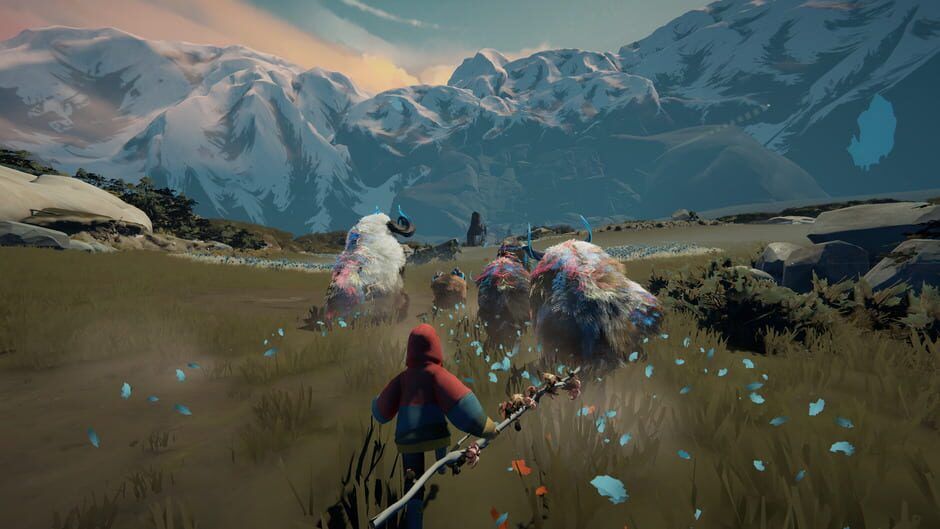
What sells that mood is the way the calicorns inhabit it. These huge cat-cow things move with surprising weight: hooves sinking into wet soil, coats catching the light as they brush past mushrooms and saplings. When they huddle together at night, their breath fogs the air and fireflies pool around their flanks. Herdling rarely calls attention to these details, but they accumulate until your little caravan feels heartbreakingly real.
Calicorns as companions, not resources
Mechanically, Herdling lives somewhere between a pared-back herding sim and a narrative adventure. You guide your growing herd across linear, chaptered environments, nudging them with whistles, food, and your own position. There is no complex resource spreadsheet, no branching tech tree. Your main “stats” are emotional: how safe your herd feels, and how much you, as a player, are willing to risk them.
The game understands that attachment is a system, not just a cutscene. The first time you pull a shivering calicorn out of a fenced-in slaughter lot, you are prompted to name it. Every new rescue gets the same treatment. It is a small, familiar trick, but it works. Having to decide whether this new arrival is a silly nickname or a solemn one immediately flips an abstract hitbox into an individual.
Herdling reinforces that individuality with subtle visual and behavioral touches. Horn shapes vary from delicate spirals to blunt, chipped prongs. Coats carry different patch patterns and fades. Some calicorns hang back near the child, reluctant to charge ahead. Others are needy, pushing their heads into your hands whenever you pause. A few are almost comically dim, wandering nose-first into obstacles. The result is a herd that reads like a group of scattered personalities rather than a brown blur.
You care for them through low-friction routines. Rest spots let you groom mud from coats and gently shoo smaller calicorns into the center of the group. You can spend a moment scratching a specific one’s chin, or simply sit in the grass while they mill around you. None of this is required to “win,” but the animations are so tender that it becomes hard to rush through these breaks. The game is quiet, even cozy, yet that coziness is always haunted by the knowledge that the world beyond the rest circle is trying to take these creatures away from you.
A light-touch herding sim
Where sim-minded players may start to chafe is in how little friction Herdling applies to your decisions. On paper, there is a lot you might expect from a creature-management game: hunger, stamina, sickness, complex morale. Herdling is deliberately uninterested in most of that.
Instead, your main verbs are guiding, protecting, and occasionally using your calicorns to manipulate the environment. You whistle to gather them close. You walk ahead to draw the bolder ones forward and the rest follow like a slow, fluffy comet. In more treacherous areas, you fan them out, steering their bodies as a living bridge to cross gaps or as a pushing wedge to move dead trees and boulders. They can bunch up to create a ramp that lets the child climb where they otherwise could not, a simple mechanic that cleverly doubles down on the game’s central tension: these animals are both loved companions and tools.
Stealth segments punctuate the journey, where you are funneling your herd past hunters, spotlights, or predatory machines. Here, the game constrains the path into tight corridors and asks you to manage spacing and timing so that no one gets caught. These scenes are visually striking, often framed in deep reds and ash-grey silhouettes against the autumn background, but mechanically they are forgiving. Patrol patterns are readable, fail-states are generous, and checkpoints are frequent.
Puzzle design is in the same vein. You might need to coax a nervous calicorn into a dark tunnel so they can shove a mine cart from the other side, or organize them by size to weigh down specific pressure plates. Yet solutions are rarely more than a beat or two of thought away. The game’s worst moments are when it repeats these ideas a few too many times, especially in late-game stealth gauntlets that feel more like padding than meaningful escalation.
If you come to Herdling looking for systemic challenge or crunchy optimization, that softness may feel like a cop-out. There are no cascading failures to pull back from, no complex interlocking needs to balance, no deep progression layer beyond finding more calicorns and unlocking a handful of traversal tricks. Several reviewers’ “it’s basically a walking sim” shorthand is not far off, although that phrase undersells how precise and tactile the act of steering a dozen horned bodies through a crumbling world can feel.
The emotional arc of a short journey
Herdling clocks in at roughly five to seven hours for most players, even if you take your time at rest sites and hunt down optional calicorns hidden in side paths. This brevity is not a downside so much as a thesis. The game is structured as a single, continuous migration with barely any mechanical bloat. You start with one calicorn, hit a kind of emotional peak once your herd has become a bustling family, then ride out a final act that strips things back down.
The writing, such as it is, lives entirely in these peaks and valleys. There are no lore dumps or dialogue trees. Instead, Herdling leans hard on environmental tableau and the tiny behaviors of your companions. You will crest a hill to find burned clearings full of abandoned fences, or pass a derelict freight station where rusted train cars still bear the shapes of creatures penned inside. Calicorns flinch at certain noises, or refuse to go near specific structures, and from that you infer their history.
The short runtime makes every loss hit like a truck. Calicorns can die, or be taken, and the game does not sensationalize it. A misjudged order in a canyon sequence and you might watch a named companion slip, tumble, and vanish in a muted thud of dust. There is no slow-motion, no screaming HUD alert. The herd just stutters, then closes ranks around the gap. Your save file will remember that absence for the rest of the journey. The credits quietly acknowledge who made it and who did not, a small touch that turned my playthrough into something I felt responsible for long after I put the controller down.
Because Herdling is so short, it can afford to be tightly curated. Orchestral swells only kick in for key moments, most of them built around your bond with the calicorns: the first time they willingly fan out at your gesture to shield you from a storm of debris, or when an older calicorn gently nudges a newborn toward you, as if asking you to take over. The final stretch toward the mountain summit, with leaves giving way to snow and the herd’s footprints dragging behind in long, tired tracks, is one of those sequences that feels designed to lodge permanently in your memory.
Cozy narrative, not deep simulation
For sim fans, the question is whether Herdling’s mechanical lightness is redeemed by that emotional density. I would argue yes, but with clear boundaries.
Taken as a management game, Herdling is extremely shallow. Your choices are almost always binary: risk the narrow shortcut, or take the longer safe path; push your calicorns into a tense situation to progress quickly, or take an extra night at camp to regroup. There are no long-term builds or optimization layers to chew on. You cannot really “break” the game in satisfying systemic ways, nor can you dive into a post-story sandbox where your bond with the herd is expressed through player-driven goals.
Taken as a story about choosing to care for vulnerable creatures in a dying world, the design is sharp. By stripping away most fiddle and friction, Herdling keeps your focus on the feeling of possession and responsibility. Every time the game gently reminds you that you could proceed faster if you treated the calicorns more like platforms than partners, it is actually asking what kind of shepherd you want to be. The fact that the systems are light is the point. You are never so overwhelmed by stats that you can comfortably abstract these animals into numbers.
The autumnal art direction does much of the heavy lifting here. The entire game looks like a picture book illustrated in late afternoon. Warm, desaturated foliage wraps around cold, unyielding industrial forms. Every new area feels like flipping to a fresh double-page spread, and the short runtime keeps it from becoming visually routine. Herdling is full of quiet visual metaphors that need no words: flocks of birds abandoning the valley as you enter, or a single dead calicorn skeleton collapsed under a tangle of turned-off floodlights.
If you have room in your life for a tightly edited, emotionally targeted game that plays more like a wordless graphic novel you occasionally nudge forward, Herdling is extremely easy to recommend. If you are hoping for the next great livestock-management sim, you are likely to walk away charmed but unsatisfied.
Verdict
Herdling is a compassionate, creature-herding adventure that lands its emotional beats with almost embarrassing precision. Guiding a herd of calicorns through its autumn-drenched world feels less like min-maxing livestock and more like protecting a slowly expanding family in hostile territory. Its mechanics are light to the point of fragility, and sim purists will find barely anything to dig into once they have internalized the basics. Yet as a cozy, melancholy narrative experience about bonding with strange animals and shepherding them toward a better life, it is one of 2025’s most affecting journeys.
Treat it like a weekend-length illustrated novel rather than a systems-heavy sim, and Herdling’s mix of calicorn bonding, autumnal art, and gentle pacing will likely stay with you long after the last leaf falls from its painted trees.
Final Verdict
A solid gaming experience that delivers on its promises and provides hours of entertainment.