
Review

By Pixel Perfect
Image: IGDB
Store links: A Game About Chopping Trees on Steam
A tiny premise with a surprisingly sharp edge
The most concrete thing to know before buying A Game About Chopping Trees is also the central tension of this A Game About Chopping Trees review: according to VGTimes, this is a roughly three-hour PC game from Space Raccoon Game Studio, described there as an independent three-person team, built around felling trees, hauling logs, processing them into planks, earning money, and buying upgrades so the same act happens faster. That sounds like a gag stretched into a Steam purchase. The better question is whether the gag mutates into a satisfying loop before the forest runs out.
On the evidence available, it does, but only for a specific kind of player. This is a small, direct indie game with a clean mechanical promise. You arrive on a plot of land as an unnamed lumberjack, according to VGTimes, and work through three forest areas: a birch grove, an oak forest, and a spruce woodland. Each area ends with a special golden tree that can only be chopped after the regular trees have been cleared. GameCritics also notes that the campaign’s price list includes different tree values, including golden wood, which frames the whole experience as a job board with an axe attached.
That structure gives the game its momentum and its discomfort. The loop is cheerful on the surface, with what multiple outlets describe as pleasant, vibrant forest presentation, yet its goal is to turn a pretty landscape into stumps. GameCritics reads that as an intentionally dark core, arguing that the game’s sunny look camouflages a more cynical cycle of extraction and efficiency. GamingHQ, by contrast, focuses less on satire and more on whether there is enough to do after the first few trips to the sawmill. Both readings can be true for a buyer: A Game About Chopping Trees is charming, concise, and mechanically readable, but the simplicity is doing nearly all of the work.
The chop, carry, sell loop lands because the friction is deliberate
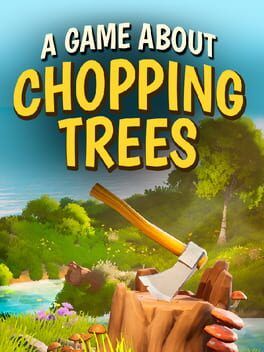
A strong tree chopping game needs the first swing to feel good. GameCritics describes the act of cutting as immediately satisfying, calling out the tactile pleasure of pulling the trigger, seeing pieces of wood fly away, and hearing the creak that signals a tree is finally falling. That matters because everything else in A Game About Chopping Trees depends on whether repetition feels meditative or thin.
The early hours are intentionally slow. GameCritics reports that the player can initially carry only three pieces of wood and has enough stamina to cut down only a couple of trees before spending in-game money to recover energy. That sounds annoying on paper, but it is also how the upgrade economy gets its hooks in. The same screen that restores energy also shows permanent upgrades, so every inconvenient walk back to base becomes a sales pitch for better stamina, stronger tools, improved carrying capacity, and faster processing.
VGTimes lists the core tool path as a starting axe followed by a chainsaw unlocked through leveling, with upgrades for tool power, stamina, grip strength, and sawmill speed. After the first and second stages, VGTimes says the game adds a mine cart and a Chain Fall ability. GameCritics highlights the pleasure of domino-felling a series of trees as one of the game’s best moments. That is the design at its most elegant: the joke begins as manual labor, then turns into a compact automation fantasy where each irritation is converted into a purchase goal.
The catch is that this economy is built on a narrow base. GamingHQ argues that once players have experienced the chop, carry, process, upgrade cycle, they have effectively seen the game’s current offering. I agree with the concern as a buyer’s guide judgment. The loop is clean, but it does not appear broad. If you need side activities, collectibles, hidden spaces, or surprise objectives to keep a cozy work sim alive, the sources suggest A Game About Chopping Trees will feel underfed.
Pacing is brisk, but the game spends its best ideas quickly
The reported three-hour completion time from VGTimes is one of the game’s biggest strengths and one of its limits. A Game About Chopping Trees does not sound bloated. It moves from grove to forest to woodland, raising wood value slightly between stages and pushing the player toward stronger tools and better hauling. For an indie game review, that compactness matters. A silly premise often survives because it knows when to leave.
The pacing curve appears to be built around transformation. At first, you are underpowered, tired, and forced to remember where logs rolled after a tree came down, a frustration GameCritics specifically calls out. Then the game hands over stronger upgrades and transport options. The sawmill’s processing time can be improved. The mine cart reduces hauling pain. Chain Fall turns individual tree cutting into a cascading reward. In a stronger version of this game, those upgrades might open new kinds of decisions. Here, based on the available reports, they mostly make the same decision faster.
That is not automatically a flaw. Some players want a small optimization toy with a clear finish line. VGTimes frames the experience as simple but pleasant, with a setup, an ending, and little traditional story in between. The absence of narrative sprawl keeps attention on the rhythm of movement, chopping, loading, and returning. But players expecting the premise to escalate into a richer survival, crafting, or exploration game should adjust expectations now.
GameCritics adds an interesting wrinkle: there are reportedly not enough trees in a single run to earn enough money to unlock everything, so full completion requires either new game plus or reforestation. That is a clever structural joke and a practical warning. Completionists may find themselves grinding beyond the natural end point, while players satisfied by seeing the three plots through can stop before the loop curdles.
The charm comes from contrast: pretty forests, ugly incentives
The presentation seems to be doing more thematic work than the title admits. VGTimes says the game greets players with a simple but genuinely pleasant look and offers plenty worth admiring. GamingHQ is even more direct, praising the vibrant forests, strong lighting, peaceful atmosphere, and relaxing quality of walking through the environment. GameCritics similarly points to a pleasant, cartoon-like aesthetic and a sun-dappled setting.
That charm is important because the underlying action is bleak. GameCritics spends much of its review interrogating the goal of destroying special golden trees for relatively modest monetary value, then using the reward to buy upgrades that accelerate further destruction. The game reportedly allows reforestation with a trowel and seeds that grow within minutes, but GameCritics reads that less as environmental redemption and more as a gesture toward sustainable logging.
This is where A Game About Chopping Trees becomes more interesting than a novelty title. It does not need a heavy script to make the player feel the absurdity of optimizing a landscape into absence. The bright forests make each new clearing legible. The upgrade menu turns inefficiency into temptation. The special trees become objectives because the game says they are objectives, even if the reward is not grand. That small discomfort gives the game a personality beyond its mechanical loop.
Still, players should not expect a full narrative payoff based on the source material. VGTimes reports there is little story beyond a setup and an ending. GameCritics hints at a spoiler-adjacent reveal, but the provided material does not establish enough to discuss it safely. The better way to frame the charm is tonal rather than plot-driven: cute woods, blunt tools, and a system that keeps asking whether faster is the same as better.
Performance and polish are the main reasons to hesitate
The clearest caution comes from GamingHQ, which says performance is not unplayable but still has rough edges that need optimization and stability work. The outlet also criticizes the update priority it observed, saying the developers were releasing hotfixes while adding new achievements frequently, and arguing that existing issues should be polished before small additions. GamingHQ says the developers had published a roadmap through August with three planned updates over roughly a month, which it reads as a sign that support is active.
VGTimes provides the most concrete technical context. Its review was conducted on PC using a Ryzen 5 7500F, an NVIDIA RTX 4070 Ti Super, and 32 GB of RAM. The system requirements it lists are modest in storage terms, requiring 4 GB of available space, but not trivial for a tiny-looking indie. VGTimes reports minimum specs of a quad-core Intel or AMD CPU at 2.5 GHz or higher, a GTX 1660 or Radeon RX 5500 XT, and 8 GB of RAM. Recommended specs are listed as a quad-core Intel or AMD CPU at 2.5 GHz or higher, an RTX 3060 or Radeon RX 6600 XT, and 16 GB of RAM.
For players deciding whether to buy now, that creates a simple split. If your PC is comfortably above the listed requirements and you are tolerant of some roughness in small indie releases, the current version sounds playable. If you are near minimum spec or highly sensitive to inconsistent performance, GamingHQ’s warning makes waiting for post-launch polish the safer move.
The Steam material provided confirms the game has a Steam app page and community hub for app 4512570, but the supplied Steam extract does not include price, release date, controller support, Steam Deck status, user review rating, or language support beyond the page’s language selector. Those details should be checked directly on Steam before purchase, especially if handheld compatibility or regional pricing matters to you.
Verdict: a good short loop, not a forever forest
A Game About Chopping Trees works best when treated as a compact, oddly self-aware labor toy. The chopping reportedly feels good, the forests look inviting, and the upgrade path gives each inconvenience a near-term solution. Chain Fall and mine cart transport sound like exactly the kind of small mechanical escalation a premise this narrow needs. For players who enjoy cozy repetition, incremental efficiency, and indie games that turn one clean verb into an evening’s entertainment, this has an easy appeal.
The reason to be cautious is equally clear. GamingHQ’s critique that there is not much to do beyond the central loop is not a side complaint, it is the purchase decision. This game is about chopping trees. The title is honest. If that sentence makes you smile, and a three-hour runtime sounds like a virtue, the joke likely lasts. If you are hoping the title is hiding a broad sim, a mystery-heavy adventure, or a deep crafting game, the available reviews do not support that expectation.
As a GameLoop buyer’s guide call, I land on a warm but qualified recommendation. A Game About Chopping Trees has the craft to make repetition feel pleasant and the tonal bite to make its bright forests linger in the mind. It also appears thin, technically imperfect for some players, and dependent on your tolerance for doing one thing over and over with slightly better tools. Buy it for a focused indie curiosity. Wait if you need performance polish, varied activities, or a longer reason to stay among the stumps.
Final Verdict
A solid gaming experience that delivers on its promises and provides hours of entertainment.