
Review
By Story Mode
A roguelike twin-stick shooter built on pure physics
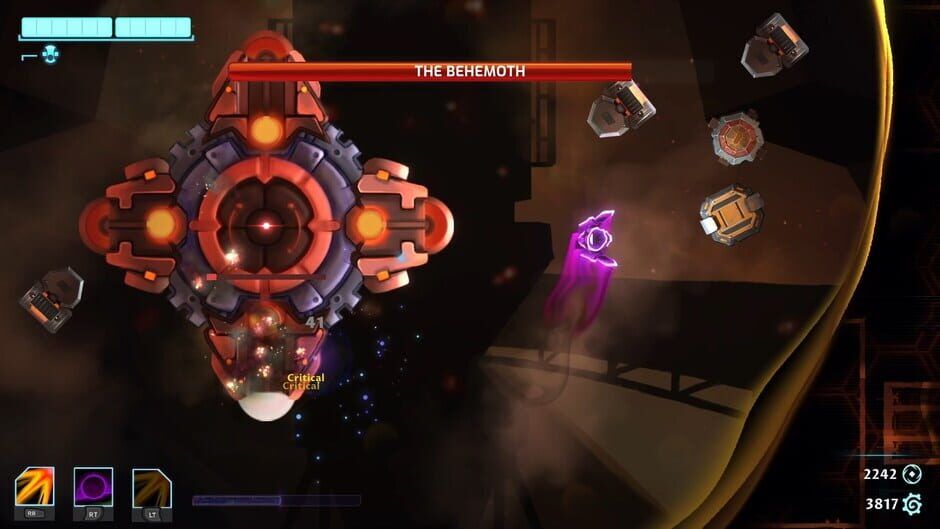
Galactic Glitch pitches itself as a twin-stick roguelike where everything is physical. Bullets aren’t just lines on the screen, they are little projectiles you can catch, deflect, or shove off-course. Rocks, mines, enemy ships, even bits of exploded debris all exist as objects you can grab with your grav gun and fling like angry meteors.
In a genre where most games are about reading patterns and strafing correctly, Galactic Glitch wants you to think like a pool player, banking shots and curving trajectories through crowded arenas. When it works, it feels fantastic, like someone mashed up the chaos of Nuclear Throne with the tactile satisfaction of a really good physics sandbox.
Physics-driven combat: genius idea, uneven execution
The grav gun is the star of the show. With a squeeze of the trigger you can scoop up rocks or loose parts of the environment, hold them in orbit around your ship, then whip them into enemies. Shots actually push things around, so a barrage of enemy fire can shove your makeshift shield out of position or send your rock careening into an unintended target.
At its best, this system creates those beautiful improvised plays that roguelike fans live for. You catch a barrage of missiles in a panic, swivel them around yourself like a shrapnel halo, then launch them back into a mini-boss. Or you pull a chunk of geometry into a tight choke point and watch enemies splatter themselves against it.
The problem is that the physics model is almost too committed to being “real.” Objects bounce, slide and drift in ways that are technically impressive but not always readable in the half-second windows twin-stick shooters give you. In tight spaces it can feel like pinball, only you’re the ball and every flipper is pointed straight at your face.
Where Nuclear Throne and Enter the Gungeon prioritize clarity, Galactic Glitch often buries you under its own spectacle. Projectiles, debris, and enemies can blend into a neon soup, and because so much is in motion, it is easy to lose track of what is lethal and what is just background junk. You can tell the developers love their physics system, but sometimes it feels like they’re designing for GIFs rather than for moment-to-moment legibility.
Upgrade synergies: clever ideas strangled by repetition
On paper, the upgrade system is exactly what you want from a roguelike shooter. Runs drip-feed you new weapons, ship powers, and modifiers, and many of them interact meaningfully with the physics layer.
You get gravity wells that suck in bullets and debris, damage bonuses for slamming enemies into walls, orbiting shields that turn stray junk into a spinning kill-sphere. There are builds that lean into telekinetic control, others that emphasize raw bullet spam, and some that try to turn the whole screen into your personal asteroid blender.
The issue is that the pool of toys just doesn’t feel as deep or as wild as its best genre peers. In Enter the Gungeon, every new gun feels like a dare and every passive has the potential to spiral your run out of control. Nuclear Throne’s mutations are simple, but they interact with weapons in ways that make almost every build feel distinct.
In Galactic Glitch, synergies exist, but too often they feel like slight numerical tweaks dressed up in flashy visuals. You might pick up yet another minor damage bump when throwing objects, or a barely noticeable increase in grav gun pull strength, instead of a transformative effect that changes how you engage with rooms.
Worse, the strongest builds lean heavily on a few obvious combos. Once you discover that a certain cluster of powers can turn you into an unkillable debris hurricane, it is hard to get excited about anything else the game rolls for you. There is a solid foundation here, but the variety doesn’t quite keep up with the ambition of the physics sandbox.
Run variety and structure: fun bursts, shaky legs
Structurally, Galactic Glitch sticks close to the roguelike playbook. You push through discrete zones, each with their own enemy sets and hazards, gathering currency for meta-upgrades and hunting for that one run where everything clicks.
The first few hours are a blast. The physics gimmick is fresh, the learning curve feels fair, and the thrill of mastering the grav gun carries you through early failures. Rooms shuffle enemy formations and obstacle layouts enough that you rarely see the exact same encounter twice.
The cracks start to show once you begin to outplay the basic content. Enemy archetypes repeat frequently, and while their attacks interact with physics in cool ways, they don’t evolve much across zones. You become very familiar with certain attack patterns and projectile spreads, and without a huge stable of enemies to draw from, the game leans on sheer numbers and damage spikes to maintain difficulty.
Compared to Nuclear Throne’s brutally dense enemy roster or Gungeon’s almost absurd library of room layouts, Galactic Glitch feels thin. It is not that runs are identical, but the envelope of possibilities feels narrower than you would expect from a game selling chaos as its main attraction.
The meta-progression doesn’t fully rescue this. Unlocks are useful but rarely exciting, giving you small edges that speed up your early game rather than opening dramatically new styles of play. If you are chasing that “one more run until sunrise” high, Galactic Glitch will probably give you a few very late nights, but it doesn’t have the same gravitational pull its best-in-class competitors have.
Comparing the feel: Nuclear Throne and Gungeon
Moment to moment, Galactic Glitch tries to split the difference between the raw, twitchy violence of Nuclear Throne and the arena puzzle feel of Enter the Gungeon.
From Nuclear Throne, it borrows the sense that every second counts and every mistake is punished fast. From Gungeon, you get dense projectile patterns and an emphasis on smart positioning. The physics system is the twist, turning every room into a dynamic puzzle of moving parts.
The problem is that the game often feels looser and less precise than either of those benchmarks. Shots can curve unexpectedly when they clip debris, enemies can take stray hits that knock them out of carefully lined up kill zones, and sometimes your own thrown objects ricochet in ways that punish you more than the enemies.
Fans who lived in Gungeon’s tight dodge-roll windows or Throne’s brutally fair hitboxes may find Galactic Glitch’s chaos a little arbitrary. When you die in Gungeon, you almost always know exactly why. When you die in Galactic Glitch, the replay in your head is more likely to be a confused blur of “I think that rock bounced off a mine that bounced off a missile that bounced into my face.”
There is an audience for that level of entropy, no question. But it is a narrower one, and the game is not quite generous enough with its build diversity and run variety to offset the frustration when the physics engine decides it is your time to go.
Long-term replayability: good, not legendary
This all adds up to a roguelike that is genuinely interesting, occasionally brilliant, but not quite a must-play classic. The physics-driven combat gives it a unique identity in a crowded field, and if you click with the grav gun, you will get a solid chunk of hours out of just chasing cleaner, smarter runs.
But long-term, Galactic Glitch struggles to compete with the genre’s titans. Where Nuclear Throne and Enter the Gungeon feel almost infinitely replayable thanks to their extreme weapon pools, mutation systems, secrets and hidden routes, Galactic Glitch starts to feel like variations on a theme.
You’ll see the same kinds of rooms, fight the same handful of enemy archetypes, and build toward the same core synergies. It is still enjoyable, and for a while it feels fresh, but the ceiling is lower than it should be given how strong the central idea is.
Verdict
Galactic Glitch is a smart, stylish roguelike twin-stick shooter that bets everything on physics-driven chaos. When its grav gun and upgrade systems align, it delivers some of the most satisfying environmental kills in the genre. Unfortunately, a limited upgrade pool, repetitive enemy design, and occasionally unreadable visual noise keep it from achieving true roguelike greatness.
If you adore twin-stick shooters and are hungry for something different from yet another bullet-hell clone, Galactic Glitch is absolutely worth a spin. Just do not expect it to replace Nuclear Throne or Enter the Gungeon as your forever roguelike. This is a fascinating experiment, not the new gold standard.
Final Verdict
A solid gaming experience that delivers on its promises and provides hours of entertainment.