
Review

By Pixel Perfect
A heavier roll of the dice
For The King II does not try to reinvent Fahrul. Instead it drags you back into it with a heavier, more sprawling campaign that takes almost everything the first game did and dials it up. Sometimes that means richer tactical decisions and better long-term planning. Sometimes it just means more things that can go wrong.
The original For The King carved out a niche by feeling like a rogue-lite tabletop campaign you could knock out in an evening. You juggled a handful of stats, managed a tight budget of Focus points and gold, and sprinted from crisis to crisis across hex-based maps. For The King II keeps the same DNA, but stretches it over a multi-chapter story where your success in one run can unlock permanent options and shortcuts for the next.
The campaign is now a sequence of linked adventures instead of discrete scenarios. Each chapter has its own map and objectives, but they feed into a larger push to overthrow Fahrul’s tyrannical queen. There is still permadeath. Party wipes will throw you back to the start of a chapter, but your account-level progress persists through lore unlocks, classes and equipment. It feels closer to a full tabletop campaign book than a one-shot module, and that shift is the sequel’s best idea.
Tabletop tactics with sharper edges
Moment to moment, For The King II is still a game about dice disguised as stats. Movement rolls decide how many hexes you can travel. Events pop up on the road and in dungeons, asking for talent, awareness or strength checks. Combat is turn-based and initiative driven, with characters and enemies slotting into an order that can be manipulated with skills.
The new game adds a row-and-lane system that effectively gives battles a front and back line. Weapon ranges and skills interact with that layout in satisfying ways. Heavy melee units feel genuinely scary when they are parked in the front row protecting fragile casters, and suddenly skills that manipulate positions or apply taunts matter more than raw damage. Compared to the first game’s simple face-to-face slugfests, fights here demand more thought about party composition and weapon choice.
Gear variety has been meaningfully expanded. There are more conditional effects attached to weapons, more status types and more reasons to swap equipment when you stumble across something interesting. The risk is that the item pool can feel noisy, and the balance is not always tight. You will run into weapons that completely outclass their peers at the same tier, and others that are dead on arrival because their gimmick does not justify the lower base damage or awkward requirements.
The good news is that the underlying push-your-luck rhythm still works. You constantly debate whether to spend Focus to guarantee hits and event successes or bank it for the next crisis. You weigh the risk of one more dungeon against the chance that the global chaos meter will tick up and flood the map with stronger enemies. When the dice tilt your way, For The King II can feel like the best board game night you have had all month.
New classes and party building
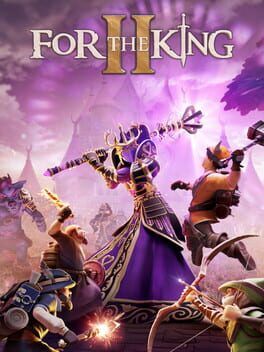
Class design is where the sequel earns its place. The roster is bigger, and more importantly the roles overlap less than in the original. You have brawlers and archers, support-focused characters, hybrid casters and some stranger picks that hinge on debuffs or battlefield manipulation.
What stands out is how the classes encourage synergy. Building a party of four feels like assembling a combo deck. You start thinking about stacking bleed, armor shredding or evasion buffs. You pick classes that compensate for each other’s weak stats so that your party can pass as many world checks as possible. Unlockable advanced classes deepen this further, though they can be slow to reach if you are not already winning.
Balance is a mixed bag. Some early-game classes feel overtuned compared to their peers, especially those with crowd control attached to fairly basic attacks. Others come online so late or require such specific gear that most players will simply not see their full potential before a run collapses. That said, across a handful of campaigns, you are unlikely to feel completely trapped by bad choices. The broader toolset mostly helps more than it hurts, even if a later rebalance patch would be welcome.
A rough but improving balance pass
If you played For The King on high difficulties, you expect cruelty, and For The King II leans into that. The issue is less about being hard and more about being swingy. Enemy damage spikes early in the campaign can feel out of line with your available tools, particularly in co-op where a couple of bad initiative rolls can mean two characters die before you have a chance to respond.
There are also encounters that feel like they were tuned in isolation, not in the context of an entire run. A dungeon might be trivial, only for a random overworld pull to wipe you three tiles later because it happened to roll a brutal enemy combination. The game has received patches since launch that address some of the worst offenders, but the core experience is still more volatile than the first game. You need to be comfortable with the idea that sometimes the dice will simply bury you.
Economy balance is similarly uneven. Gold feels stingy in the early chapters and then floods you later if you manage to survive. This can produce awkward pacing where you limp through the first half of a run scraping together healing herbs and budget weapons, then end up overstocked and overgeared at the tail end. It is not run-breaking, but it does sap some tension from the late game.
Co-op and online stability
Co-op was the soul of the original, and that is still true here. Up to four players can control one character each, coordinating movement across the shared overworld and taking turns in combat. Because For The King II retains its board game flavor, it continues to be a perfect “talk around the table” style game on voice chat, full of agonizing group decisions over whether to split the party or burn precious Focus.
Online stability at launch was rocky, with desyncs and disconnects that could undo long sessions. Post-launch updates have smoothed a lot of that out. On PC, current builds are generally stable for multi-hour campaigns, though the occasional dropped player or stuck combat still happens often enough to be annoying. The reconnection tools are better than they were but not bulletproof. If someone’s connection dies at the wrong time, you may need to reload or, in the worst cases, restart a chapter.
Local co-op avoids those issues and is arguably the ideal way to play if you can manage it. The interface is serviceable with multiple players, though the added layers of menus and party management compared to the first game make it a bit more cumbersome to parse on a couch.
PC performance and controls
On PC, performance is stable on modest hardware. The art direction keeps the chunky, toy-box look of the original, and the sequel adds more environmental variety and atmospheric lighting without becoming visually busy. Load times between zones and dungeons are short, and hitches in combat are rare.
Mouse and keyboard controls remain the most natural fit. Hex selection, inventory juggling and targeting flow smoothly, and the UI is readable at a glance. The downside is that some of the deeper systems are tucked into nested menus and tabs. When you are trying to compare multiple weapons, enchantments and class passives, it can feel like you are wrestling with the interface more than you should.
If you are approaching the game with a controller, expect some extra friction. The radial menus and button mappings are workable, but selecting specific hexes, swapping gear across characters and navigating text-heavy menus never feels as quick or precise as it should. It is playable, not ideal.
Is it a must-upgrade for fans?
For The King II is not a clean, universally better sequel. It is bigger, harsher and more complex. In some areas that is exactly what a returning fan wants. The multi-chapter campaign, expanded class roster and more tactical combat rows create a deeper strategy layer. When a run is going well and the co-op chatter is flowing, it easily matches the highs of the first game and occasionally surpasses them.
At the same time, the balance volatility, uneven economy and residual online quirks mean it is less immediately approachable than its predecessor. New players may actually be better served starting with the first For The King, learning the cadence of its rogue-lite campaigns, then graduating to the sequel once they know what they are signing up for.
If you loved the original and want more, For The King II is worth the upgrade, provided you are patient with its rough edges and ready for a more demanding campaign. If your group already bounced off the first game’s difficulty or randomness, the sequel’s extra layers and sharper spikes will not change your mind.
For strategy-RPG and tabletop-inspired rogue-lite fans who enjoy suffering through near misses with friends, though, this is a rich, occasionally infuriating, often rewarding return to Fahrul.
Final Verdict
A solid gaming experience that delivers on its promises and provides hours of entertainment.