
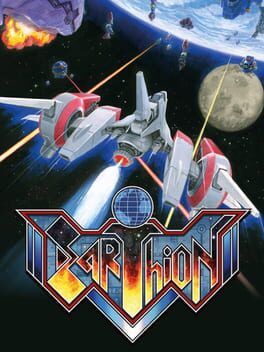
Review

By Apex
A New Old-School Benchmark
Earthion arrives with an almost unfair amount of expectation attached to it. A new horizontal shooter from Ancient and Yuzo Koshiro, pitched as a "real" Mega Drive project first and foremost, then brought to modern platforms in a 16:9 version. In 2025, when R-Type Delta: HD Boosted and Gradius Origins are already giving veterans pristine ways to revisit the genre’s past, Earthion has to justify its existence as more than nostalgia.
It does. Earthion is not just a good retro shooter. It is one of the sharpest, most confident horizontal shmups of the current wave, and it earns that status through its run-to-run upgrade system, its superb boss encounters, and a stage roster that actually understands what variety means in a 40-minute arcade loop.
Feel and Fundamentals
Earthion takes clear inspiration from Thunder Force IV and Gradius, with fast lateral movement, aggressive enemy waves, and terrain that matters. The default ship feels slightly brisker than most R-Type craft but with enough inertia to make micro-taps meaningful. Hitboxes are fair and clearly telegraphed, which keeps the game hard without ever feeling cheap.
Weapon handling is punchy. Your basic forward shot is immediately satisfying, and secondary weapons snap into place with audible and visual feedback that screams "16-bit," but the game quietly benefits from modern responsiveness. Inputs feel latency-free on PC and consoles, and 16:9 gives everything a crucial bit of extra breathing room without turning stages into empty corridors.
Importantly, Earthion is not a bullet hell. Pattern density is moderate by contemporary standards, closer to late-90s console shooters. You are weaving through layered patterns and terrain rather than threading through curtains of neon pellets. That focus on positional play feeds directly into how the upgrade system works.
Run-to-Run Upgrades That Actually Respect Skill
On paper, tying a meta layer to a traditional 1CC-focused shooter sounds like a way to dilute the purity of the arcade loop. Earthion sidesteps this by making its run-to-run upgrades feel like earned refinements instead of blunt-force power spikes.
At the end of each run, and at a few mid-run junctures, you earn upgrade points based on performance. Survival matters, but so do no-miss sections, boss clear times, and secrets. Spending those points unlocks new weapon loadouts, sub-weapon behavior, and defensive quirks rather than raw damage inflation.
Instead of a permanent plus-20-percent damage upgrade, you might buy an alternate missile spread that trades homing reliability for screen coverage, or a shield variant that absorbs one hit but recharges if you maintain a kill chain. These choices change how you approach routes and bosses rather than just making them melt faster.
The clever touch is that Earthion keeps the per-credit balance mostly intact. Even with a developed profile, you cannot transform an early-stage mistake into an effortless victory. Stronger options open up new high-risk, high-reward lines rather than offering a low-effort crutch. If you care about classic play, you can stick with default loadouts and still have a fully coherent arcade experience.
The only misstep is in how slowly some late-game unlocks arrive. Players who already have the skill to reach loop content might find themselves grinding a handful of slightly rote early runs to access some of the more exotic weapon evolutions. It is not ruinous, but the pacing assumes you are content to live in the game for a while.
Stage Variety That Earns Its Loops
Horizontal shooters live or die on stage design, and Earthion’s campaign understands that variety is more than just changing the background tiles. Across its core stages and alternate routes, it constantly toys with tempo, visibility, and terrain control without leaning on gimmicks for gimmicks’ sake.
The opening orbital approach is pure comfort food, a clean introduction where enemy waves telegraph the game’s fondness for crossfire and pincer attacks. It is forgiving enough to let new players settle in, but careful routing already pays off in score and upgrade currency.
Things escalate quickly. A canyon run pays homage to Thunder Force, with vertical scroll bursts that conceal turrets in overhangs and demand foreknowledge. A derelict space colony stage leans into claustrophobic corridors and power-down hazards, with narrow chokes that make your ship feel just a touch too big for comfort. Another standout is a storm-lashed atmospheric dive where foreground elements and lightning flicker to obscure bullets. It is visually busy but stops short of being unreadable, and repeated runs reward you with a genuine sense of mastery as you learn to read silhouettes in chaos.
Alternate routes deepen the replay loop. Clearing certain objectives or taking risky paths can branch you toward secret stages with their own bosses and enemy sets. These are not throwaway extras. One hidden route in particular brings in organic, Darius-style bio-mechanical foes and shifting parallax that looks stunning in motion. The payoff is both mechanical, with higher scoring opportunities, and aesthetic, since the game reserves some of its best setpieces for these paths.
Checkpoints are merciful without being generous. Dying in later stages typically sends you back far enough to make a mistake sting, but not so far that a single death invalidates a strong run. Combined with the meta progression, this helps Earthion walk a careful line between arcade harshness and modern approachability.
Boss Design: Spectacle With Teeth
It is the bosses that really cement Earthion as a modern standout. These fights are readable, pattern-driven battles that change shape as you chip away at armor and limbs, rather than pure HP sponges.
Take the early orbital defense satellite. Phase one is a ring of turrets and laser arrays that rotate in time with the background parallax, forcing you to parallel-park in safe zones. Break enough segments and the core sheds its outer shell, switching to sweeping beams that key off your position. It is a brisk encounter, but it teaches you that bosses in Earthion rarely stick with a single pattern.
Mid-game, the tank-train boss that rumbles through a cityscape is a highlight. You can prioritise specific cars, sniping missile platforms or anti-air cannons to simplify later patterns. If you are aggressive, you blow off components and change the fight’s arc, shaving off attack sequences at the cost of having to deal with nastier retaliation earlier. It feels dynamic on replays, especially as your build choices change your best targets.
The late-game bio-mechanical leviathan is where Earthion fully channels Gradius energy. Segmented hitboxes, destructible pods, and internal weak points create a boss that is half encounter, half micro-stage. You are dodging organic laser arrays in tight tunnels one moment and then back outside looping around the creature’s carapace. It is demanding but fair, and it makes great use of the screen width on modern platforms.
Crucially, bosses always telegraph. Bullets are high-contrast, warning cues are clear, and death almost always feels like a failure to learn rather than a camera or clarity problem. Even in busier fights, there is a disciplined restraint to projectile density that keeps Earthion on the side of old-school pattern memorization instead of modern bullet mazes.
Presentation: 16-bit Roots, Modern Polish
Earthion’s visual identity struck a perfect middle ground for me. On PC and consoles, the 16:9 version expands the playfield while staying faithful to Genesis color limitations and pixel density. Backgrounds layer parallax smartly, with orbital debris fields, city skylines, and asteroid belts all moving at slightly different speeds. Explosions crack with that chunky, multi-frame flair that defined late-16-bit shooters.
The game is not chasing the ultra-clean, razor-sharp look of a pure HD sprite set, nor is it slavishly emulating CRT output. Instead, it feels like the best version of a Genesis game running through pristine modern hardware. Optional filters let you nudge it toward softer or sharper looks without compromising clarity.
Koshiro’s soundtrack is predictably stellar. It leans on driving FM basslines and crisp percussion, layering in more modern synth textures during climaxes. Stage themes are distinct, and boss tracks kick hard enough that I never once considered turning the music down to hear bullet cues. Earthion sounds like a lost cousin of Thunder Force IV and Streets of Rage 2, which is exactly what you want from this team.
Performance is rock solid across platforms. Even the most chaotic explosions and overlapping particle effects hold at a stable frame rate, which is crucial for a skill-driven shooter. Input latency is low enough that I never felt the need to tinker with display modes beyond turning off any TV-side processing.
Positioning Among Today’s Retro Shooters
In a year where R-Type Delta: HD Boosted and Gradius Origins dominate the conversation around horizontal shooters, Earthion manages to carve out its own lane. The former are essentially preservation projects with modern niceties. They are essential, but they are also familiar.
Earthion, by contrast, feels truly new while speaking the same language. Its run-to-run upgrade structure acknowledges that players in 2025 expect some form of progression, yet it refuses to trivialize the 1CC chase. Its bosses are more reactive and segmented than many of their 90s counterparts without devolving into script-heavy setpieces. Its stages riff on past greats but are built from the ground up with modern aspect ratios and clarity in mind.
If you want a pure museum piece, the HD re-releases still win. If you want a game that understands why those classics worked and then nudges the genre forward, Earthion is the shooter to beat right now. It belongs in the same conversation as those reissues, not as a novelty but as a peer.
Verdict
Earthion is a rare thing: a retro-inflected shmup that feels like it actually belongs in 2025. Its finely tuned run-to-run upgrades give it long legs without compromising arcade purity, its bosses are consistently inventive, and its stages earn their replay value with smart routing and sharp visual identity.
A slightly drawn-out unlock curve for some of the more interesting upgrades is the only real knock, and even that quibble assumes you are not already content to grind for just one more better run.
If you care at all about horizontal shooters, Earthion is essential. In a crowded field of retro re-releases and nostalgia bait, this one stands tall as a genuine modern standout, worthy of every 1CC you will inevitably chase.
Final Verdict
A solid gaming experience that delivers on its promises and provides hours of entertainment.