
Review

By The Completionist
Drywall Eating Simulator has a killer one-sentence pitch: life is so numbing that the only sane response is to walk away from small talk, KPIs, and middle managers to gnaw a hole in the nearest wall. As a snapshot of everyday stress and the impulse to opt out, it is painfully on point. As a game built around that idea, it keeps tripping over its own feet.
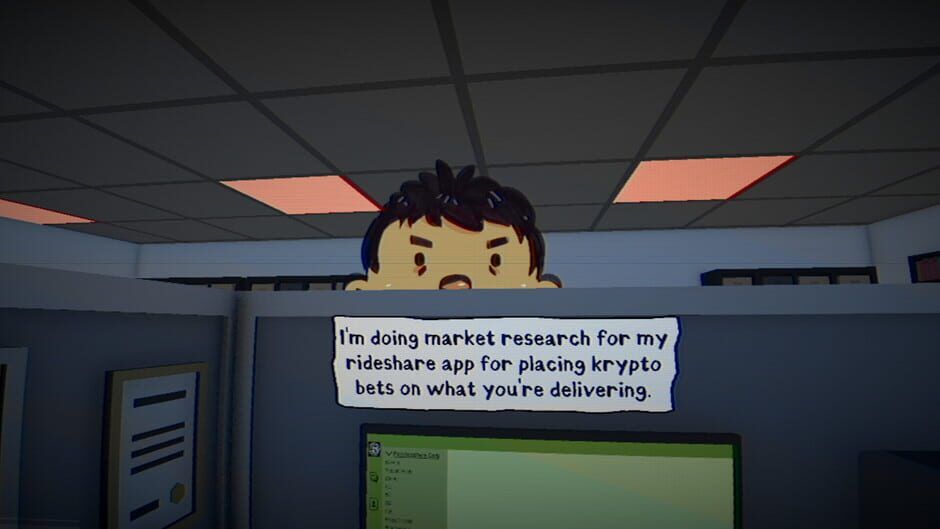
At its best, this is a quietly vicious satire of modern work. You clock in to retail-like spaces and bland offices, navigating stiff conversations with customers, coworkers, and bosses. Dialogue is pointed but rarely subtle, poking fun at hollow corporate jargon, weaponized positivity, and the way responsibility flows down while credit flows up. The world feels intentionally awkward, from the stiff animations to the dead-eyed stares, mirroring that feeling of being trapped in a conversation you cannot escape.
The escape valve is the drywall. When it all becomes too much, you slip away, find a nice, flat surface, and start eating. In first person, you inch close, center a patch of wall, and click to rip out chunks. Each bite leaves a jagged hole, plaster dust drifts down, and the sound design leans into chalky crunches and muffled scraping. The simple act of destroying an unfeeling surface works as a crude metaphor for breaking through pressures you cannot otherwise push back against.
That core loop of endure, withdraw, devour is the smartest part of the design. It captures the rhythm of surviving a draining job: hold it together, absorb the nonsense, then sneak off for a private, slightly shameful coping ritual. The way the game makes you physically walk away before you can start chewing underscores how far you have to move to feel even a little in control.
Unfortunately, the exploration wrapped around that loop is where the frustration stops being productive. Navigation is clumsy. Movement has an unpleasant float that makes tight spaces annoying rather than tense. Interact prompts are fussy, so you shuffle around scenery just to get the game to recognize that yes, you really do want to open this door or talk to that NPC. The layouts often feel like slightly varied corridors, and when you are already being asked to marinate in irritation, getting lost in visually similar spaces pushes the experience from intentional discomfort into plain tedium.
The actual wall eating also undercuts itself as it goes on. Early on, lining up the perfect bite and carving out a crude tunnel is grimly funny. After a while, the process becomes a slog of tiny, nearly identical nibbles. The hit detection can be inconsistent. Sometimes a bite registers as a big satisfying gouge, other times it feels like the click goes nowhere and you are left pecking at the same spot. When the game wants you to clear a larger area, the repetition is deadening in a way that does not feel insightful, just poorly paced.
This repetition might be defensible if the game escalated the comedy alongside the grind, but instead it tends to recycle the same tone. The satire of everyday stress never really sharpens; it just repeats. You hear variations on the same management clichés, the same customer entitlement, the same passive-aggressive directives. The premise begs for escalation, for scenarios that push the absurdity or horror of modern work to new extremes, and instead it mostly spins in place.
Performance problems make the experience even rougher, especially if you are tempted to treat it as a portable oddity. On a desktop PC with decent specs, frame pacing hitches crop up during busier scenes and in some of the denser interiors, which is already disappointing in something that looks this modest. On handheld PCs like the Steam Deck, things degrade significantly. Dropped frames, inconsistent frame times, and occasional hitching when loading new areas or heavily damaged walls can turn basic navigation into a stuttery mess.
Because so much of the comedy relies on timing and mood, this instability matters. A joke that should land as you pivot from a soul-sucking exchange into a cathartic drywall binge instead gets swallowed by a half-second freeze. Wandering a cramped office at sub-30 FPS is not “part of the bit,” it is just a technical failure that muddies the experience. Tweaking settings helps somewhat, but even aggressive reductions cannot fully smooth out the performance on handheld hardware.
What keeps the game from collapsing entirely is that its concept is undeniably strong, and when things line up, it hits something raw and real. The mundanity of the environments, the way you trudge past motivational posters and bland décor, the contrast between forced politeness and private vandalism, all speak to a particular flavor of contemporary burnout. There are moments when you gouge an ugly, jagged tunnel through a pristine corporate wall and it feels genuinely transgressive, in a pathetic kind of way.
Yet for every honest moment, there is another where the rough edges pile up. Awkward physics occasionally fling debris around in ways that break the atmosphere. Minor bugs, like misaligned interaction points or textures flickering as you chew deeper into a wall, distract more than they amuse. The game seems to want you to sit with discomfort, but it lacks the polish and variation to make that discomfort consistently compelling.
The real question is whether the humor and premise justify putting up with these problems right now. As a short, experimental curiosity sampled on a capable PC, it is easy to appreciate what Drywall Eating Simulator is trying to say about everyday stress and the absurd things we imagine doing just to feel in control. As something you might actually want to play through, especially on a handheld, it feels like a draft.
If you are drawn to stranger, more abrasive indie experiments and have the patience to push through uneven performance and repetition, there is enough here to chew on, figuratively and literally. For everyone else, the joke runs out long before the walls do, and the game’s rough edges start to feel less like intentional discomfort and more like simple lack of refinement. With more optimization and sharper pacing, this could become the definitive interactive ode to biting through late-capitalist misery. Right now, it is mostly a reminder that some ideas need more than a single thick coat of plaster to hold together.
Final Verdict
A solid gaming experience that delivers on its promises and provides hours of entertainment.