
Review

By Big Brain
A football game that barely cares about football scores
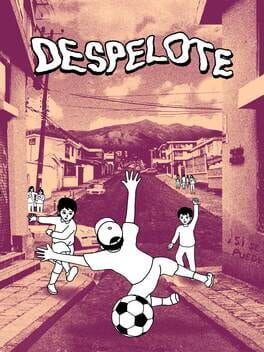
Despelote opens not with a stadium roar or a tactics screen, but with the scratch of cheap shoes on concrete and the echo of a ball in a narrow Quito courtyard. You play as eight‑year‑old Julián in the late 90s, as Ecuador inches toward qualifying for the 2002 World Cup. That historic campaign hums in the background, on radios and TVs and in overheard conversations, but the real subject is smaller and more intimate: what it feels like to be a kid whose world is slowly, finally, getting bigger.
Calling Despelote a sports game is almost misleading. There are no leagues, no team management, no stats to grind. Instead it is a semi‑autobiographical slice‑of‑life vignette where football is the language everyone speaks, the excuse for wandering, and the tool the game uses to say something honest about memory and place.
Semi‑autobiographical storytelling with the texture of memory
Developer Julián Cordero draws directly from his own childhood in Quito, and that personal history gives the writing a lived‑in specificity most games never touch. Conversations drift between football gossip, family worries, school anxieties, and stray bits of neighborhood drama. Adults complain about money and politics while kids repeat half‑understood slogans. It feels less like a scripted narrative and more like eavesdropping on a city at a particular, unrepeatable moment.
What makes this work is how loosely structured it all is. Rather than funneling you through big dramatic beats, Despelote trusts the weight of small details. Someone rehearsing goal calls in an empty classroom. A friend secretly terrified of repeating a grade. Shopkeepers who begrudgingly tolerate your ball skimming their merchandise. These vignettes stack into something larger, a portrait of a community hanging its hopes on a distant team and the kids who are just beginning to understand what that hope means.
The semi‑documentary quality is reinforced by its use of real audio and a bilingual script that lets Spanish breathe instead of flattening it for an English‑only audience. Subtitles are there, but the rhythms of delivery, overlapping chatter, and abrupt changes of subject are all doing narrative work. This is not just a story about football fans. It is a memory scrawled across walls and sidewalks, smudged around the edges the way real recollections are.
Kicking the ball as exploration, mischief, and character study
Mechanically, Despelote is incredibly simple. You walk, you talk, and, crucially, you kick a ball. That is almost the entire input vocabulary, yet the game wrings surprising nuance out of this tiny set of verbs.
Kicking the ball is how you test the world. A gentle tap down a side street invites you to follow and see what conversations you accidentally interrupt. A hard shot at a bench might send pigeons scattering or provoke a scolding adult. Rolling the ball around a park becomes a way to map its subtle elevation changes and hidden nooks, as much as it is a way to annoy your friends.
Because you are a kid, the ball is your proxy. You would not walk up to a stranger to see how they react, but you will absolutely shank a shot that bounces perilously close to their stall. The city responds accordingly. People shout, laugh, grumble. Some join in, some tell you off. Each reaction is characterization without exposition, sketching their personalities through the thin line between playful disruption and genuine nuisance.
There are a few more directed sequences that briefly formalize the kicking into mini matches or challenges, yet even these resist traditional sports design. The outcomes are rarely about whether you “win.” Instead, they are about what the attempt reveals. A scrappy game in a cramped lot shows how kids invent pitches wherever they can. A more organized match hints at budding hierarchies of skill, class, and confidence, as certain kids automatically take the forward positions while others hang back.
In Despelote, dribbling down a street is character work. Your clumsy, slightly floaty control of the ball underlines Julián’s age and inexperience. When you finally pull off a clean pass through a congested alley, it feels less like mastering a system and more like a child momentarily feeling the world snap into place.
A city painted with mixed media and shared obsession
Visually, Despelote blurs the line between documentary and dream. The streets of Quito are rendered with a mix of stylized 3D, photo textures, and hand‑drawn detail that makes every block feel specific. Sunlight washes out colors at midday, graffiti and posters flake on stucco walls, and hills roll away in hazy distance. It is not photorealism in a tech demo sense. It is realism in the emotional sense, the way your mind stitches together fragments of places into a coherent mental map.
That aesthetic choice matters because setting is the real co‑protagonist. The city changes as Ecuador’s qualifying run progresses. Flags appear. More people cluster around televisions. Conversations grow fevered, then nervous, then euphoric. The match broadcasts you glimpse are grainy, rooted in real historical footage, and their presence shrinks the gap between this digital Quito and the one outside the game.
Football is the throughline tying these visual and social changes together. Chalk scuff marks on walls, street sellers hawking knockoff jerseys, kids re‑enacting famous goals hours after the final whistle, they all show how the sport saturates public space. Despelote never lectures you about “the power of sport.” It just lets you feel how the game’s orbit pulls everyone in, from your mother negotiating work and childcare to the grizzled guy at the corner store who swears he could have gone pro.
Why it stands apart from traditional sports games
Most sports games frame football as performance. You are the coach, the superstar, the invisible hand optimizing line‑ups and formations. Narrative, when it appears at all, is usually grafted on through cutscenes about rivals and championships. Despelote walks away from all of that.
Here, football is context and catalyst, never a spreadsheet. There are no season modes, no transfer markets, no card packs or gear treadmills. You are not climbing a ladder of divisions. You are weaving through crowds, trailing conversations, and learning how a nation’s fragile optimism seeps into the lives of children who barely grasp its stakes.
The closest point of comparison is not FIFA or eFootball, but diary‑like narrative games and city walks that use light interaction to ground you in a perspective. Yet the ball makes a crucial difference. Where many walking simulators risk becoming passive sightseeing, Despelote gives you a toy that inherently interacts with physics, people, and space. Your kicks, good or bad, are little authored moments that shift how scenes play out. The sport is not a backdrop so much as a conversational partner.
Crucially, the game understands when to stop. It is short, focused, and uninterested in padding its runtime with repetitive drills. Some players will bounce off that brevity, especially if they arrive expecting a robust set of modes. But its compact length is part of why it hits so hard. Like a specific childhood afternoon you remember with impossible clarity, it flares up, burns bright, and is gone.
Verdict
Despelote is not for someone looking for their next obsessive sports sim. It is for anyone who has ever watched a city hold its breath over a match, or who remembers being eight years old and only half understanding why the adults around them suddenly cared so much about a ball on a faraway field.
As a narrative football vignette, it is remarkable. The semi‑autobiographical storytelling is intimate without being insular, the act of kicking the ball is woven deep into exploration and characterization, and its depiction of Quito during a pivotal qualifying campaign feels both specific and universal. Where traditional sports games chase authenticity through licenses and photorealistic kits, Despelote finds something truer in dusty playgrounds, echoing alleyways, and the small, stubborn joys of sending a ball skittering just a little farther than you could yesterday.
If you are willing to trade league tables for lived experience, Despelote is one of the most affecting sports‑adjacent games in years.
Final Verdict
A solid gaming experience that delivers on its promises and provides hours of entertainment.