
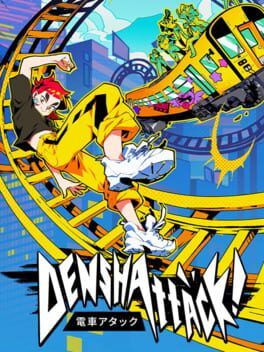
Review

By Pixel Perfect
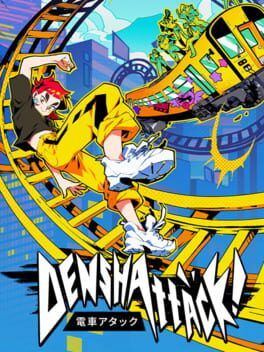
Image: IGDB
Store links: Denshattack! on Steam
A breakout launch with one loud caveat
The strongest concrete fact around Denshattack! is that its launch buzz is real. OpenCritic lists Undercoders’ train-stunt action game in the 98th percentile of scored games, while the r/Games review thread for Denshattack! recorded an 87 average and 96 percent recommended across 46 reviews. That is a rare reception for a new indie action game built around the absurd pitch of trains doing skateboarding tricks through a post-disaster Japan.
The tension is that the praise is not unanimous. Rock Paper Shotgun called Denshattack “utterly and genuinely brilliant,” Eurogamer described it as “irreverent, unpredictable, funny, and unputdownable,” Console Creatures gave it a 10 out of 10, and CGMagazine scored the PC version 9 out of 10. PC Gamer, however, landed far lower with a 63 out of 100, calling it “an inconsistent spectacle that fails to make good use of its chosen themes.” Nintendo Life’s OpenCritic excerpt also praised the arcade hook while arguing that “needless fluff” bloats the experience around it.
That split is useful for buyers. This Denshattack review is therefore less about whether the Denshattack game has energy, because every source agrees it has that in abundance, and more about whether its speed, combat, trick scoring, and maximalist storytelling hold together long enough to justify a purchase. For players who live for stylish momentum games, the answer is mostly yes, with one important warning: Denshattack! asks for patience before it gives you full fluency.
The trick system is the sell, and it has teeth
Denshattack! is repeatedly described by critics as a train skateboarding game, but the comparison only gets you halfway there. Rock Paper Shotgun reports a driving style built around multi-track drifting, grinding over broken bridges, and a thumbstick-flick trick system whose early accessibility hides deep, finger-twisting score potential. The in-game “Tricktionary,” according to RPS, lists individual moves and their inputs, which gives score chasers a clear reference point rather than leaving advanced play buried in guesswork.
Eurogamer’s review adds the crucial caveat: the opening hours can be rough. Even with experience in OlliOlli and Tony Hawk’s games, Eurogamer’s reviewer said they adapted slowly to the controls. The first two worlds are described as tutorial-heavy, teaching jumping, braking, drifting, slamming back onto tracks after derailing, kickflips, heelflips, special moves, wall-rides, vert transfers, manuals, and combo linking.
That makes Denshattack! a better fit for players who enjoy the learning curve of momentum games than for anyone looking for a frictionless spectacle ride. The game’s appeal is in the moment when a chaotic track stops feeling like a cartoon accident and starts reading as a line. If you enjoy chaining manuals in Tony Hawk, chasing cleaner runs in OlliOlli World, or surrendering to the rhythmic precision of Hi-Fi Rush, the sources suggest Denshattack! understands that loop. If you bounce off games that front-load mechanics, you may feel the strain before you feel the flow.
Speed, combat, and stage design keep changing the rules
The best case for Denshattack! is that its stages appear to keep finding new ways to use the same core verb: move fast, stay stylish, survive the track, and turn spectacle into control. Console Creatures reports five broad level types: finish-line stages, high-score trick stages, races, multi-objective levels with multiple routes, and boss battles. That variety matters because a trick system this loud could have become repetitive if every stage were only a score lane.
The combat and boss material are where the game seems to push hardest into cartoon absurdity. Console Creatures describes stages where Emi lands atop a giant Ferris wheel, breaks it loose, and rides it through the bay, as well as sequences involving crashing through enemies and a giant boss that throws baseballs. Rock Paper Shotgun also refers to a giant baseball chase and an AI data centre being destroyed by ploughing a locomotive through it. These details are ridiculous on paper, but the consistent critical thread is that Denshattack! turns ridiculousness into set-piece design rather than leaving it as a joke.
That said, the speed is not free spectacle. Rock Paper Shotgun notes that the game moves fast enough that players must pay attention to rapidly approaching hazards. Eurogamer describes it as hard, with a “just-one-more-go” pull similar to OlliOlli. The Denshattack action game therefore sits closer to arcade mastery than passive rollercoaster. Its best moments appear to come when the player is reacting, steering, tricking, and fighting all at once, not merely watching a train do something wild in the background.
The style works because the world gives it pressure
Denshattack!’s premise could have survived on visual novelty, but the sources agree that Undercoders gives the chaos a social and emotional frame. Rock Paper Shotgun describes Emi as a ramen-on-rails driver in a climate-ravaged Japan where wealthy people have retreated into domed cities while others scrape by outside. Console Creatures likewise frames the story around environmental catastrophe, giant domes, high-speed rail lines for the powerful, and Emi’s delivery work helping her community before she discovers Denshattack, the illegal train-battle culture used by gangs across Japan.
CGMagazine supplies more specific story context, naming the protagonist as 19-year-old Emi Araki from Beppu in Ōita Prefecture and describing a mega-corporation called Miraidō, which operates the country-spanning VACTRAIN. Console Creatures says the story grows into an anti-capitalist and anti-corporate campaign about community and love, while Eurogamer’s OpenCritic excerpt calls the game “anti-capitalist, pop-punk optimism distilled.”
Here, PC Gamer’s dissent is worth taking seriously. Its verdict says Denshattack! fails to make good use of its chosen themes. That does not erase the broader praise for Emi and the cast, but it does suggest the writing may land differently depending on tolerance for shounen-style earnestness. Console Creatures calls the story cheesy at times but sincere. For buyers, that is the fair read: expect loud heart, broad villains, big friendship energy, and political framing delivered with maximalist anime confidence rather than subtle restraint.
PC, Deck, price, and platform details
For practical buying advice, the reported facts are mostly clear, though there is one publisher-listing wrinkle. PC Gamer’s “Need to know” box lists Denshattack! at $20, with Undercoders as developer, Fireshine Games and Boltray Games as publishers, no multiplayer, no VR, and Steam Deck Verified status. CGMagazine lists the MSRP as $19.99, release date as July 14, 2026, developer Undercoders, and publisher Fireshine Games. The r/Games review thread lists Undercoders as developer and Fireshine Games as publisher, with PC and Nintendo Switch 2 dated June 15, 2026, and PlayStation 5 and Xbox Series X/S dated July 15, 2026.
Those source details do not perfectly align. CGMagazine’s date differs from the r/Games platform dates, and PC Gamer includes Boltray Games where CGMagazine and the r/Games thread list Fireshine Games alone. The safest conclusion is that Undercoders is the confirmed developer across sources, Fireshine Games is consistently attached as publisher, Boltray Games appears in at least PC Gamer’s listing, and buyers should verify the current storefront page for exact regional release timing and publisher display.
On performance, the source material is thinner than the praise might imply. PC Gamer reviewed the game on a very high-end laptop with an Intel Core Ultra 9 275HX, RTX 5090 laptop GPU, and 64GB of RAM, but the provided excerpt does not give detailed frame-rate results. The most useful portable note is Steam Deck Verified from PC Gamer, echoed by the r/Games thread excerpt of Console Creatures saying it “plays great on Deck.” For a Denshattack PC review buyer, that points to encouraging handheld compatibility, but not enough sourced data to make promises about low-end PCs.
Buying advice and score
Denshattack! justifies the launch buzz for the audience most likely to search for it: players who want stylish, momentum-driven action with trick scoring, speed, expressive inputs, and levels that keep escalating. Its strongest reported qualities are the feel of chaining tricks at high speed, the constant set-piece variety, the cel-shaded pop-punk presentation, and a campaign that critics such as Rock Paper Shotgun, Eurogamer, Console Creatures, and CGMagazine found unusually joyful and inventive.
The reasons to wait are equally clear. If you dislike steep early learning curves, Eurogamer’s warning about frustrating first hours should matter. If you prefer lean arcade games without story or map structure around the runs, Nintendo Life’s OpenCritic excerpt about bloat is relevant. If you need nuanced political writing, PC Gamer’s much cooler assessment suggests Denshattack!’s themes may feel underused or inconsistent to some players.
For everyone else, especially fans of Tony Hawk, OlliOlli, Jet Set Radio, and expressive indie platformers, this looks like one of 2026’s easiest recommendations at the reported $19.99 to $20 price. It is a buy if you want to learn a system, chase cleaner runs, and let a small studio throw every wild train idea it has at you. It is a cautious buy if you only want instant gratification. It is a wait if you need broad accessibility, multiplayer, or a low-chaos arcade format.
Final Verdict
A solid gaming experience that delivers on its promises and provides hours of entertainment.