
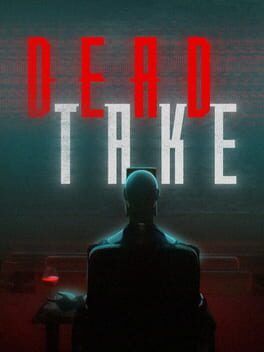
Review

By Story Mode
Platforms: PC
Developer: Surgent Studios
Publisher: Pocketpair
Genre: FMV horror, first-person adventure
Dead Take wants to be the horror equivalent of a prestige escape room: you’re trapped in Cain’s opulent mansion, piecing together codes and riddles while scrubbing through live‑action footage of washed‑up Hollywood monsters in human skin. On paper, it is an irresistible pitch, especially with Ben Starr and Neil Newbon chewing the scenery in full FMV glory.
As a live‑action experiment, Dead Take is confident and frequently gripping. As an escape‑room style game, it never quite trusts you to be clever, and that’s where the tension leaks out.
FMV performances: a horror movie worth unlocking
Dead Take’s strongest trick is obvious the moment you sit down in the estate’s private theater and start feeding USB sticks into the projector. The live‑action clips of auditions, interviews, and behind‑the‑scenes footage are uniformly well shot and sharply edited, framed with grainy lenses and sickly lighting that make the whole thing feel like a cursed Hollywood EPK.
Starr and Newbon are the anchors. Starr’s Vinnie Monroe is all wounded vulnerability and brittle ego, a guy who knows he’s disposable but hasn’t worked out where the cameras really are. Newbon’s Duke Cain walks a tightrope between charismatic producer and predator, smiling his way through questions that clearly terrify everyone else in the room. Lesser FMV games feel like table reads in a garage; Dead Take, at its best, looks and sounds like an actual mid‑budget horror film.
The supporting cast sells the fiction too. Casting directors, handlers, hangers‑on and house staff all slot into their archetypes without turning into caricature. That grounded banality is important, because the mansion itself slides steadily from plausible rich‑guy excess to spatially impossible nightmare. The intercutting between your exploration and the footage you’re uncovering does a lot of heavy lifting, and it usually works.
The problem is that this material is paced like a linear film. You rarely feel like you are shaping the scenes so much as unlocking them in the correct order. When Dead Take lets its FMV clips feed directly into puzzle logic, it feels interactive and alive. When it shifts back into long stretches of non‑branching exposition, you remember you’re on rails, watching a performance that will play more or less the same no matter what you do.
Puzzle design: an escape room that keeps hiding the locks
Structurally, Dead Take certainly looks like an escape room. The Cain mansion is a web of safes, locked study doors, mysterious props rooms and themed wings built around Duke’s old movies. You will be cracking keypad codes, matching visual motifs across rooms and slotting obscure objects into equally obscure receptacles.
When the game sticks to that format, the puzzle design is solid. Codes are usually signposted somewhere in the environment or in the videos you’ve found. A four‑digit combination might be tucked into a throwaway line during an interview you watched two hours ago, or visually echoed in posters that line the theater hallway. Recreating a shot from one of Duke’s films by arranging mannequins and camera rigs is both thematically sharp and mechanically satisfying, because it fuses the filmmaking motif with spatial reasoning.
Too often, though, the escape‑room fantasy breaks. There is a recurring feeling that Dead Take doesn’t trust you to connect dots without big neon arrows. Clasps pop open the moment you pick up the right object. Doors unlock because you happened to step on an invisible trigger, not because you reasoned out a solution. A few of the headline puzzles are scarcely puzzles at all, “find the only thing you can interact with” moments dressed up as breakthroughs.
On the other side of the spectrum, the occasional outlier puzzle tips into trial‑and‑error tedium. The much‑discussed sequence where you stage a dummy‑filled scene for the cameras is a low point, reliant on fiddly repositioning and uncommunicated rules instead of logical deduction. When you finally brute‑force the layout, the solution doesn’t feel earned; it just feels like you were willing to suffer longer than the game was willing to clearly communicate.
The best escape rooms make you feel smart by strictly playing fair. Dead Take often has the right clues sprinkled around, but then undercuts that pleasure with scripting that advances progress on its own terms. You are not dismantling a locked space so much as keeping pace with a haunted house ride that occasionally pauses until you jiggle the right prop.
Branching outcomes: the illusion of directing the cut
Dead Take advertises branching paths and multiple endings, and technically that is true. Dialog choices, whether you uncover certain incriminating clips, and how deeply you probe Duke’s rot all influence which of several final montages you see and who gets out of the mansion intact.
In practice, the structure feels more like selecting from a few alternate final shots than truly branching the story. The mansion’s layout remains fixed, the core beats of Vinnie’s disappearance and Duke’s depravity hit in almost the same order, and most “choices” are simply gates that ask whether you have collected enough specific videos or documents.
You can miss scenes, and some late‑game sequences play quite differently depending on what you know. The best example is a climactic confrontation that shifts tone radically if you have already unearthed certain audition tapes. Go in ignorant and it plays as a standard horror blow‑up. Go in informed and the same confrontation reads as a quiet, horrible inevitability. That kind of recontextualization is where Dead Take’s branching design actually sings.
Sadly, there are not enough of these pivot points. Across playthroughs, you will retread the same hallways, sit through the same long theater sequences, and solve the same core locks. The outcome variations feel bolted onto a fundamentally linear spine, closer to choosing which post‑credits stinger you unlock than truly directing a different cut of events.
Worse, the game sometimes telegraphs choice while keeping the consequences meaningless. Moments that feel like they should radically alter relationships or the balance of power usually resolve in almost identical scenes a chapter later. For a game so explicitly about performance and control, it is disappointing how often your supposed agency slips right through your fingers as the script snaps back to its default path.
Replayability: one good shoot, a messy second take
The first three or four hours in Cain mansion are compelling. The mystery has just enough forward momentum, the live‑action clips are novel, and the early puzzles walk a comfortable line between thematic and accessible. As a single‑sitting psychological horror story, Dead Take works.
The moment you finish your first run and consider going back for different outcomes, the seams start to show. There is no meaningful fast‑forwarding through clips you have already watched beyond the basic skimming you do on any first pass, and the game frequently forces you to rewatch material because vital codes and hints are buried in them. What felt like careful observation the first time becomes busywork on a replay.
Route variance is thin. You might tackle a wing slightly earlier or later, depending on what caught your eye, but the puzzle chain is mostly linear. There are no radically different paths through the mansion, no alternative puzzle sets, no hard‑fork decisions that lock off whole sections of content. Once you have mapped the estate and cracked its key safes, you have essentially seen the mechanical portion of Dead Take.
What remains on subsequent runs is mostly narrative cleanup: grabbing the few missable clips and documents you skipped and nudging a small number of choices in the opposite direction to see how the ending montage assembles. That is mildly satisfying for lore completists, but it doesn’t function like a true escape‑room campaign, where different groups might legitimately have very different experiences.
Dead Take is not cynical or lazy about its replay hooks; it simply feels like a film that has been retrofitted as a branching game rather than a branching game from the ground up. Once you know the major twists, there is little mechanical or structural novelty left to justify another full trip through the mansion.
Verdict
Taken as a live‑action horror experiment, Dead Take is absolutely worth one watch. The FMV performances are sharp, the cinematography is better than it has any right to be, and the central mystery of what happened to Vinnie Monroe pays off with some memorably nasty images. If you want a stylish, actor‑driven haunted‑Hollywood story with light puzzling wrapped around it, you will have a tense, satisfying evening.
As a true escape‑room style horror game you can obsess over, replay, and gradually master, it falls short. Puzzles wobble between over‑guided and opaque, branching outcomes are more garnish than backbone, and replayability drains away the second the final credits roll. Dead Take is a slick first take on FMV mansion horror, but if you show up looking for something you can keep re‑staging like a favorite locked‑room, you may walk away wishing the team had been bold enough to really let players direct the cut.
Final Verdict
A solid gaming experience that delivers on its promises and provides hours of entertainment.