
Review

By MVP
[Previous preview note: This review builds on our earlier hands-on with a pre-demo build of DarkSwitch, which already hinted at something special in its claustrophobic treetop setting. The Steam prologue is our first chance to see how those ideas work as a self-contained experience.]
A self-contained climb into the canopy
DarkSwitch’s free Steam demo carves out a generous two-hour prologue that feels more like the opening chapter of a campaign than a throwaway vertical slice. You are dropped onto a colossal tree rising above a sea of mind-shredding Fog, told simply that the Tree provides, protects, and prevails, and then asked to prove it.
Structurally the prologue is smartly scoped. It walks you from a fragile hamlet of rope bridges and lanterns to a compact, multi-level treetop town that is just starting to feel alive when the credits roll. There is a clear beginning, middle, and end: first contact with the Fog, your first real defensive stand, and a final story beat that teases the wider mystery of the Veil.
As a standalone experience, it feels complete enough that you are not left wondering where the game is. Instead you are left wondering how high this tree actually goes.
Vertical city-building that earns the “built on a tree” pitch
Our earlier preview was impressed by the concept of building a city up instead of out. The prologue proves that DarkSwitch is more than a gimmicky elevator map. Every decision is forced through the lens of limited, precarious real estate.
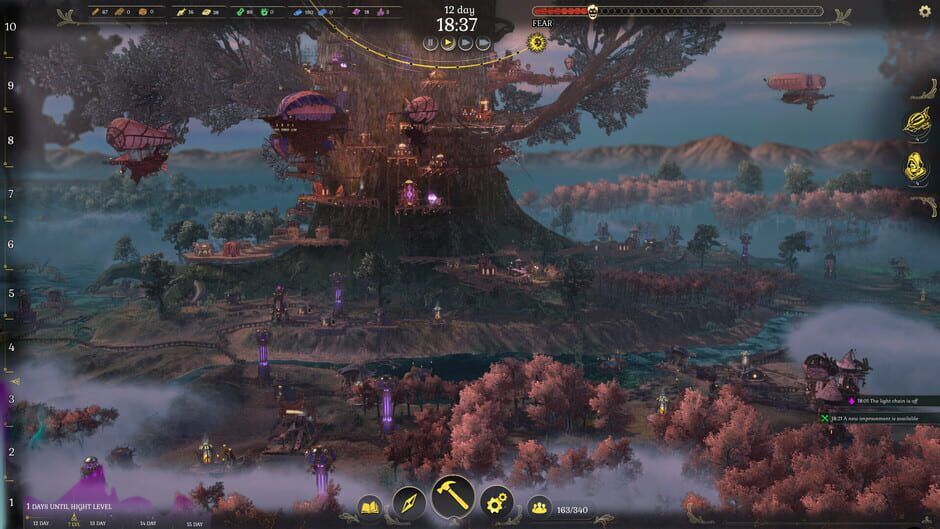
Space is not just tight, it is contested vertically. Residential pods cling to the bark while farms, workshops, and watchtowers compete for the same limited anchor points. Ladders, lifts, and branching walkways are as important as the buildings themselves, because a misplaced stairway can choke off entire districts. There is a real sense of planning three-dimensionally even though you are looking at a side-on 2D slice.
The demo’s best moments come when verticality and survival pressure intersect. You might shunt low-value industry down near the Fogline, gambling that the next wave will not quite reach it, just to keep your more fragile housing and research higher up and better lit. When the Fog surges and you realize that your outer lantern network is two stories too low, watching corruption creep up the bark while your citizens scramble along narrow walkways is genuinely tense.
Importantly, the map is not just a tall rectangle. The prologue’s tree has distinct biomes as you ascend. Knotted roots at the base, a busy mid-canopy with criss-crossing branches, and a sparse upper zone where space opens up but resources grow scarcer. Each layer nudges different layouts and tradeoffs, giving the demo’s single tree more personality than many full-release city builders manage across entire maps.
Survival, light, and the creeping Fog
The survival layer already feels cohesive in this early slice. Food, lumber, and refined materials form a familiar city-builder backbone, but all of it bends toward a single priority: keeping the Fog at bay.
Light and flame are the real currency. You chain torches, braziers, and later more advanced fixtures along the tree’s surface, pushing back the Fog in a tangible radius. Let one link go dark and coverage collapses. The demo slowly introduces variations on this idea, such as focusing intense light into chokepoints or building redundant rings of illumination in case an outpost falls.
What sells the entire system is how visually readable it is. At a glance, you can see the frontier between safety and madness. The Fog pulses in time with Akira Yamaoka’s score, surging when events escalate. When you are zoomed out, your little colony looks like a fragile string of campfires hanging over a black ocean, which does wonders for the game’s survival horror vibe.
The prologue never becomes brutally punishing, but it is not a cozy builder either. I lost my first run about an hour in because I underinvested in redundancy. One broken support, a toppled lantern chain, and a whole section of the trunk went dark, spiraling into panic as workers refused to path through the corrupted zone. The restart was fast and frictionless, and more importantly it taught a clear lesson about resilience in vertical layouts.
Tutorialization: good intentions, rough edges
The big question for this demo was less about atmosphere and more about onboarding. Could DarkSwitch teach a fairly unusual kind of city-building without overwhelming people? The answer is that it mostly succeeds, but there are a few splinters.
The tutorial layers information in sensible chapters. First you learn basic construction and worker assignment. Then the game asks you to connect resource chains vertically, explaining how ladders and lifts affect travel time. Only after this foundation is set does the Fog truly awaken, at which point light management and defense come into play.
Text pop-ups are mercifully brief and often tied to contextual highlights on the tree. When the game explains structural supports, it shades in load-bearing anchors and shows you exactly which tiles will collapse if you get too greedy. When it introduces light networks, it previews the radius before you place a torch, clearly showing how gaps in coverage will appear.
Where the tutorial stumbles is clarity in edge cases. The occupation system, for instance, lets you specialize citizens and restrict certain jobs to certain floors, but the UI tooltips on this in the demo are vague. I spent too long trying to understand why a cluster of workshops sat idle despite having free workers, only to realize that my vertical transport bottleneck was the culprit. The game eventually surfaced a warning, but far later than a new player would like.
Fog interactions can also be under-explained. The demo hints that some structures can operate while partially shrouded as long as their heart remains lit, yet the rules around this are never spelled out cleanly. Losing a building is impactful enough that the game should make these thresholds more legible.
These are not dealbreakers, but they are the one major caveat on what is otherwise a very approachable prologue. If Cyber Temple sharpens the in-game glossary and overlays before launch, DarkSwitch could be one of the least intimidating “hard” survival builders out there.
Story hooks and mood in a tight window
Narratively, the demo plays out like a pilot episode. You meet a small cast of leaders and zealots, argue over how much to trust the Tree’s supposed benevolence, and glimpse relics from earlier, fallen treetop cities below. Dialogue is brief and avoidant of exposition dumps, delivered in voiced snippets and interstitial comic-panel scenes.
It works. The religious fervor around the Tree feels founded in actual dependence rather than generic prophecy. The few moral decisions you do get in the prologue are framed within immediate survival stakes, not abstract ideology. Do you send a pioneer team down the trunk, likely condemning them to the Fog, to recover a relic that might stabilize the light network? There is no clearly correct answer, which is exactly what you want in this subgenre.
All of it rides on a presentation package that is already striking. The woodpunk art direction gives every platform and pulley a tactile, hand-built look. When the Fog surges, the soundtrack shifts into distorted chimes and low, grinding drones that feel just shy of horror without turning the game into a jump-scare machine. For a free demo, it feels lavish.
Performance and usability
On a practical level, the demo runs cleanly. Camera controls over a tall vertical map can easily become a chore, but DarkSwitch’s mouse wheel zoom and quick-snap hotkeys for different strata of the tree make navigation surprisingly painless. I rarely felt lost, even once the city stacked into five or six busy layers.
The UI, while visually dense, uses color and iconography well enough that resource flows and citizen moods are easy to parse after the first half-hour. The only rough spot is the alert feed, which can bury important structural warnings beneath minor notifications during hectic moments. An option to prioritize structural and light-network alerts would help a lot.
I did not encounter crashes or major bugs in my time with the prologue. Pathfinding occasionally hiccupped on very crowded stairwells, but pausing, deleting a ladder, and re-routing traffic usually fixed it.
Does the prologue sell a wishlist?
This is the heart of it. As a piece of marketing for a March 2026 release, does DarkSwitch’s demo feel convincing enough to claim a permanent slot on your Steam wishlist?
For anyone with even a passing interest in survival city builders, the answer is yes. The prologue nails the genre’s essentials while doing something genuinely fresh with verticality and light-driven defense. It delivers a memorable, self-contained scenario, communicates a clear design identity, and leaves obvious room for expansion in later chapters: more complex tech, more aggressive Fog behaviors, and multi-tree networks are all teased without being playable yet.
The only people I would hesitate to recommend it to are those who want either a zero-stress builder or instant Frostpunk-level brutality. The demo lands in an intentional middle ground, more about learning the language of treetop life than brutally punishing you for every misstep. That feels right for a prologue, but difficulty tuning will matter a lot in the full release.
As it stands, though, DarkSwitch’s two-hour climb is one of the most effective strategy demos on Steam right now. It explains itself just well enough, shows you something you have not quite played before, and then cuts to black at the moment you are ready to sink ten more hours into this tree.
Wishlist earned.
Final Verdict
A solid gaming experience that delivers on its promises and provides hours of entertainment.