
Review

By Parry Queen
Overview
Cross Blitz arrives at 1.0 as a lavish, boisterous mashup of RPG and deckbuilding roguelike. It splits itself between two major pillars. Fables is a story-driven campaign mode, built around bespoke encounters, character arcs, and a world map of events. Tusk Tales is a Slay the Spire style climb with branching paths, relics, and permanent meta-progression.
The good news is that the fundamentals are strong. Turns are fast, card effects are flashy without being unreadable, and the card pool is large enough to support genuine build expression. The bad news is that many of the quality-of-life problems flagged back in Early Access are still very much here, only now they are baked into what is otherwise a generous, content-rich package.
Cross Blitz is an easy recommendation if you have a high tolerance for friction in menus and information surfaces. If you are sensitive to repetition, fiddly deck management, and opaque systems, it might cap out at “weekend fling” rather than “new obsession.”
Fables: Great Characters, Uneven Campaigns
Fables is where Cross Blitz most clearly stands apart from other deckbuilders. Each protagonist gets a discrete campaign, blended with light RPG progression and exploration on a hex-based map. Named characters, goofy pirates, pop-star divas, and magical weirdos bounce off each other in a tone that sits comfortably between Saturday morning cartoon and gacha-anime spoof.
Narratively, the writing lands more often than it misses. Jokes rarely outstay their welcome, and side events do a solid job of selling each region as a place worth exploring. The campaigns are also fairly generous in length, especially once you factor in optional fights and challenges tied to unlocks.
Mechanically, Fables rides a line between tutorial and full-fat campaign. Early chapters act as extended onboarding. They drip-feed core mechanics like positioning, charge, and keyword synergies while offering curated card rewards nudging you toward particular archetypes. This structure works well for your first few hours. You get to feel powerful quickly without needing encyclopedic knowledge of the card pool.
As the campaigns progress, however, some seams start to show. Enemy encounters are frequently tuned to punish experimentation. If you try to pivot into a new synergy mid-chapter, you can find yourself soft-locked by a boss that expects a much tighter, more coherent deck than the game has helped you build. There are also stretches where the map design leans too hard on filler battles with low stakes, which drags out runs without adding meaningful variety.
Despite that, Fables is a strong, distinctive pillar. It feels like a full RPG mode rather than a glorified tutorial, and it justifies Cross Blitz as more than “Slay the Spire with cute animals.” If anything, the frustration is that UI and quality-of-life issues prevent it from being as replayable as its systems deserve.
Tusk Tales: Strong Roguelike Bones, Shaky Flesh
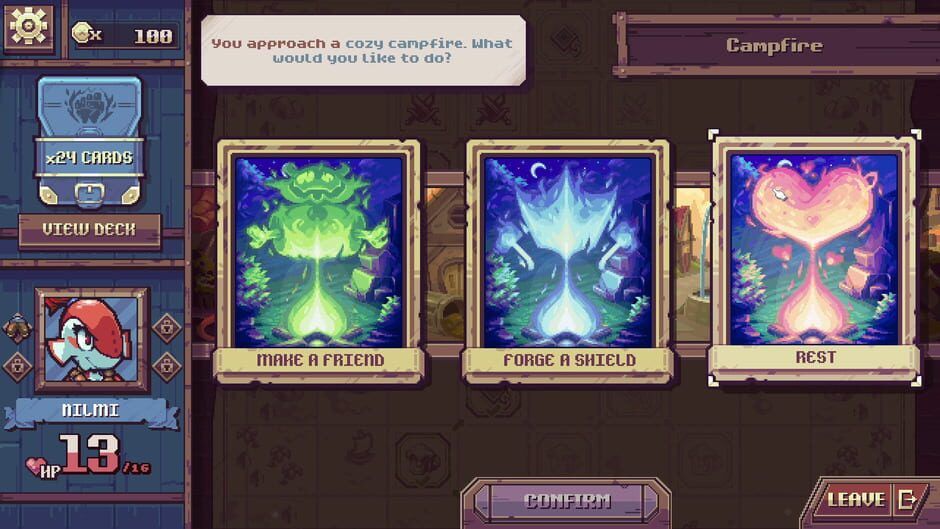
Tusk Tales is where Cross Blitz flips fully into roguelike deckbuilder territory. You pick a character, choose a starting deck and passive, and climb a series of increasingly punishing fights, shops, and events. There is a broad spread of relics and artifacts that drastically alter how your deck plays, plus metaprogression systems that unlock new cards and options across runs.
On paper and in the best runs, Tusk Tales absolutely sings. Cross Blitz’s combat model is built around board control and tempo rather than pure hand management. Positioning units, timing buffs, and manipulating lanes feel distinct compared with the standard “play cards until your energy runs out” model. The card pool supports familiar archetypes like burn, discard, and swarm, but many of them twist in ways that suit the board-based battlefield. It can be thrilling to lock an opponent out of the board entirely or to set up a combo that flips a losing position in a single turn.
The problem is that Tusk Tales is also the mode where Cross Blitz’s volatility and balance issues are most exposed. Fights swing heavily on early snowball effects and access to high-impact relics. Poor draw sequences or late access to essential enablers often feel unrecoverable. This is standard fare for the genre to a degree, yet here the variance feels more punitive than empowering. When enemies curve perfectly and you whiff on synergies, it is hard not to feel that the mode is less tactical and more a stress test of your patience.
Meta-progression tries to smooth this out, but it introduces another layer of friction. Unlocks arrive at an irregular pace, and the game does a poor job of signposting what you are working toward at any given time. If you enjoy a sense of long-term planning between runs you will feel underserved. Reaching stability in Tusk Tales is more about grinding until enough strong options happen to exist in your card pool rather than making deliberate, informed investments.
Still, when the stars align, Tusk Tales is compelling and dangerously moreish. The core loop is good enough that I kept queuing up “one more run” despite regularly cursing the relic RNG and occasionally miserable opening draws.
Combat and Deckbuilding: Deep, Fun, Poorly Surfaced
Moment to moment, Cross Blitz’s battles are fast, punchy, and distinct. A lane-based board, combined with the ability to move units and manipulate enemy positions, gives the game a tactical texture missing from many of its peers. Decisions about whether to block, push damage, trade units, or set up a multi-turn combo feel satisfying even in early encounters.
Deckbuilding offers genuine identity for each hero. The same card can behave very differently depending on your passive and relic setup, and archetypes often overlap in interesting ways. A card that looks like basic removal in one deck becomes a core combo piece in another when paired with the right scaling tools.
However, the game struggles to present this complexity cleanly. Keyword explanations are not always as prominent as they should be, and it can take too many clicks to parse exactly how a new relic or card interfaces with your existing build. Lack of clear “compare with currently equipped” views for some relics and items, plus occasional ambiguity around stacking rules, can leave you theorycrafting in a vacuum.
Veteran deckbuilder fans will push through this, but new players have to memorize a lot of nuance by brute force instead of relying on the game’s own presentation.
UI and Stability: Still Rough Around the Edges
In Early Access, Cross Blitz attracted criticism for fussy menus, unclear information, and missing quality-of-life touches. Some of that has improved at 1.0. Tooltips are more consistent than they were, there are more filters and sorting options for cards, and the overall visual polish is higher.
Unfortunately, the game still feels oddly resistant to modern UX expectations. Deck management remains clunkier than it needs to be, particularly in Fables where you are frequently swapping cards in and out based on new rewards. Simple tasks like quickly checking what is in your discard, or confirming the exact impact of a stat change, involve more input and screen transitions than they should.
The interface also does not always respect player time. Animations, while charming, can pile up during large board states and cannot always be sped up in a satisfying way. Repeating similar runs through Fables or grinding Tusk Tales magnifies every little delay, and over tens of hours these micro-frictions add up.
On the technical side, performance is mostly stable. I encountered occasional hitches when the board was packed with units and effects, but no hard crashes or save-corrupting bugs. Load times are acceptable on a modern SSD and patching between minor versions has been painless so far. It feels like a solid, if not perfectly optimized, 1.0 release.
Quality-of-Life Gaps and Long-Term Appeal
The big question for Cross Blitz after Early Access is whether the remaining quality-of-life issues materially hurt its ability to sustain long-term engagement.
Across both Fables and Tusk Tales, the answer is “yes, but not fatally.” The core systems are strong enough that dedicated fans of the genre will happily tolerate the friction. There is a satisfying amount of content to clear, builds to explore, and challenges to chase. The card pool and hero design are interesting enough to support many playstyles.
However, the game clearly leaves approachability and comfort on the table. Basic conveniences like richer run history, clearer trackers for unlock progress, better deck comparison tools, and more automation around repetitive actions feel conspicuously absent in a 2025 deckbuilder. Compared with best-in-class peers, Cross Blitz asks you to do more bookkeeping in your head and spend more time wrestling its menus.
For players with limited time or lower tolerance for these pain points, that friction will likely shorten the game’s lifespan. When every return session starts with re-learning half-forgotten synergies and wading through repetitive management, it is that much easier to bounce off to something more streamlined.
Verdict
Cross Blitz at 1.0 is a vibrant, generous, and mechanically inventive deckbuilder that never quite gets out of its own way. Fables is a charming and surprisingly robust story mode. Tusk Tales, while occasionally hostage to its own variance, delivers high highs for roguelike fans. The card pool and core combat mechanics are more than strong enough to place the game in the upper tier of recent deckbuilding releases.
Yet the same UI and quality-of-life issues that dogged it in Early Access still cast a long shadow. If the developers commit to another round of focused UX work, Cross Blitz could easily graduate from “really good” to “genre classic.” Right now, it feels like a terrific card game trapped inside a slightly obstinate shell.
If you can live with that friction, you will find dozens of hours of inventive, personality-packed deckbuilding here. If not, keep an eye on patch notes and hope that a future update finally lets this excellent design breathe as easily as it should.
Final Verdict
A solid gaming experience that delivers on its promises and provides hours of entertainment.