
Review

By Headshot
A Viking Afterlife On A Flying Turtle
Cloudheim has one of the easiest hooks to pitch: you and up to three friends are chosen by the gods after Ragnarok to help shape the next world, operating out of a cozy little village strapped to the back of a giant flying turtle. That hub glides over shattered islands below, you dive down for raids, then return to upgrade shops, unlock new gear, and slowly tame the chaos.
It is a strong premise with a charming, slightly scruffy art style that leans into exaggerated Vikings and chunky mythic beasts. The question for Early Access is whether there is enough game beneath that pitch to justify buying in right now.
At this stage, Cloudheim feels like a promising prototype that is starting to behave like a real game. When everything clicks, it hints at something genuinely special. The problem is that you have to push through repetition, balance issues, and rough performance before you consistently see that potential.
Four-Player Co-op Combat: Chaotic In A Good-And-Bad Way
Moment to moment, Cloudheim is an action RPG about smashing, dodging, and juggling enemies in physics-heavy brawls. Up to four players can group up, each bringing slightly different weapon types and abilities. You have light and heavy attacks, a dodge, and a handful of skills on cooldowns. On paper it is standard action-RPG fare, but the physics-driven interactions give fights a slapstick edge.
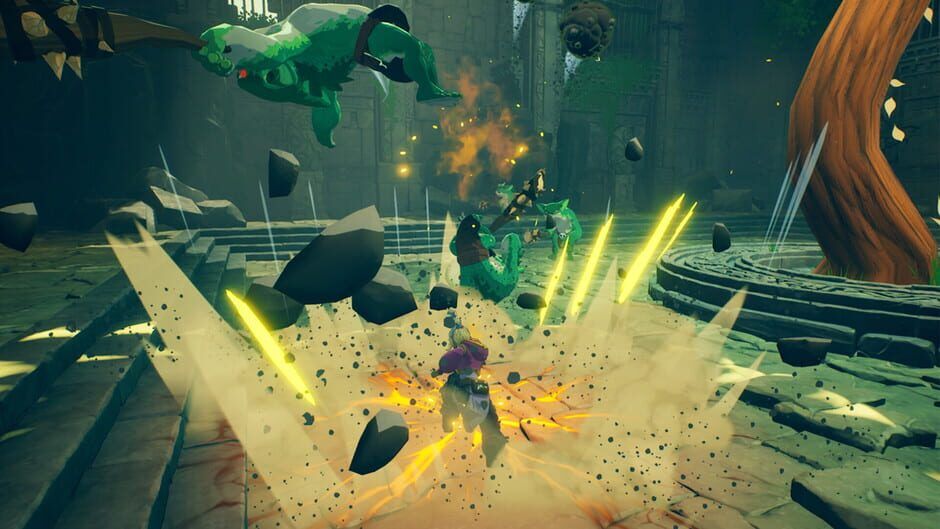
Shield bashes and heavy swings send draugr pinwheeling over cliffs. Large enemies topple and crush smaller mobs. Environmental props get flung around, occasionally turning the battlefield into a mess of flying debris. With a coordinated group, this can be delightfully chaotic. One player sets up a cluster with a crowd-control ability, another Viking lines up a charged hammer swing that sends enemies sailing, and the rest dive in to clean up.
The flip side is that Cloudheim often feels tuned more for comedy than clarity. Hit feedback is inconsistent. Heavier weapons can feel like you are swinging through soup, with delayed impact and enemies ragdolling in ways that make it hard to tell if you actually landed a clean hit or just grazed them. The camera struggles when everyone piles into a tight arena, especially with four players. Expect to occasionally lose track of both your character and incoming attacks.
Enemy variety in the Early Access build is serviceable rather than impressive. You will see reskinned variants and familiar attack patterns across the first few biomes. There are a handful of standout minibosses that showcase what the team is going for, mixing telegraphed attacks with environment hazards, but you will burn through the current roster in a few hours of co-op play.
If you are primarily interested in a polished, highly readable combat system, Cloudheim is not there yet. If you can tolerate some jank in exchange for physics-driven nonsense and shared laughter in voice chat, there is fun to be had.
Progression: A Strong Loop Stuck In A Thin Layer Of Content
Where Cloudheim shows the most promise is in its progression structure. Your flying turtle village acts as a persistent hub. Each expedition you gather resources, loot gear, and rescue NPCs. Back in the sky you invest those rewards into buildings, crafting stations, and permanent upgrades.
There is satisfying early momentum. Unlock a blacksmith and you gain access to new tiers of Viking weapons. Upgrade the apothecary and more potions and buffs come online. Bring in specialists and new quest lines open up. The sense of gradually reclaiming order from the ruins below fits the post-Ragnarok theme nicely.
Character progression hits both gear and meta layers. You are chasing weapon drops with elemental properties and perks, but you also earn currencies used to permanently upgrade stats, tweak skill loadouts, and unlock new archetypes. In a group, people naturally drift toward roles: the shield-heavy frontliner, the axe crit machine, the utility-focused support with buffs and debuffs.
The snag is that Early Access simply does not have enough variety to keep that loop fresh for long. Weapon families feel distinct, but within each family there are not yet enough interesting modifiers to meaningfully change your playstyle. Many upgrades boil down to flat numbers rather than new mechanics, so builds start to blur together after a dozen runs.
The turtle hub itself is likewise front-loaded. You will knock out the first wave of building upgrades surprisingly quickly, after which progression slows into a grind for marginal gains. The roadmap promises more systems and facilities, and the current skeleton is solid, but right now it feels like a promising framework waiting for content injections.
The Flying Turtle Hub: Personality With Room To Grow
Cloudheim’s best idea is that flying turtle village. It gives the game a clear identity and works well as a social space between runs. NPCs bustle around, buildings sprout up as you invest resources, and you get a gentle sense of your own mythic caravan drifting above a world in recovery.
In co-op, that hub becomes a welcome cooldown zone. People split up to craft, compare loot, and plan the next drop, then gather by the edge before launching down to the next island. It has the same cozy energy as a good MMO capital or Monster Hunter gathering hall.
Right now, though, it is mostly cosmetic and functional rather than reactive. The turtle does not yet feel like a character in its own right. You do not make meaningful choices about where it flies or how it evolves. Weather and lighting change, new NPCs arrive, but the larger idea of steering the future world from this mobile hub is underused.
If the developers build on this centerpiece with events that attack the turtle, narrative beats that play out on its back, and more systems that only exist in that space, Cloudheim could graduate from having a neat hub to having one of the more memorable home bases in co-op RPGs. In Early Access, it is more of a very charming lobby.
Performance And Technical State
Cloudheim’s performance is the part that most clearly betrays its Early Access status. Even on competent hardware, frame rates dip in busy fights, loading stutters pop up when moving between islands, and the physics that make combat entertaining also make it unpredictable for your GPU.
Network performance is decent but not rock solid. Two-player sessions ran relatively smoothly with only occasional rubber-banding. At four players, spikes in latency became more common, especially when everyone triggered abilities and ragdolls simultaneously. It is not unplayable, but it contributes to the overall feeling that the game is a little out of control.
Bug-wise, Cloudheim is in that familiar Early Access middle ground. I ran into UI elements getting stuck, quest flags not updating until we restarted the session, and enemies clipping into geometry. None of it destroyed our saves, but it occurred often enough to be noticeable.
The upside is that the game’s visual ambition is modest. Stylized models and relatively limited draw distances make it easier to smooth out performance over time. If the developers focus on optimization passes and netcode improvements over the coming months, there is no reason this should not stabilize.
Buy Now Or Wait
Cloudheim is not a bad game hiding behind Early Access branding, nor is it a breakout hit that happens to be unfinished. It sits squarely in the middle as a co-op action RPG with a fantastic premise, a delightfully strange flying turtle hub, and a combat and progression model that are fun but undercooked.
If you have a reliable group of two to four friends, enjoy laughing through physics-driven chaos, and are comfortable with repetition in the name of watching a game grow, Cloudheim is already capable of delivering a weekend or two of good memories. You will see most of what is currently on offer in ten to fifteen hours, at which point the grind for incremental upgrades will start to grate.
If you are more of a solo player, picky about technical performance, or looking for a dense, content-rich ARPG, waiting for a fuller launch is the better call. The systems are promising, the flying turtle hub has genuine personality, and the Viking framing is charming, but it all needs more time in the forge.
Right now, Cloudheim is a solid foundation with a few standout ideas, wrapped in Early Access roughness. Worth wishlisting and keeping an eye on, and worth buying early only if you know exactly what you are signing up for.
Final Verdict
A solid gaming experience that delivers on its promises and provides hours of entertainment.