
Review

By Apex
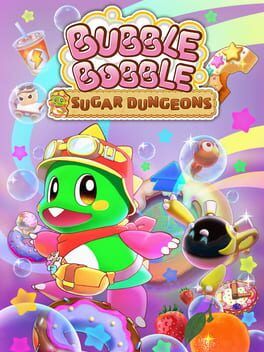
From the outside, Bubble Bobble Sugar Dungeons looks like the ideal way to bring Bub and Bob back. It has the sugary aesthetic, the single-screen rooms, the familiar pop of trapping enemies in bubbles and bouncing them into candy showers. Add roguelike structure and a full port of the beloved Bubble Symphony, and this should be a slam dunk tribute to Taito’s legacy.
It is not. Sugar Dungeons is a mechanically competent but deeply repetitive spin-off that misunderstands what makes both Bubble Bobble and roguelikes tick, then leans on Bubble Symphony as if the classic can plug the holes in a leaky design.
Roguelike sugar coating, not a roguelike core
Sugar Dungeons keeps the basic Bubble Bobble loop. You clear single-screen stages by blowing bubbles, trapping enemies, then popping those bubbles while snagging as much loot as possible. On paper, wrapping this around runs through randomized dungeons sounds like a natural evolution. In practice, the roguelike elements feel like a loose wrapper instead of the spine of the game.
Each run sends Bub into candy-themed dungeons and castle areas with layouts that rearrange themselves every time you dive back in. You collect treasure and power-up trinkets that are meant to persist between attempts. Over time you unlock new skills such as rolling attacks, movement buffs and perks that slightly widen your toolset. There is a cap on how many items you can carry into each trip, and you choose which skills to equip and in what order your permanent treasures activate.
None of that ever truly changes how you play. A good roguelike constantly pushes you to adapt, to rethink your approach because your latest build or room generation twists the rules. Sugar Dungeons mostly has you doing the same thing for hours. You float on bubbles to reach higher platforms, you trap foes and pop them, and you hoover up treats while watching a meter tick upward. The procedural generation mixes up enemy placement and platform shapes, but the tactical decisions rarely evolve beyond whether to take the slightly safer route or go for an extra gem.
The result is a structure that looks like a roguelike but behaves like a grind. You repeat short runs through familiar-feeling rooms hoping the next permanent upgrade nudges you forward. Instead of that “just one more run” compulsion, you get “just one more chore” fatigue.
Dungeon variety that blurs into sameness
Sugar Dungeons technically has multiple dungeon types and castle segments, with different palettes and gimmicks. One tower might emphasize windy currents that carry your bubbles around. Another leans on moving platforms or enemy projectiles that crisscross the screen. On the first couple of hours, this is charming in that familiar, toybox Bubble Bobble way.
Then the repetition sets in.
Despite the procedural layouts, stages start to feel interchangeable quickly. Encounters are built from a small set of enemy types and hazards, and the game’s idea of escalation is to throw more of them at you in tighter spaces. There are very few memorable “set piece” rooms or clever gimmicks that stick with you. You do not get the sense of diving into wildly different biomes with their own rules, the way the best roguelikes manage with far fewer assets.
The castle sections are arguably the best part of Sugar Dungeons. These are more curated, with slightly more deliberate platforming challenges and enemy waves that at least feel designed instead of shuffled. For short bursts, they recapture a hint of classic Bubble Bobble stage craft. But they are thinly spread over a lot of randomized filler, and you are still funnelled back into the same pool of mechanics afterwards.
It creates an odd tension. The game clearly wants you to replay these dungeons dozens of times to build up your persistent power. Yet it does not give you the visual or mechanical variety that makes that repetition enjoyable.
Difficulty spikes and sour frustration
That structural grind is made worse by a difficulty curve that lurches instead of flows. Early floors are almost insultingly easy, with enemies that drift into your bubbles and hazards that barely register. Then, without much warning, you hit floors or boss encounters where the number of projectiles and cramped platforms jump dramatically, and a single mistimed hop sends you back to the hub with your tail between your legs.
Roguelikes are supposed to punish you, but they also need to make your failures feel like learning opportunities. Sugar Dungeons often makes them feel like you tripped over random clutter. Because your move set and room archetypes change so little from run to run, the game cannot credibly say you should have “played differently.” You were already doing the one viable thing there is to do.
Itemization also undercuts the difficulty balance. Some skills are almost mandatory, others are so situational or underpowered that they may as well be junk. Yet the game is stingy about how many boosts you can carry, which means it is easy to walk into a spike of difficulty with a bad loadout and no way to meaningfully course-correct. Instead of clever builds, you end up chasing a narrow list of “correct” tools that make the game tolerable.
This leads to a paradoxical loop. It is not that Sugar Dungeons is impossible. Most reviewers and players report that with enough patience, the curve can be overcome. The issue is that the road there is paved with dull, low-stakes runs punctuated by cheap-feeling deaths that do not teach you much.
Controls, feel and presentation
Moment-to-moment feel is one area where Sugar Dungeons does not completely fall apart. Bub still moves with that slightly floaty precision that long-time Bubble Bobble fans will recognize. Bubble trajectories behave predictably, and chaining enemy captures into score showers is satisfying in brief bursts.
That said, the translation of those arcade physics into longer roguelike sessions exposes seams. The floatiness that was once part of the charm becomes grating when you are navigating busier screens over and over. A missed platform that costs you a run because Bub did not quite catch a bubble the way you expected is a lot harder to forgive in a game asking you to grind out progression than it is in a straightforward arcade climb.
Visually, Sugar Dungeons is saccharine in a way that mostly works. The candy motif is bright, the enemies are expressive, and backgrounds pop without becoming too noisy. The soundtrack hits the peppy, looping earworm vibe that defines Bubble Bobble as a brand. The problem is not presentation. It is that all this gloss is layered over design that feels stuck in place. The longer you play, the less the cute wrapper can distract you from the monotony.
Bubble Symphony: the real treat in the box
The wildcard in this package is Bubble Symphony, included here in its Sega Saturn form. For many, this is the real reason to pay attention.
Bubble Symphony is a proper 90s follow-up to the original arcade hit. It brings in four playable characters, branching paths and themed stages that lean hard into the kind of handcrafted, single-screen design that Sugar Dungeons only brushes against. Co-op play is supported, which instantly restores that couch chaos energy that newer spin-offs keep forgetting is part of Bubble Bobble’s soul.
The port here is faithful and runs well, with the original art and soundtrack intact. It is basically instant arcade gratification. You pick a path, shout at your friend for popping your carefully set-up bubble chain, and chase food items for score instead of meta-currencies for a grindy upgrade shop.
The contrast with Sugar Dungeons is brutal. Where the new game stretches thin ideas across hours of incremental progress, Symphony is dense and inventive from the first few stages. Stage gimmicks arrive quickly and retire before they wear out their welcome. Difficulty ramps more naturally, and deaths usually feel like the result of your own greed or impatience rather than a random spike.
For long-time fans, finally getting an accessible, modern release of Bubble Symphony is a big deal. It has been relatively obscure outside of compilations, and for many regions this is the easiest way to play it legally. In that sense, Bubble Symphony is not just a bonus. It is the best part of the entire package.
Does the bundle justify the price for fans?
That brings us to the real question. As a combined product, is Bubble Bobble Sugar Dungeons plus Bubble Symphony worth your time and money, especially if you care about the series?
If you strip Symphony away, Sugar Dungeons would be a hard sell. Its roguelike label feels more like marketing than design philosophy, its dungeon variety collapses under repetition, and its difficulty balance encourages grind more than mastery. There is some fun in short sessions, particularly in the more curated castle segments, but it rarely feels essential and often feels like work.
With Symphony in the box, the value calculation changes, but only for a specific audience. If you are a Bubble Bobble devotee who has been waiting for a convenient way to play Bubble Symphony on modern hardware, then this compilation starts to resemble a retro package bolted to an experimental spin-off. In that context, Sugar Dungeons becomes a curio you poke at between bouts of the classic.
For everyone else, the bundle is tougher to recommend. Symphony is excellent, but it is also an older game, and the new headliner fails to establish a strong identity. Fans of tight roguelikes will bounce off the repetition and shallow builds. Players looking for that chaotic, multiplayer energy that defined the original Bubble Bobble will find a lonely, single-player grind propped up by nostalgia.
Verdict
Bubble Bobble Sugar Dungeons tries to sweeten the classic formula with modern roguelike structure, but the flavor never quite comes together. The dungeons blur into each other, the difficulty spikes feel more arbitrary than satisfying, and the progression loop lacks the variety that could have turned short, punchy runs into a compelling habit.
Bubble Symphony, meanwhile, quietly walks off with the show. Its inclusion is the reason any fan should care about this release, and the fact that a decades-old port so thoroughly outclasses the new game on the same disc says everything you need to know.
If you want to revisit one of Bubble Bobble’s best sequels, this package is worth watching for a sale. If you are here for the new roguelike twist, though, Sugar Dungeons is all sugar crash and no high.
Final Verdict
A solid gaming experience that delivers on its promises and provides hours of entertainment.