
Review
By Big Brain
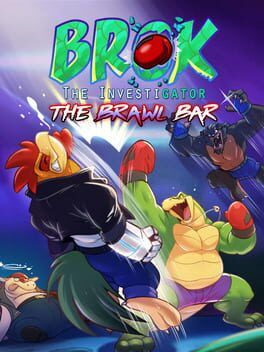
Brok the InvestiGator was a strange hybrid to begin with, mixing point and click sleuthing with honest brawler combat. Brok: The Brawl Bar pulls that combat out of the adventure framework and drops it into its own underground fight club, reimagined as a party beat them up you can play in quick bursts with friends.
Instead of a story driven campaign in the Castle Crashers mold, the Brawl Bar is built around more than 60 short “event” challenges. You walk Brok into a hidden Slums bar, chat with familiar faces from the original, then jack into a VR setup where the real game lives. Each event lasts a couple of minutes at most and riffs on some kind of twist, from basic horde survival to platforming gauntlets, item juggling exercises or absurd hazards that constantly mess with your footing. It is closer to Smash Bros style special modes than a traditional stage‑based brawler, and that framing is what gives the game its identity.
On the mechanics side, this is not some tossed off mini mode. Combat is a refined version of what was in Brok the InvestiGator, now with a heartier move list and a more responsive feel. Brok and the rest of the cast have light and heavy strings, launchers for air juggles, charged moves, a parry, grabs, wall bounces and a satisfying dash that lets you close gaps or reposition during hectic waves. Enemies fly convincingly when you pop them into a corner, and the game encourages you to keep them bouncing with generous hit stun and lenient juggle windows. It is still simple compared with the layered systems of Streets of Rage 4, but it is much tighter and more expressive than most “cheap” party brawlers.
Where it falls short of the genre greats is in long term depth rather than moment to moment feel. Streets of Rage 4 and Castle Crashers build arcs around enemy sets, weapon economies and character growth. The Brawl Bar is explicitly about micro sessions, so most events are built on gimmicks instead of evolving enemy design. Some of those gimmicks are excellent and force you to really engage with parries, crowd control and positioning. Others are glorified minigames that you will clear once and never think about again. When the balance leans toward the latter, you are reminded this started life as DLC rather than a purpose built full price brawler.
Roster variety pulls a lot of weight. You get Brok himself plus a generous spread of other anthropomorphic residents of this cyberpunkish world, many returning from the main game in roles fans will instantly recognize. Movesets are not wildly different, but they are distinct enough that your crew will find favorites. One character might excel at big, slow crowd clearing swings, another at aerial mobility and bounce heavy combos, another at projectiles and zoning. Because matches are so short, swapping characters between events never feels like a chore, and learning a new kit is painless.
As a spin off, The Brawl Bar treats the original universe with affection. The whole structure is framed as Brok stumbling into an underground bar run by colorful new faces and a few returning ones. You walk around the bar, overhear side conversations, unlock new events and characters through light interaction and progression, and enjoy small callbacks to specific cases and story beats from Brok the InvestiGator. None of it is essential narrative, and newcomers will not be lost, but it gives fans a pleasant sense that this is a real place in the same world rather than a generic menu with an alligator pasted on top.
For multiplayer, the game is clearly designed around local co op. Up to four players can jump into events together with very little friction. Controllers are picked up instantly, UI is clean and readable, and chaos on screen stays just this side of overwhelming. This is where the game sings. Those bite sized challenges that sometimes feel trivial solo become shrieking, slapstick messes with a living room full of people, and the failure conditions are short enough that no one minds restarting.
Online play exists, but it is more functional than feature rich. The netcode in current builds is serviceable for the pace of the game, and the brief nature of events keeps desyncs or minor lag spikes from ruining entire sessions. However, there is not a robust lobby system, no deep ranked structure and limited tools for filtering challenges or rotating players in and out. If you are looking to grind a favorite character online for hours like you might in more serious brawlers or fighting games, you will bump against the limitations quickly. The experience feels like online was added so you could occasionally play with distant friends, not as the main pillar of the design.
Mode variety tries to pick up that slack. On top of the core Event progression you get Survival, Versus, Support focused missions, Daily challenges and a Creator mode. Survival does exactly what it says on the tin: you push a single life as far as you can through increasingly aggressive enemy patterns, which exposes the underlying systems more cleanly than the gimmick events. Versus lets you turn your friends into punching bags using the same toolset, turning a co op brawler into a messy party fighter for a few rounds. The Support scenarios flip the script by asking you to keep an NPC alive or control hazards for your team, and they are some of the more inventive uses of the underlying mechanics.
Creator mode is the clever wildcard. It gives you access to an in game editor to stitch together your own challenges, plus Steam Workshop support on PC so you can browse and download others. The tools are not on the level of something like Mario Maker, but they are accessible enough that you can set up nasty gauntlets, goofy item showers or boss rushes with only a little experimentation. On console you lose the Workshop layer, but being able to tailor events for your own game night group adds a lot of life. It is also where you see the combat’s limits most clearly, since building encounters around parry timings or air juggles reveals how basic enemy AI can be.
Presentation is in line with Brok the InvestiGator. Hand drawn characters and backgrounds have a Saturday morning cartoon meets grimy cyberpunk look that stands out immediately. Animations are snappier than they were in the main game thanks to the tighter combat focus, though a few hit reactions still look a bit stiff when you juggle someone across the screen. The soundtrack leans on punchy, looping tracks that keep energy high, even if they lack the memorable hooks of Castle Crashers’ iconic tunes. Voice work in the bar hub and occasional quips during fights help tie this back into the original’s cast.
In the end, Brok: The Brawl Bar does not dethrone genre royalty. Its systems are too streamlined and its encounter design too tied to gimmicks to rival the meticulous brawling of Streets of Rage 4, and it cannot match Castle Crashers’ sense of progression. What it does offer is a remarkably polished ten dollar package built for pick up and play local sessions, with enough mechanical nuance to satisfy for a weekend and a deep well of challenge variety to keep you dipping back in. As a fan facing spin off that respects its universe and turns a side dish from the main game into a full course, it is absolutely worth a seat at your next couch co op night.
Final Verdict
A solid gaming experience that delivers on its promises and provides hours of entertainment.