
Review

By Pixel Perfect
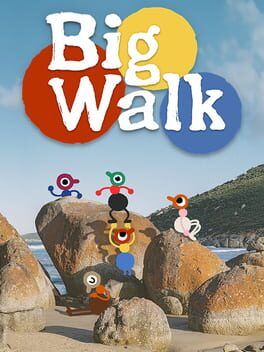
Image: IGDB
Store links: Big Walk on Steam
Big Walk's biggest strength is also its firmest demand
The most important confirmed fact about Big Walk on Nintendo Switch 2 is not its island, its puzzles, or its strange little avatars. It is that House House and Panic have built a cooperative game that requires other people. NintendoEverything lists the Switch 2 release date as August 4, 2026, with House House as developer and Panic as publisher, and reports that you need at least one other player to participate. Up to 12 players can join a session, but the same source says solo play and random matchmaking do not appear to be options. This is a friends-first game in the strictest sense.
That instantly defines the review. Big Walk can feel like one of the most memorable Nintendo Switch 2 co-op games available if you can gather the right group. If you cannot, its best ideas may sit out of reach. It is a social design with teeth: progress depends on coordination, conversation, patience, and a little forgiveness when someone misunderstands a plan or decides to be a menace. NintendoEverything also reports that progress is tied to the host, so the same player needs to host future sessions if the group wants continuity. That makes Big Walk less of a drop-in party toy and more of a game you schedule.
For the right audience, that structure is a gift. Big Walk turns getting lost, pointing at landmarks, misnaming objects, and dragging friends toward a half-understood contraption into the main event. It is not chasing the frictionless convenience of a matchmaking lobby. It is chasing the feeling of being out on a strange walk with people whose voices, habits, and poor decisions you know well.
Traversal becomes a communication puzzle before the puzzles begin
Big Walk looks simple from a distance: walk around an open island, find odd structures, solve cooperative challenges, collect the strange red rewards, and keep moving. The clever part is how aggressively it makes communication part of every step. NintendoEverything reports that the Switch 2 version uses the system microphone for proximity voice chat, a rare feature on the platform. Nintendo Life's review adds that Big Walk explicitly asks players to keep communication inside its own voice chat, rather than Discord, texts, or shouting across the house.
That rule changes the whole texture of traversal. According to Eurogamer and The Verge, proximity chat fades quickly as players move apart. Drift a little too far from the group and friendly voices become distant or disappear. The Verge also notes a proximity text system, giving players an alternate channel, but the design still pushes everyone toward spatial awareness. You are not simply telling a friend where to go. You are trying to stay close enough to be heard, deciding whether to split up, and using the landscape itself as shared language.
The nonverbal tools matter because separation is inevitable. Nintendo Life describes independent arm gestures, pointing, sitting, jumping, spinning, and head-shaking as practical tools once a group invents its own shorthand. Polygon's review similarly describes players waving, flailing, jumping, and even punching the ground to be noticed when voice range fails. That is where Big Walk's craft shines. It turns primitive inputs into expressive social mechanics. A raised arm can mean follow me, look there, stop touching that, or please rescue me from my own bad navigation. The game trusts players to invent the rest.
The best puzzles make the group feel clever together
Big Walk's puzzle design works because it rarely isolates the brain from the body. NintendoEverything says challenges cannot be cleared alone, and the sources consistently describe puzzles that require players to physically coordinate rather than simply announce solutions. Polygon and Kotaku both mention an early tower-style challenge where players stack or lift one another to reach a high button. The Verge describes brightly colored buildings scattered across the island that house cooperative puzzles, while Eurogamer notes that some elements are tuned for two, three, or four players even though up to a dozen can occupy the same world.
That scaling is important. A two-player Big Walk session appears to be a legitimate way to play, with The Verge reporting more than 13 hours spent exploring as a duo. NintendoEverything estimates roughly 10 to 20 hours of gameplay. Larger groups create louder, messier stories, but the available reports do not frame Big Walk as requiring a full party to function. Instead, the number of players changes the flavor. Two players get intimacy and clearer decision-making. Four players get richer coordination problems. Twelve players sounds like a glorious argument with legs.
The rewards are deliberately underexplained. Eurogamer describes curved red objects as the main form of progression and says they unlock transformative features, while Polygon, The Verge, Kotaku, and Nintendo Life all note that groups tend to invent their own names for these objects because the game does not label everything. That absence is a design choice with real payoff. Big Walk's puzzles make you feel clever, but its language gap makes the group feel like it has built a private field guide. You do not remember the collectible because the game gave it a proper noun. You remember it because your friends named it something ridiculous and then treated that name as sacred law for the next ten hours.
The island is readable without becoming a checklist
House House's open world is doing a careful balancing act. The Verge reports that Big Walk does not provide a map menu or golden arrows, which means navigation depends on sightlines, memory, and landmarks. Polygon describes a naturalistic map dotted with bright structures that stand out through the trees. Nintendo Life calls the world substantial rather than enormous, imposing at first but digestible after several hours. Eurogamer frames the island as a wilderness punctuated by colorful, artificial landmarks and pockets of focused challenge.
That makes the island feel designed for conversation rather than completionist autopilot. A good landmark is not only something pretty to look at; it is a meeting point, a compass, and a shared argument. The Verge notes that nighttime gets genuinely dark, pushing players toward lanterns and togetherness. That detail reinforces the social rhythm. Wander too far, lose your group, lose the light, then start improvising a rescue plan with gestures and half-heard calls.
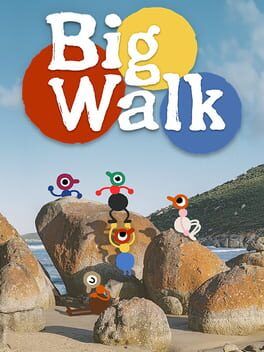
Visually, Big Walk trades spectacle for readability and odd charm. The avatars are repeatedly described across the reviews as strange, colorful, birdlike or sphere-like creatures with arms and legs. The island contrasts rugged hills, trees, coasts, rivers, and valleys with toy-like structures in loud colors. It is easy to imagine a more polished-looking version of this game losing some of its utility. Big Walk needs objects to be readable from a distance and silly up close. On those terms, its art direction serves the mechanics beautifully.
Switch 2 is a smart home for Big Walk, with caveats
The Switch 2 version has an obvious advantage: NintendoEverything reports built-in use of the system microphone for proximity voice chat, and also notes a surprisingly large set of accessibility settings from the main menu. Big Walk's interface is described as no-nonsense, with hosting and joining rooms made easy. That matters for a game whose biggest barrier is already social logistics. Anything that reduces setup friction helps.
There are still practical concerns. NintendoEverything says progress is tied to the host, which means groups need to be deliberate about who starts the room. It also says teammates can actively slow progress if they choose, including by kicking important items into the ocean. That is funny when everyone is in on the bit and maddening when one player derails an evening. Big Walk is built around trust as much as teamwork.
Platform information in the source material needs careful handling. NintendoEverything specifically lists Big Walk for Switch 2 with an August 4, 2026 release date. GameSpot's page metadata lists Mac, NS2, PC, and PS5, while Nintendo Life says the game supports crossplay with friends on other platforms. However, GameSpot's metadata also includes a December 31, 2026 first released date, which conflicts with NintendoEverything's Switch 2 release listing and the broader August review coverage. Based on the provided sources, the Switch 2 date is the clearest platform-specific date, while the December 31 entry should be treated as conflicting metadata rather than the useful date for Switch 2 buyers.
Performance is the least settled part of this Big Walk Switch 2 review. Nintendo Life's headline characterizes the game as struggling on Switch 2, but the supplied excerpt does not provide frame-rate numbers, crash notes, resolution details, or specific technical symptoms beyond docked capture context. Because the available material does not support precise diagnosis, the safest guidance is this: the Switch 2 version is clearly playable enough to support full published reviews, but performance-sensitive players should look for final technical testing before buying if smoothness is their top priority.
Who will get the most from Big Walk multiplayer
Big Walk is easiest to recommend to small, consistent groups who like figuring things out without being over-instructed. Couples, close friends, siblings, and regular Discord groups willing to use the in-game chat rules should get the richest version of it. The game seems especially strong for players who enjoy the social problem-solving of a co-op game but want less combat pressure and fewer fail-state tantrums. If your favorite multiplayer memories involve someone shouting a terrible plan, everyone trying it anyway, and the room erupting when it somehow works, Big Walk is built for you.
It is a weaker fit for solo players, anyone who depends on public matchmaking, or groups that need constant objective markers. NintendoEverything's report that random play does not appear to be supported is the major buying caveat. The lack of a map menu noted by The Verge is a strength for discovery-minded players and a likely frustration for those who want clean routing. The host-tied progress system also makes casual rotation awkward.
Price is another unanswered practical point. None of the provided source material includes a price, upgrade path, file size, or eShop listing detail. That prevents a value judgment based on cost. Judged on reported length and structure, NintendoEverything's 10 to 20 hour estimate and The Verge's 13-plus-hour unfinished duo run suggest a substantial co-op adventure rather than a one-evening novelty. The value will depend heavily on whether you have the group to see it through.
Score and verdict
Big Walk succeeds because it understands that simple movement can become meaningful when players have to negotiate every hill, tool, landmark, and half-heard instruction together. Its traversal is intentionally awkward in the best co-op sense. Its puzzles are physical enough to create stories and clear enough to avoid becoming homework. Its island is spare, strange, and readable, with bright structures and dark nights that keep the group talking.
The caveats are real. No solo path, no apparent random matchmaking, host-tied progress, and potential griefing mean Big Walk asks for the right circumstances before it gives you its best. The Switch 2 version also carries a technical question mark because one supplied review headline flags struggles on the platform without enough excerpted detail to identify the problem. Those issues keep it from being a universal recommendation.
As a Big Walk co-op game, though, it is special. As a Big Walk Switch 2 review verdict, the answer is clear: if you have at least one trusted friend and you are willing to let communication, confusion, and discovery drive the adventure, Big Walk is one of the standout Nintendo Switch 2 co-op games to put on the calendar.
Final Verdict
A solid gaming experience that delivers on its promises and provides hours of entertainment.