
Review

By Pixel Perfect
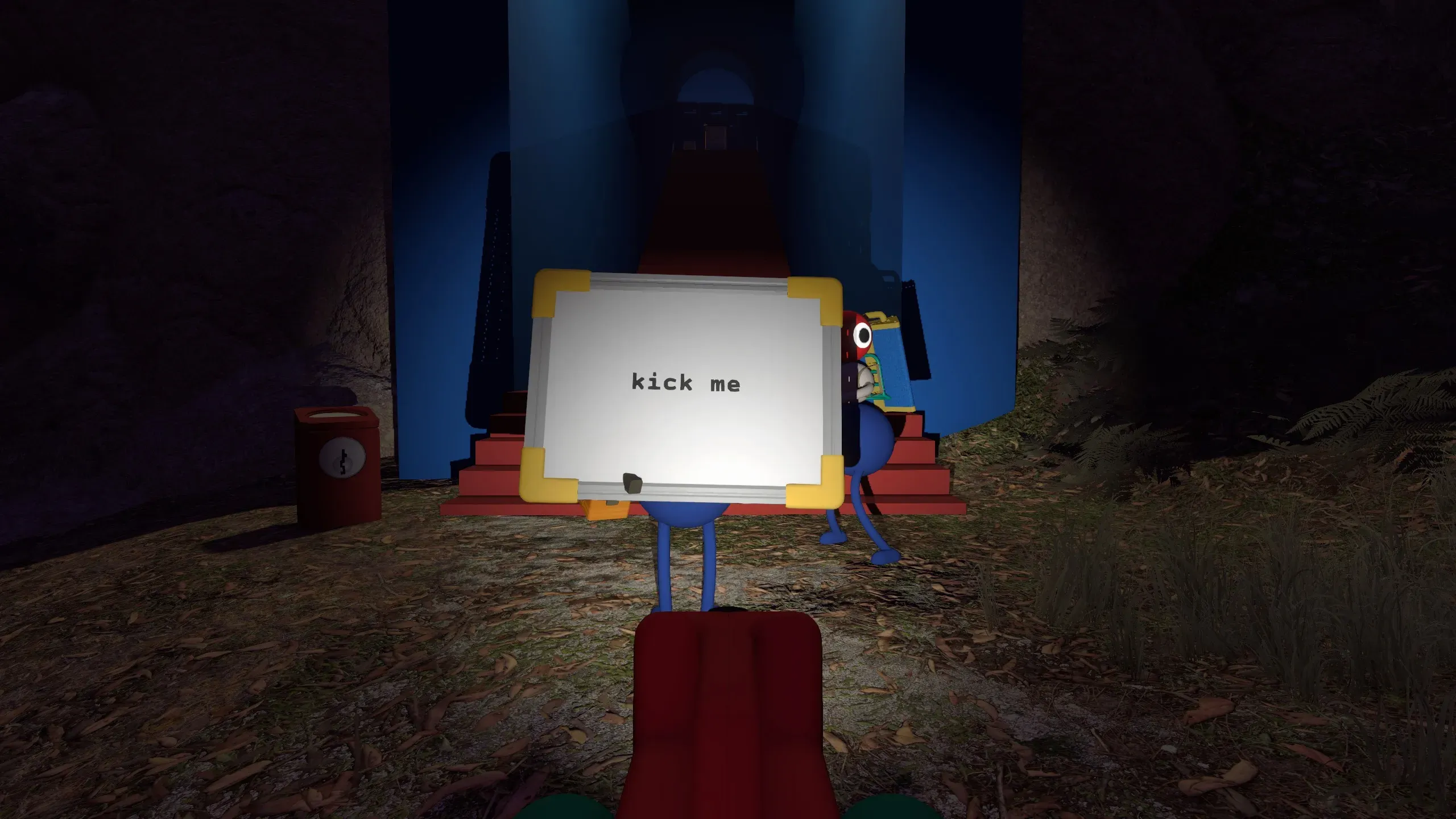
Image: gameinformer.com
A co-op game that refuses to work alone
Big Walk launches on August 4, 2026 for PC, PlayStation 5, Switch 2, and Mac, according to Game Informer’s review listing, with Panic Inc. publishing and House House developing. The most important buyer-facing detail is also the game’s boldest design line: Game Informer reports that Big Walk requires co-op and cannot be played solo.
That requirement changes the whole shape of this Big Walk review. House House, the Melbourne studio best known for Untitled Goose Game, has made a game about walking, talking, getting separated, misunderstanding each other, and slowly turning those little failures into a shared language. It is a co-op adventure with puzzles, unlocks, landmarks, towers, and strange collectible objects, but its real subject is the work of being together in a space that keeps gently pulling you apart.
The gamble is obvious. A co-op-only game asks for calendars, microphones, patience, and a group willing to meet it on its own terms. Game Informer notes that Big Walk supports up to 12 players in a lobby, while puzzles are tuned around two, three, or four-plus players. Eurogamer similarly describes it as designed for small groups, with elements retuned for two, three, or four players, while allowing up to a dozen participants. GameSpot reports that the host maintains save data across sessions, which helps with drop-in group logistics, but the game still lives or dies by whether your friends are present, audible, and willing to get lost with you.
On those terms, House House Big Walk is a rare co-op success. It does not outsource the fun to the group chat so much as make the group chat unstable, physical, and necessary. The friction is the point, but it is also the catch.
The island gives you very little, then trusts you with everything
Big Walk starts with a restrained move set. PCGamesN describes the basics as sprinting, jumping, moving your arms, picking up objects, and turning objects on or off. GameSpot says the opening area functions like a playground or children’s gym, teaching gestures, physics, proximity chat, and object handling before the first four puzzles open the rest of the island. Polygon’s reviewers also describe first encountering Big Walk through a tutorial space full of simple interactions before stepping into an open world filled with natural landscapes and bright, artificial structures.
That simplicity is crucial. The game does not bury cooperation under ability wheels, cooldowns, class roles, or crafting menus. Instead, it gives players bodies that can wave, point, sit, slide, stack, carry, fall, and fumble. Game Informer notes that each player controls an orbish, bird-like avatar, with gestures such as lifting arms, pointing, and raising arms out to the side. Those gestures are not cosmetic garnish. When proximity chat drops out or a friend is too far away to hear, a frantic wave from a hillside becomes navigation. When someone is carrying an object and slips down a slope, physics becomes comedy and consequence in the same motion.
The island itself does important teaching work. GameSpot emphasizes that Big Walk’s island is handcrafted rather than randomly generated, contrasting it with Peak, and that the landscape uses switchbacks, landmarks, radio stations, and colored structures to guide curiosity. Polygon describes the world as naturalistic but dotted with playground-like structures, making points of interest readable from a distance. That readability matters because Big Walk, according to GameSpot’s tips coverage, has few rules and no quest markers. It wants groups to make their own routes, invent their own names for objects, and build memory through shared detours.
The best version of this game happens when your party stops asking where the objective is and starts arguing about what that weird thing on the ridge might do. House House’s craft is in making that impulse productive. Wandering does not feel like dead air because the world keeps offering shape, color, elevation, sound, and half-understood machinery as invitations.
Big Walk puzzles are built out of miscommunication
The Big Walk puzzles are collaborative in the literal sense. PCGamesN describes puzzles involving standing on each other’s shoulders to dunk a basketball, miming instructions through soundproof glass, and using a one-way telecom system while struggling to describe something as simple as the shape of a letter. Polygon recounts an early puzzle in which one player is lifted in a totem-pole stack to reach a switch holding a red object. GameSpot’s guide to the 4166, 1899 puzzle shows how far the game pushes spatial teamwork: one player must remain with a locked object while another travels to coordinates, finds a camouflaged button, and holds it down to open the box back at the original site.
That last example captures the game’s design philosophy without needing to spoil its broader secrets. Big Walk puzzles often ask players to separate, specialize, relay incomplete information, and trust that someone else is doing a job they cannot currently see. The puzzle is rarely only the mechanism. It is the translation layer between people.
PCGamesN says many puzzles are variations on a theme but argues no two feel the same. That matches the game’s strength and its likely pressure point. Big Walk is not a traditional puzzle-box game obsessed with escalating mechanical complexity. It is closer to a social puzzle field, where similar verbs produce different outcomes because the players keep changing. A button, a diagram, a distance, a blocked line of sight, or a missing voice channel can all become fresh when the people involved have to describe them under stress.
The design is at its sharpest when it turns competence into a group discovery. You start by over-explaining. Then someone invents a phrase for a shape. Someone else realizes that sitting down and raising both arms can mean success, distress, or “come here,” depending on context. By the time the group has its own private vocabulary, Big Walk has done something more durable than teach puzzle rules. It has made a little culture.
Proximity chat is the star, and the biggest reason to play properly
House House strongly encourages players to use in-game proximity voice chat rather than a Discord call or local split-screen, according to Game Informer. The outlet also notes that there is no real way to enforce that approach. Still, Big Walk is clearly tuned around it. Eurogamer says the proximity chat range is aggressive, with players losing contact after moving a relatively short distance away. Polygon similarly describes the voice range as small but intentional, pushing players toward waving, jumping, arm-flailing, and other physical signals.
This is the hinge of the whole experience. If your group stays in an external voice call, Big Walk still has puzzles, scenery, funny avatars, and slapstick physics. It also loses one of its best instruments. The game’s social friction depends on uncertainty. You are supposed to hear a friend fade away. You are supposed to crest a hill and realize the person with the object is gone. You are supposed to describe a symbol while half the team has wandered out of range and the other half is confidently wrong.
That can be wonderful. It can also be exhausting if your group hates being interrupted, separated, or misunderstood. Big Walk is warm, but it is not frictionless. PCGamesN’s review opens with the writer admitting to getting lost often enough to deserve the expletives thrown his way. Game Informer compares organizing a Big Walk session to setting up a board game night because of the co-op requirement and recommended voice setup. Those are not incidental complaints. They are accurate warnings.
The game is best for friends who enjoy a little procedural mess. If your group likes solving out loud, laughing at bad directions, and accepting that progress may arrive through chaos, Big Walk sings. If you want a tightly guided co-op campaign where everyone knows the next waypoint and no one has to repeat themselves, this strange walk may feel like a long argument with better scenery.
Progression gives wandering a spine without flattening the mystery
Big Walk is loose, but it is not aimless. GameSpot’s tips coverage explains that after the tutorial section, players can go almost anywhere, with red, blue, green, and yellow mountaintop towers acting as major progression goals. Filling a tower console with enough puzzle rewards unlocks a significant item or feature. PCGamesN describes these rewards as small, knobbly objects used to unlock towers and new ways to travel around the island. Eurogamer identifies the curved red puzzle rewards as the main form of progression, unlocking transformative features.
The tower structure is smart because it gives groups a reason to focus without turning the island into checklist territory. GameSpot recommends focusing on one tower at a time and says the red tower is a sensible early target because the game starts players nearby and the reward makes the rest of the game easier. In a separate GameSpot puzzle guide, completing the red tower with five MacGuffins unlocks a key that opens a room near the session spawn point containing a large 3D island map and a paper map with coordinates. That detail matters because it shows how Big Walk folds navigation tools into discovery rather than handing them over through a menu.
Object persistence also supports the adventure-night structure. GameSpot notes that the starting area includes a Lost and Found table showing items players were holding when the previous session ended. Backpacks and belts found in blue structures let players carry extra items, though equipping and unequipping those storage tools requires help from another player. These systems respect the fact that Big Walk may be played over multiple evenings, with shifting attendance and half-remembered plans.
The risk is that sparse instruction will stop some groups cold. GameSpot’s existence of a dedicated guide for the 4166, 1899 puzzle is a useful signal: Big Walk wants players to infer, triangulate, and sometimes leave a mystery for later. That is elegant when the group is in a curious mood. It is less elegant at midnight when everyone is tired and one player is standing by a box while another insists the coordinates must mean something else. The game usually earns that ambiguity, but it asks for a group that can tolerate not knowing.
Craft, tone, and the House House leap
The easy comparison is Untitled Goose Game, because House House made both games. The useful comparison is smaller. Eurogamer says Big Walk shares the earlier game’s playful silliness and delightful touches while otherwise being unlike it. Game Informer frames the shift as a studio leaning hard into one core idea: a world of puzzles, physics, basketball, music, lights, sounds, secrets, and ominous hints, all built around walking with friends.
That leap is impressive. Untitled Goose Game worked because its verbs were simple, readable, and mischievous. Big Walk keeps the simplicity but trades directed mischief for shared interpretation. Its avatars, described by multiple outlets as birdlike or strange snowman-breadstick creatures, are expressive enough to be funny from across a clearing. Its colored structures stand out against the wilderness in a way that makes the island legible without sanding off its oddness. Its lack of heavy UI lets bodies, landmarks, and objects carry meaning.
Audio design is where the craft becomes most inseparable from play. The provided sources do not give platform-by-platform performance data or technical measurements, so it would be irresponsible to claim that all versions run flawlessly. What is supported is that the sound and chat implementation are central. Eurogamer highlights the aggressive tuning of proximity chat, PCGamesN emphasizes how communication failures become puzzles, and Polygon describes physical gestures filling the gap when voices disappear. For a co-op adventure, that is the technical feature that matters most.
There is also reported praise for the ending, though details should remain untouched. Polygon’s review roundup cites Eurogamer’s Chris Schilling describing it as a subtle twist on a familiar design maxim, focused on what players have come to understand about the people they traveled with. That tracks with Big Walk’s broader design. The game’s lasting moments are unlikely to be a single solution or vista. They will be the dumb shorthand your group invented and somehow needed again three hours later.
Verdict: a brilliant walk, if your friends meet it halfway
Big Walk turns its constraints into its identity. It requires co-op, strongly prefers in-game proximity chat, withholds quest markers, and lets players wander into confusion. Those decisions will push some people away, and they should. This is a poor fit for solo players, silent groups, or anyone who wants co-op to feel clean and friction-free.
For the right group, though, Big Walk is one of the most memorable co-op adventure designs in recent indie games. The puzzles are strongest when they force players to invent language under pressure. The island supports curiosity without drowning it in icons. The progression structure gives wandering a spine. The physical comedy lands because the mechanics are simple enough for everyone to understand and loose enough for everyone to make a mess.
The answer to the central question is clear: Big Walk does not leave the fun to the group chat. It redesigns the group chat as terrain, distance, gesture, error, and trust. House House has made a game where getting lost is rarely wasted time, provided you brought people who can laugh, listen, and eventually find you at the bottom of the cliff.
Final Verdict
A solid gaming experience that delivers on its promises and provides hours of entertainment.