
Review

By Headshot
A 3D Platformer Built For People Who Refuse To Walk
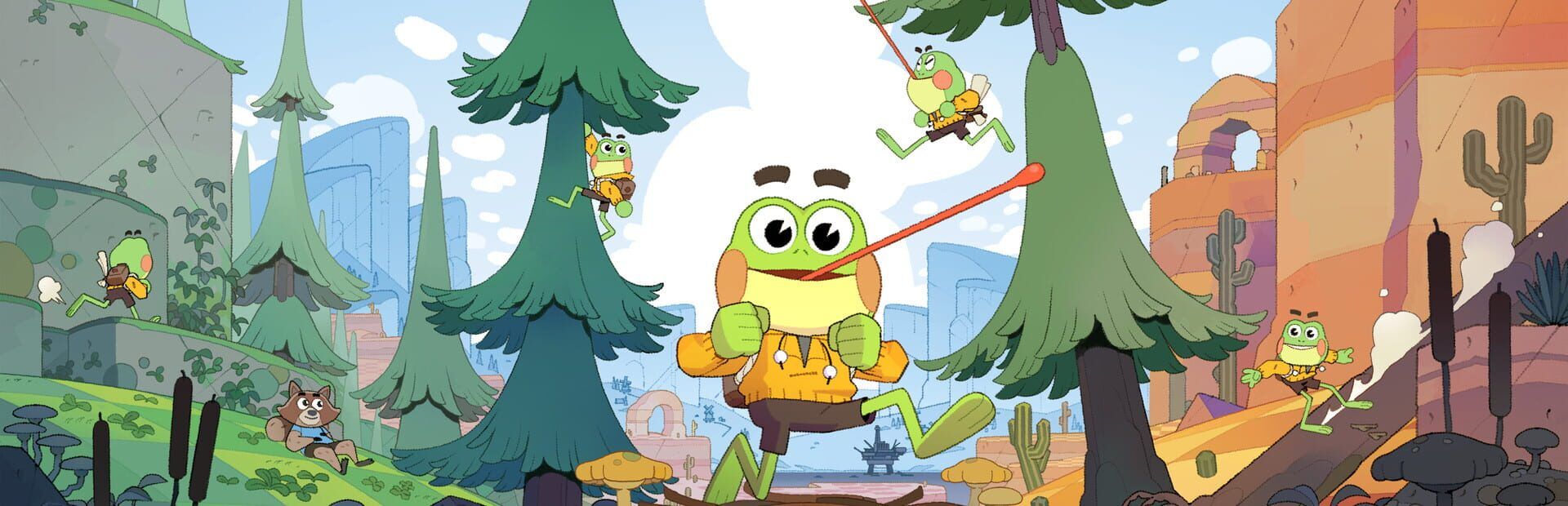
Big Hops looks like a cozy collectathon about a cartoon frog, but plays like a lab experiment in how far you can push physics‑driven movement before it becomes a competitive sport. It is, very transparently, built for players who see a straight line and immediately look for a wall to bounce off instead.
As a traditional playthrough, it is a charming, creative 3D platformer. As a speedgame, it is the most exciting “frog tech showcase” since someone first broke Super Mario 64 wide open. The reason people are already whispering “future GDQ staple” is simple: Big Hops gives you an absurdly expressive movement toolkit, then designs levels that practically beg to be shattered.
Movement Tech: The Gospel Of Frog
Big Hops is a movement‑centric platformer in the purest sense. Combat is nonexistent and traditional power creep is minimal. The entire arc of the game is about learning to bend its physics to your will.
Your basics are familiar at a glance: a jump, an air‑turn, a tongue that works as a grapple and slingshot, and a dive for fast repositioning. None of these are impressive alone. It is in how they layer that the game explodes.
The tongue is the star. You can latch onto surfaces, physics objects, and dangling veggies, then reel in, swing, or fling with a generous amount of control. The animation is loose, but the math behind it is precise. Once you understand how the arc behaves, you can consistently generate exactly the momentum you want. Crucially, you keep your speed when you hit the ground, so any successful fling becomes an improvised speed boost.
The dive is the glue that holds runs together. Out of a jump or tongue fling, you can dive to redirect your arc, convert vertical height into horizontal speed, or correct a slightly bad line before it becomes a reset. There is a tight but forgiving window to cancel the dive into a hop, which turns what should be a recovery tool into a full‑on movement engine.
Within an hour, you go from “I can just barely make that gap” to chaining tongue swings, dives, and bounces to clear whole rooms without touching the intended platforms. You start seeing the levels less as discrete jumps and more as one continuous line that you carve through the air.
For speedrunners, the key is that Big Hops is deterministic. The physics are playful but not sloppy. When you discover a line, you can reproduce it. When you miss it, you know why. That reliability is exactly what makes or breaks a potential marathon game.
Level Design: Intentionally Breakable
Luckshot Games talked publicly about avoiding rote retro homages, and you can see that in how Big Hops handles space. Each world is a chunky, semi‑open playground. The golden path is readable and approachable, but it rarely feels like the only way.
The best levels are built around layered verticality. You have gentle routes along low platforms for casual players, mid‑tier routes that use simple tongue swings, and aggressive top‑shelf angles that let you skip half the area if you dare to chain your movement tech. It feels a lot like a modern take on Super Mario 64’s castle hub philosophy, blended with the line‑hunting obsession of contemporary speedgame design.
Where the game really sings for runners is in its “soft permission” to break things. Ledges are placed just close enough that a well‑timed tongue fling can clear intended gates. Optional secrets stack above the main route in ways that double as time saves. Moving veggies that act as temporary grapple points drift through spaces that are only barely reachable, hinting at tricks before you have the chops to pull them off.
The few linear sequences, like tongue‑centric gauntlets or tight interior corridors, are less open but still speedrun aware. There are usually alternate dangle points, slightly faster wall angles, or risky dive lines that shave seconds off if you cut a corner. Even in the most constrained stages, you are solving a miniature routing puzzle instead of running a prescribed obstacle course.
There are criticisms to be made. Not every world is equally inspired. A midgame swamp area has a more cluttered layout and a few camera‑unfriendly pockets that feel hostile to high‑speed play. One late‑game sky zone tries to combine delicate platforming with heavy wind effects and ends up more annoying than tense in real‑time runs. But those weaker stretches are the exception, not the rule, and they are short enough that routing around the worst of them will become part of the meta.
Difficulty Curve: Casual On The Surface, Brutal In The Margins
Big Hops has a split personality when it comes to difficulty, and that is exactly why it works so well as a future marathon pick.
If you play it like a normal person, the curve is friendly. Early worlds are wide, forgiving, and full of safety nets. Fall off a ledge and you usually land somewhere only a few seconds back. Checkpoints are frequent and death is a slap on the wrist. The game is generous about letting you experiment without ejecting you all the way back to the start of a section.
But if you play it like a speedrunner, the difficulty spikes sharply. The same wide arenas that feel cozy to a casual player become punishing when you are committed to high‑risk routes where a missed tongue line costs fifteen seconds. Secret collectibles and side challenges push movement to its limit, asking for precise mid‑air cancels, angle‑perfect slings, and frame‑tight dives.
It creates a natural tiered experience. New runners can route mostly along the intended paths and still feel fast. Intermediate players start chaining together the obvious skips and shortcuts. Expert runners will mine the optional content for tech that lets them obliterate whole sections of the game.
The important thing is that the game does not force you into the deep end just to finish the story. The true cruelty lives in the optimization, which is exactly what you want in a speedgame that needs to look impressive on stage, but still be something a viewer could realistically try at home.
Why Big Hops Screams “Games Done Quick”
You can usually tell within minutes if a 3D platformer is marathon material. Big Hops hits most of the critical criteria that make a game a GDQ natural.
First, it is instantly readable. A frog swinging around colorful, compact worlds is easy to parse at a glance. You can look away from the stream, come back, and immediately understand where the runner is and what success looks like. That clarity matters for donation‑heavy segments where the commentary is competing with on‑screen chaos.
Second, the skill ceiling is clearly visible. Even in casual footage, you can see moments where the player almost strings together a wild combo but biffs the landing. Turn that dial to 11 in a speedrun and you get nonstop “how did they do that” sequences. Tongue flings into dive cancels into wall rebounds look spectacular without needing high production values or cinematics.
Third, the game is full of self‑contained setpieces that lend themselves to race formats and category variety. Individual worlds feel like strong candidates for Any%, 100%, and IL grinding. There is room for challenge incentives like “no tongue” sections, all‑veggie routes, or “ground is lava” restrictions. You can very easily imagine a couch full of runners debating routing differences as donations pour in.
Finally, Big Hops has an approachable run length. Early estimates place a clean Any% run in the 45 to 70 minute window depending on how aggressively you skip optional content. That is a sweet spot for GDQ scheduling: long enough to showcase depth, short enough to keep a late‑night crowd engaged.
Criticisms: Where The Frog Stumbles
Big Hops is not flawless, and some of its issues matter more the harder you push the movement.
The camera, while serviceable, struggles in tight indoor spaces and near tall geometry. When you are lining up pixel‑perfect swings at full speed, a slight auto‑adjustment can be infuriating. Runners are going to fight it in a few specific rooms until muscle memory and backup strats settle in.
There are also spots where the visual design clashes with ideal routing. The soft, painterly look is gorgeous, but occasionally foreground elements or gentle fog obscure long‑range tongue targets. Once you know a route this stops being an issue, yet it makes early learning runs more awkward than they need to be.
Finally, not all movement tech is properly surfaced. The game teaches you the basics, but some of the more advanced interactions, like specific dive‑cancel timings or tongue buffering tricks, are things you either discover by accident or learn from community guides. For a title so deeply about movement, a more robust in‑game lab or challenge suite that spotlights that depth would have been welcome.
None of these problems are dealbreakers, and to its credit the game is technically solid. Loads are quick, crashes appear rare, and inputs feel crisp even on Switch and Steam Deck. But you will feel these rough edges most when you play at the highest possible speed.
Verdict: A Frog‑Shaped Invitation To Go Faster
Big Hops is one of the most deliberately speedrun‑friendly 3D platformers in years. Its physics are expressive but reliable, its levels are intentionally breakable, and its difficulty curve hides genuine brutality behind an accessible, charming surface. It is both a great time for anyone who misses the exploratory joy of early 3D platformers and a terrifying canvas for the people who see a sloped wall and think “that’s a launch pad.”
Assuming Luckshot Games keeps supporting it with small balance passes and maybe a time‑trial mode or in‑game leaderboards, it is hard to imagine a future Games Done Quick where Big Hops is not part of the lineup in some form. Whether it is a comfy morning Any% showcase or a late‑night no‑tongue monstrosity, this frog is built for the spotlight.
If you care about movement‑driven platformers or you are looking for the next game to grind into muscle memory, Big Hops belongs at the top of your queue.
Final Verdict
A solid gaming experience that delivers on its promises and provides hours of entertainment.