
Review
By Apex
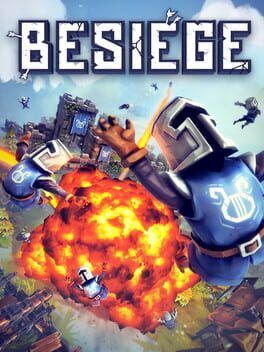
Besiege has spent more than a decade quietly becoming one of the best physics sandboxes on PC, and the 2020 "final" release already felt like a culmination. In 2026, with The Splintered Sea in the wild and The Broken Beyond taking aim at space later this year, Besiege is no longer just a weird medieval siege toy. It is a full engineering suite that happens to be wrapped in slapstick violence, and right now is the best time it has ever been for new players to jump in.
Campaign: from rickety carts to naval artillery and orbital fiascos
The base game’s campaign is still the spine of the experience. Across its islands you get a carefully ramped lesson plan in structural integrity, weight distribution, propulsion and control. Early missions are almost toy-like: knock over a cottage, crush a few soldiers, maybe ignite something for fun. By the final worlds you are juggling flying machines, precision bomb drops, armored siege towers and Rube Goldberg torture devices built out of pistons and spinning blades.
What’s striking in 2026 is how well that original structure still holds up. Levels have seen gradual tuning over the years, with clearer objectives, better performance and more flexible completion conditions that let you pass with elegant machines or barely functioning death kites. It never fully becomes a traditional puzzle campaign, but it gives you just enough constraint that success feels earned rather than handed to you by sheer brute force and block spam.
The Splintered Sea bolts a whole new vector onto that arc. Its ten mission campaign is compact but dense, built around water physics that fundamentally change how you think about building. Buoyancy, drag and shifting weight become as important as torque and traction ever were on land. The first time your proud, over‑engineered warship lists to one side and slowly rolls under the waves because you put too much metal on the starboard cannon deck is both humiliating and hilarious.
Spiderling wisely keeps the objectives focused: escort a fragile vessel through reefs and artillery fire, raid island fortifications with amphibious contraptions, duel other ships across choppy seas. Compared with the base campaign it is shorter, but almost every level introduces a twist, from tight channel navigation to weather and wave conditions that test stability. As an expansion campaign it does the crucial job of pushing you into fresh design problems instead of just giving you more targets to shoot.
Looking ahead, The Broken Beyond seems poised to do the same for spaceflight. Details from the announcement and preview coverage point to a self‑contained space campaign, with new celestial bodies, orbital insertion challenges and vehicle types that lean on thrust vectoring, staged rockets and reaction control. It is not trying to be Kerbal Space Program, but Besiege’s DNA fits this setting perfectly: build something that really should not work, light it up, and watch physics decide the outcome in exquisite slow motion. If it lands as well as The Splintered Sea did for water, the full campaign suite will cover land, sea and orbit as a kind of twisted engineering curriculum.
Sandbox depth: the best toy box Besiege has ever had
The heart of Besiege has always been its sandbox, and in 2026 it is frankly absurd in scope. The base game already lets you spawn props, enemies and environmental hazards across spacious maps, set victory conditions and then unleash increasingly cursed machines upon them. Years of updates have layered in quality of life improvements like symmetry tools, advanced key binding, saveable sub‑assemblies and a cleaner part browser.
The Splintered Sea elevates this with its ocean sandbox. It is not just a reskinned map; it is a workshop for testing hull designs, propulsion experiments and amphibious monstrosities. You can sculpt coastlines with fortifications, build floating platforms, then spend an evening iterating on one specific problem such as making a self‑righting gunboat that can survive a direct hit to one side. Even just spawning a solitary fortress in the middle of nowhere and trying to approach it under cover of improvised smoke screens reveals how much systemic depth is hiding behind the playful presentation.
Spiderling has also reworked the broader sandbox over the last couple of years, with an eye toward performance and usability. Better time controls, smoother camera movement and clearer simulation feedback make giant builds less of a chore to test. The impending space sandbox in The Broken Beyond should complete the trio, effectively turning Besiege into three overlapping toolsets that share a common logic but ask very different questions. The same understanding of center of mass that helped you keep a tower from toppling on land is now how you prevent a spacecraft from tumbling into an uncontrollable spin.
There is still one caveat for newcomers: Besiege never pretends to be anything other than a deep toy box, and it can be overwhelming. The tutorials and campaign levels do more onboarding than they used to, but if you freeze up in front of a blank canvas, this is not suddenly a cozy city builder. You are expected to fail, repeatedly, in increasingly catastrophic and hilarious ways.
Mod ecosystem: an engineering multiverse
On PC, the Steam Workshop continues to be the soul of Besiege. Thousands of contraptions cover everything from practical siege engines to fully functional CPUs, programmable walkers, transforming mechs and improbable recreations of other games’ vehicles. For a new player in 2026, this has two immediate benefits.
First, it is the best learning resource you could ask for. Download a top‑rated flying machine, tear it apart block by block, and you will come away with a visceral understanding of what keeps it airborne. The same goes for complex steering rigs and suspension setups. The community has essentially documented every clever trick you might want to build on.
Second, it means you will never run out of toys even if you ignore the campaigns completely. Challenge maps, puzzle packs, adventure levels and even lightweight story campaigns exist in huge quantity. Many creators have already adopted water mechanics from The Splintered Sea, and once The Broken Beyond lands you can expect a wave of orbital stunt courses and interplanetary absurdity.
On the downside, mod support is still fundamentally a PC story. Console versions benefit from the core game and official content updates, but they cannot touch the wild variety the Workshop offers. If you are a player who lives for modded experiences, the decision is easy: play on PC. Spiderling has been good about keeping the mod API updated and documenting breaking changes, and there is every reason to expect the space expansion will hook cleanly into those systems.
Performance and controls on modern PC and consoles
Besiege in 2026 runs like a dream on pretty much any reasonably modern PC, at least until you deliberately try to break it. The core land campaign and older sandbox maps have been heavily optimized over the years, and even mid‑range hardware can handle intricate siege machines at high frame rates. The game’s low‑poly aesthetic and mostly static environments help, and time scaling lets you slow down when you inevitably hit the physics limits.
The Splintered Sea is a bit more demanding. Water rendering and buoyancy calculations place extra strain on both CPU and GPU compared with the base game, and if you load a ship with hundreds of moving parts you will see the frame rate wobble on weaker rigs. Community impressions back this up: the expansion is very playable, but it is the first piece of Besiege content that feels like a real workout for older hardware. On the flip side, higher end machines shrug it off, and Spiderling has already patched in several improvements since launch.
Looking ahead, The Broken Beyond is likely to stress the simulation more than the renderer. Lots of independently simulated stages on a rocket, particle‑heavy engines and long‑running trajectories will lean on CPU physics. Given how well the base game and water expansion have been tuned, there is cautious optimism that it will scale across a wide range of systems, but this is where trying to build orbital skyscrapers out of spinning saw blades on a ten year old laptop might finally be a bad idea.
Console performance is more of a mixed bag, but generally solid. On current machines like PS5, Xbox Series X and Series S, the base campaign plays smoothly, and the simplified art style ensures clean image quality. Earlier console reviews noted occasional visual glitches and some input lag with extremely complex creations, and while patches have softened those edges, the core limitation remains: you are at the mercy of fixed hardware and a game where the whole appeal is pushing physics to the brink.
Controls on console land much better than you might expect given how granular Besiege’s building tools are. Radial menus and context sensitive prompts make it possible to construct reasonably complicated machines with a controller, and once you internalize the shortcuts it feels natural enough. It is still slower and clumsier than mouse and keyboard for serious engineering, and high end tinkerers will be happier on PC, but for a player who wants to build a moderately chaotic siege engine from the couch it works.
Switch, as usual, is the compromise option. You get Besiege’s core brilliance on a portable device, which is inherently delightful, but you feel the hardware ceilings faster than on the other platforms, especially with water heavy or part dense builds. If you treat it as a campaign and light sandbox machine instead of a place to import thousand‑part monstrosities, it holds up.
Is Besiege worth starting in 2026?
With The Splintered Sea already out and The Broken Beyond on the horizon, Besiege in 2026 is a comprehensively rounded package. The land campaign remains a clever, occasionally vicious tutorial for the sandbox. The sea expansion opens up entirely new design spaces in a short, punchy campaign and a great naval playground. The upcoming space expansion looks set to turn Besiege into a land, sea and orbit trilogy, all powered by the same deliciously unforgiving physics system.
For new players on PC, it is an easy recommendation. The price of entry for the base game is modest, The Splintered Sea is well worth grabbing alongside it, and if you find yourself hooked there will almost certainly be a bundle that folds in The Broken Beyond. Between the official campaigns, the open sandbox and a thriving mod scene, this is a game you can lose whole weekends to without even touching the same problem twice.
On console, the recommendation is slightly more conditional. The underlying game is still fantastic, and the ports capture its chaos and creativity convincingly, but they miss out on the Workshop ecosystem and feel more constrained when it comes to sprawling engineering projects. If your priority is pure playability from the sofa, it is still an easy yes. If you want the full Besiege experience with all the knobs and levers, PC remains the place to be.
Besiege has grown from a viral oddity about making wooden tanks explode into a deep, interconnected suite of engineering playgrounds. In 2026, standing on the cusp of taking that chaos into space, it is not just worth revisiting; it is one of the definitive physics sandboxes you can buy.
Final Verdict
A solid gaming experience that delivers on its promises and provides hours of entertainment.