
Review
By Apex
Battlefield Goes Free-To-Play Again
Battlefield REDSEC is EA and DICE trying, once more, to stretch the series beyond the numbered tentpoles. Slated for late 2025 and positioned alongside the proper Battlefield 6, REDSEC is pitched as a free-to-play entry that folds Battlefield’s signature scale and destruction into a tighter battle royale format. After time with the early build, it already feels more confident than Battlefield 2042’s scrapped Hazard Zone experiment, but it also walks straight into a battle royale market that is ruthless in 2025.
This is not Battlefield 6 chopped up and sold in pieces. REDSEC runs on shared tech and art direction, but it has its own cadence, progression and, crucially, its own idea of what a Battlefield firefight should feel like when there is only one life between you and the lobby screen.
Gunplay: Between Battlefield 6 and Apex, Not Quite Either
The best part of REDSEC right now is how the guns feel. DICE is clearly using REDSEC as a test bed for tweaks that sit in between traditional Battlefield and something closer to Apex Legends.
Time to kill is slightly longer than what we have seen in early Battlefield 6 test footage, but much shorter than Apex. Hitscan assault rifles bite hard at mid range, while recoil patterns are readable without turning everything into laser-tag. Weapons snap with a chunky, mechanical kick and the audio design has that Battlefield weight, even if the soundstage is intentionally a little more compressed so you can parse the chaos of 80 to 100 players.
Compared directly to Battlefield 6’s more measured, squad-focused firefights, REDSEC is twitchier. The sprint out of cover, the speed of aim-down-sights, and the slide and mantle timings inch the whole experience toward hero shooters, even though there are no heroes here, just class archetypes and perk cards. Swap back to a Battlefield 6 playtest after a REDSEC match and you immediately feel the difference. Battlefield 6 encourages methodical pushes and combined-arms play. REDSEC wants decisive, explosive ambushes.
The problem is that in chasing that in-between space, REDSEC sometimes lacks a clear identity. Weapons feel strong, but not as precise as Apex’s arsenals, and the gunfight readability is a step behind Call of Duty’s Warzone. When engagements get beyond 80 meters, the visual clarity of who is shooting whom falls off fast, especially with the current level of foliage and building clutter on Fort Lyndon. Battlefield fans will be happy with the kick and sound of the guns; battle royale veterans may find it competent but not yet special.
Fort Lyndon: A Good Battlefield Map, An Uneven Battle Royale Arena
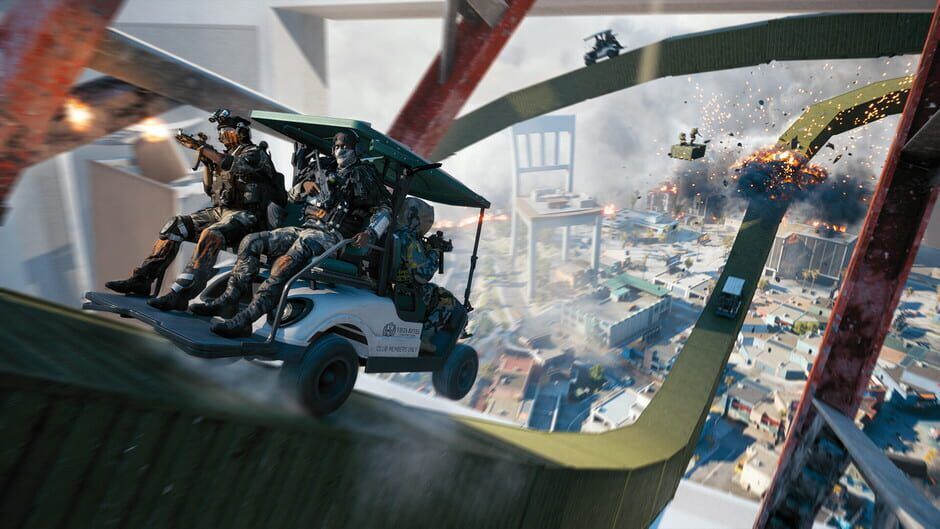
Fort Lyndon is REDSEC’s flagship battle royale map, a circular coastal city and industrial sprawl that slowly gets chewed away by a creeping electronic storm. As a Battlefield playground, it is pretty spectacular. There are dockyards full of shipping containers stacked for sightlines and parkour routes, a dense downtown core with multistory interiors, and outer-ring farmlands crisscrossed by mud roads and shallow rivers.
As a battle royale map, it is less consistent. Hot drops into the old fort itself are thrilling. You can blow open walls, collapse floors, and turn tight corridors into improvised foxholes. The destruction is more controlled than the all-out spectacle of classic Battlefield, but that restraint makes sense in a BR setting. Bringing down a whole block of buildings is impossible, yet chipping away cover piece by piece creates dynamic firing lanes that reward smart use of explosives.
Move further out, though, and the design leans too heavily on large, relatively empty in-between spaces. Rotations from the industrial zone to the outer fields feel like a limp jog across kill zones. Vehicles help, but their spawn logic in the preview build is erratic, and there are too many moments of being beamed from a rooftop or hillside by teams you have no practical way to counter.
Destruction itself sits in an awkward middle ground. It is definitely more meaningful than the token destructibility in Fortnite or Warzone’s older maps, but it is also more scripted than Battlefield 4’s old “levelution” spectacles. Certain walls, floors and pillars are clearly marked for destruction, and once you learn the language, the surprise fades. The tech is impressive, though. Firing a rocket into a tenement and watching chunks fall while dust clouds obscure vision is a tactical tool instead of just a pretty effect.
Monetization: Surprisingly Modest, For Now
REDSEC launches as free-to-play, and EA has no intention of hiding that. The build I played features a tiered battle pass, skin bundles, and timed store rotations. On paper, it is the usual 2025 live-service boilerplate. In practice, at least in this early state, it is restrained.
The battle pass focuses on cosmetics, voice lines, finishing animations and weapon skins. There are no stat buffs tucked away behind premium tiers, no paywalled weapons, and no pay-to-win perk slots. EXP boosters are present but limited to account-wide progression, not round-specific advantages. Compared to the worst impulses of mobile ports and aggressively monetized shooters, REDSEC’s structure feels almost old-fashioned.
Where the cracks show is in the pricing. Individual legendary skins flirt with the same premium pricing as Apex and Call of Duty, while bundles push the line of what feels reasonable in a game that is meant to sit alongside a full-price Battlefield 6. If you are already buying Battlefield 6 and its own cosmetic ecosystem, REDSEC starts to feel like a second job with a second wardrobe.
There is also the looming question of crossover monetization between REDSEC and Battlefield 6. EA has not committed publicly to a shared wallet or cosmetics, and if these end up being two completely separate purchase tracks, the overall package will feel needlessly fragmented.
Modes: Gauntlet And Portal Steal Some Thunder
While the focus here is the battle royale mode, it would be a mistake to ignore the rest of the package. Gauntlet is a knockout-style mode where squads race to complete objectives before others and avoid elimination. It acts as a shorter, more focused alternative to the BR and leans into Battlefield’s objective play. In some ways, it actually shows Battlefield’s strengths more clearly than the last-circle chaos of Fort Lyndon.
Portal returns as a remix tool that lets players stitch together rulesets, weapons and map slices from across the series. In the early build, Portal is a playground of small, curated experiences, from tight close-quarters gunfight arenas to silly, physics-heavy demolition modes. Ironically, these side modes often highlight how standard the core battle royale loop can feel. When you have had a half hour of bespoke chaos in Portal, dropping back into a 20-minute BR slog of looting, rotating and getting third-partied feels less fresh.
Can This Stand Out In 2025’s Battle Royale Pileup?
The biggest question hanging over REDSEC is not whether it functions. It does. The shooting feels solid, the destruction tech is satisfying, and match stability in early testing is better than Battlefield 2042’s disastrous launch window. The question is whether any of that is enough.
In 2025, Fortnite is still a cultural juggernaut. Apex has a fiercely loyal competitive base. Warzone continues to reinvent itself with seasonal map overhauls and licensed crossovers. Smaller titles carve out niches by leaning into extraction mechanics, asymmetric PvPvE designs, or ultra-hardcore gun handling. Into that pile walks Battlefield REDSEC, offering a competent, visibly expensive but surprisingly safe battle royale.
Nothing in REDSEC’s current form screams disaster, but little about it feels essential. There is no wildly inventive respawn mechanic, no radical twist on shrinking circles or objective play inside the BR, no bold cross-progression promise with Battlefield 6 that would make it feel like a required companion app. It is Battlefield’s big guns and big explosions repackaged into a mode structure players have already spent the better part of a decade grinding through.
If REDSEC can evolve quickly, lean harder into destruction as a strategic pillar, and tighten up Fort Lyndon’s pacing, it could become a dependable alternative for players who already like Battlefield and want a free-to-play extension of that experience. If not, it risks becoming yet another solid but forgettable entry in a genre that no longer has any patience for merely solid.
Early Verdict
As an early build, Battlefield REDSEC is promising but conservative. The gunplay lands in a satisfying middle space between Battlefield’s weight and modern BR speed, and the destruction is more than a bullet point, even if it needs to be pushed further. Monetization so far is mostly fair, if aggressively priced, and the overall package benefits from the presence of Gauntlet and Portal.
Whether that is enough to carve out a place in the 2025 to 2026 free-to-play landscape will depend entirely on how fast and how boldly DICE is willing to iterate. Right now, REDSEC feels like Battlefield learning the right lessons from past missteps, but not yet confident enough to define a new chapter for the series.
Final Verdict
A solid gaming experience that delivers on its promises and provides hours of entertainment.