
Review

By MVP
Premise and party pitch
Astro Party EX arrives on Switch as a dirt-cheap, local-only space brawler that lives and dies on one idea: every ship can only turn right. No analog finesse, no twin-stick precision, just two buttons that either thrust you forward or rotate your craft in a single direction while you try to blast your friends out of the sky.
On paper it sounds like a throwaway game jam concept, something you pass around for five minutes between Mario Kart sets. In practice, when you sit a group of 2–4 players down with Joy-Con, it reveals itself as something far more deliberate. This is not just another floaty arena shooter. It is closer to a slapstick version of Asteroids colliding with the rigid input discipline of old arcade games, and it understands exactly what kind of laughter it wants to pull out of a room.
The “only turn right” gimmick in the first 10 minutes
As a pick-up-and-play hook, the controls are perfect. You get two buttons and one rule: you can only pivot right. Every new player goes through the same arc. First comes confusion, when they try to overcorrect and pinball around the arena. Then comes the first accidental kill, usually a lucky shot or a panicked boost that rams straight through an opponent’s exposed pilot. That is the moment the room flips.
Within a couple of rounds, even complete non-gamers can contribute. There is no camera wrestling, no need to remember which stick does what. The cognitive load is low, which is exactly what you want when half your lobby is already a couple of drinks in. Matches are short and self-contained, so it is trivial to rotate people in and out. Passing a single Joy-Con sideways to someone who has never touched a Switch user interface before still works fine, because the controls are so binary.
Crucially, the gimmick does not make the game feel random. Even early on, it is obvious that you are losing because you misjudged your arc or panicked and held thrust too long, not because the controls are broken. That distinction is important, because the chaos feels authored rather than sloppy.
Two players versus four – how the chaos scales
With two players, Astro Party EX plays like a strange fencing duel in orbit. The destructible arenas mean every shot matters, carving holes and dangerous angles into the stage, but in 1v1 the pacing is thoughtful. You spend a lot of time trying to bait your opponent into over-rotating, then slip a missile into their predicted path or ram them just as they eject. Reads and counter-reads start to matter, and you can feel yourself consciously counting beats between rotations and thrusts.
Add a third and fourth player and that structure detonates into slapstick. The same rule-set that felt almost austere in 1v1 becomes a generator of nonsense: chain collisions, pilots getting run over mid-celebration, projectiles ricocheting through half-demolished asteroids. The Switch handles the chaos cleanly. Even in the most cluttered stages, performance holds and the silhouettes of each ship remain readable, which is vital when everyone is shouting and half-watching.
Importantly, four-player matches never become pure noise. The arenas are compact enough and the time-to-kill low enough that the match resolution is always imminent. Someone is going to do something stupid in the next five seconds, and everyone knows it. That anticipation is what gives it staying power compared to throwaway party fodder that devolves into button mashing.
Depth over longer sessions
The real test for a party game is not the first half hour, it is the second night you pull it out. Astro Party EX survives that test better than you might expect from a game that literally forbids you from turning left.
After an hour or two, players start internalizing the rhythm of their ship. Because you can only pivot in one direction, learning to pre-rotate becomes a skill. You begin setting up future trajectories, intentionally swinging wide around terrain so that your firing arc will line up two seconds later. Shots stop being reactive and become predictive. You guide missiles into likely exit paths rather than just shooting at the target.
The destructible arenas add another layer. Repeated blasts carve tunnels and dead zones into the map, which savvy players use as both cover and traps. Punching a hole in the floor is not just spectacle, it is positioning, and the right turn-only rule makes correcting a bad line dramatically difficult. A single misjudged thrust can put you in a slowly spiraling death orbit around a piece of debris while everyone else lines up the shot.
Over longer sessions, players invent house rules and informal roles. Some people become designated kamikaze pilots, throwing themselves into close-range collisions because they have learned exactly how many frames of thrust it takes to skim past an opponent and clip them with engine exhaust or a last-second shot. Others hang back, turning the stage into a minefield of stray bullets and cratered terrain.
Is it as deep as Smash or as systemically rich as Duck Game over the long haul? No. There are fewer verbs to master and fewer character-specific tricks to explore. But it has more depth than its micro price and minimalist premise suggest, especially if your group enjoys that arc of gradually mastering an intentionally awkward control scheme.
Comparing the party staple pantheon
Putting Astro Party EX next to Smash, Duck Game, and Heave Ho highlights what it is and what it is not.
Against Smash, it obviously loses in content and spectacle. There are no decades of roster or intricate combo systems here. Where it competes is in accessibility. You can drop Astro Party EX into a living room where half the players have never touched a controller and have everyone meaningfully participating in under a minute. Smash is terrible at that unless you scrub the rules down to stock basics and accept a long onboarding period.
Compared to Duck Game, Astro Party EX is less expressive but also less cognitively demanding. Duck Game thrives on mechanical freedom, item variety, and the joy of improvisation. Astro Party EX cares more about discipline under constraint. That makes it a stronger candidate for groups who get overwhelmed by too many possibilities and just want tight, repeatable interactions with a lot of room for banter.
Heave Ho is probably its closest cousin in party energy. Both games are built around a control quirk that feels wrong until it suddenly clicks. Heave Ho leans hard into cooperative failure, where half the fun is watching the group fall short of a shared goal. Astro Party EX instead weaponizes that clumsiness for versus play. It fills the exact niche of a short-round, trash-talk heavy warmup or cooldown game that you can wedge between longer sessions of heavier titles.
The key difference between all of these and Astro Party EX is breadth. Smash, Duck Game, and Heave Ho have clear progression arcs and content variety that pull you back in over weeks or months. Astro Party EX is more modest. It is a strong seasoning rather than the main course, something you reach for when you want ten minutes of focused chaos rather than an evening-long ladder.
Modes, variety, and Switch-specific considerations
The Switch version embraces its role as a couch game. Up to four players can huddle around a single screen with individual Joy-Con, and the two-button control scheme maps perfectly to the tiny controllers. There is no online play and no elaborate progression to chase, which will be a deal-breaker for some but is thematically consistent with what the game is trying to be.
Modes and arenas give it enough shape to avoid instant repetition. Slight changes in rules or hazard layouts meaningfully change how the right-turn restriction feels. Tight arenas emphasize close-range collisions and quick reactions, while more open ones play up long, arcing engagements and stray shots curling through space. Power-ups and different weapon behaviors provide occasional spikes of novelty without ever asking players to learn a new control language.
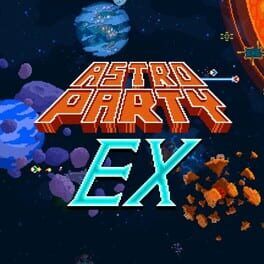
Visually, Astro Party EX hits the right notes for a party brawler. The pixel art is stylized but clean, and the color palette does a good job of distinguishing ships and hazards even when the stage is half-destroyed. Explosions and screen shake sell impacts without obscuring critical information. On the OLED screen, the contrast between the dark void and neon projectiles makes the action easy to track from across the room.
Load times on Switch are brief, matches restart quickly, and there are no intrusive menus slowing down the loop. That low friction is vital when you are passing controllers around or when another game is queued up next.
Where it falls short
The same restraint that makes Astro Party EX focused also leaves it feeling light for certain crowds. If your group expects unlock trees, cosmetic progression, or a spread of radically different modes, you will exhaust the obvious surface-level content quickly. The core loop can absolutely sustain repeated play, but there is not much scaffolding pushing you toward long-term goals or new toys.
With only local multiplayer on offer, it also lives or dies on whether you regularly have people on the couch. Solo play is functionally target practice. The game clearly is not meant to be played alone, and any attempt to approach it that way will make it look thinner than it actually is.
It also lacks the kind of madcap, systemic chain reactions that make Duck Game such a perennial favorite. There are great moments of slapstick, but they are usually the direct result of someone misjudging their orbit rather than the environment doing something unexpected. Some players will crave more toys and wild rule-bending than Astro Party EX is willing to offer.
Verdict – does it earn a spot in the rotation?
As a local multiplayer showpiece on Switch, Astro Party EX earns its seat at the table, even if it is not the headliner. The right-turn-only gimmick is more than a joke. It is a tight design constraint that teaches players to think ahead, rewards practice, and generates exactly the kind of frantic, self-inflicted disasters that fuel late-night laughter.
If you are judging it next to Smash in terms of depth or Duck Game in terms of systemic chaos, it comes up short. But as a low-friction, low-commitment party palate cleanser that anyone in the room can immediately understand, it is excellent value. For a few bucks on the eShop, it is an easy recommendation for groups that already gather for local multiplayer nights and want another reliable, instantly readable option in their rotation.
If your Switch lives mostly in handheld single-player mode, you can safely skip it. If your living room regularly turns into a four-player war zone, Astro Party EX is absolutely worth adding to the stack beside Smash, Duck Game, and Heave Ho.
Final Verdict
A solid gaming experience that delivers on its promises and provides hours of entertainment.